

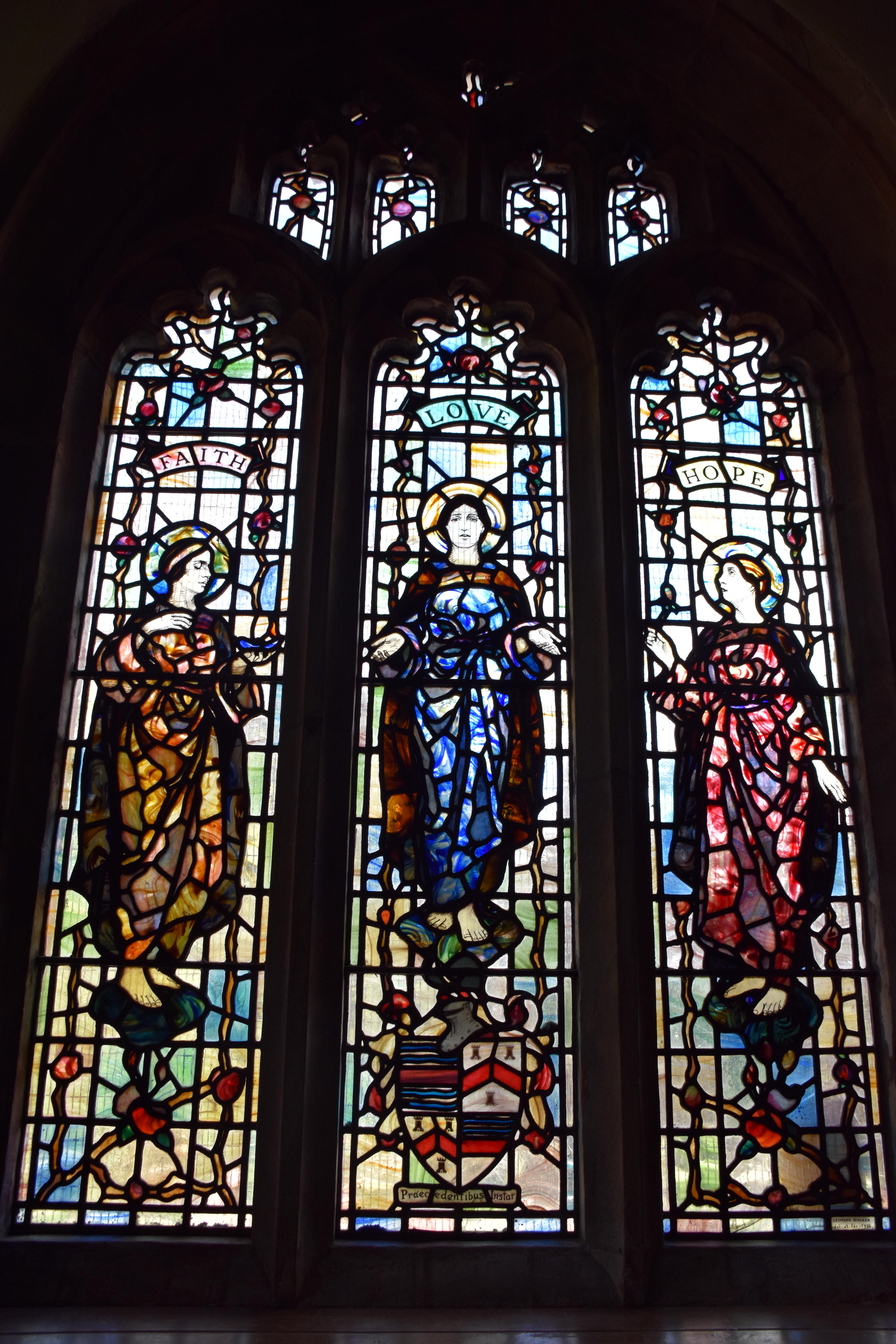
In the north‑west corner of St Michael’s Church are the memorials that record the long connection between the parish and the Eliot family, one of the earliest names in the registers. Andrew Eliot, who emigrated to Massachusetts in 1660, was baptised here in 1627. His departure marked the beginning of the American branch of the family, and it was that branch which later commissioned the stained‑glass window dedicated to Walter Graeme Eliot of New York.
Walter Graeme Eliot was a genealogist who spent considerable effort documenting the family’s English origins. In his will he left a bequest of $1000 for the installation of a window commemorating Andrew Eliot and his descendants. The commission was executed by Leonard Walker, a well‑known designer of ecclesiastical glass, and completed in 1936. The window shows the arms of Andrew’s parents: Joan Sigdon of Sigdon in Devon, and her husband John Elyot. Its purpose was genealogical rather than artistic, intended to mark the family’s seventeenth‑century roots in East Coker.
T. S. Eliot saw the window shortly after its installation and made his opinion clear. Writing in 1936, he described it as “the only ugliness in the place… recently erected by some cousin of mine — the most hideous I have seen.” His remark was blunt and entirely characteristic. It confirms that he recognised the window as a product of the American branch of the family, but he had no regard for its aesthetic qualities and no interest in attaching symbolic meaning to it. His later association with East Coker in Four Quartets had nothing to do with this memorial.
The window belongs to the period when the American Eliots were actively re‑establishing contact with the parish. They visited East Coker, corresponded with clergy and local historians, and contributed to church repairs and memorials. The Walter Graeme Eliot window is one of the clearest physical outcomes of that activity. It predates the poet’s decision to have part of his ashes interred in St Michael’s, but it forms part of the same long‑standing relationship between the Eliot descendants and the village.
Today the window remains a record of the genealogical work carried out by Walter Graeme Eliot and his relatives. Its significance lies in its documentation of the family’s origins rather than in artistic merit. It is a reminder that the Eliot connection to East Coker was maintained long before T. S. Eliot’s literary association with the parish, even if the poet himself regarded the memorial with open disdain.

