

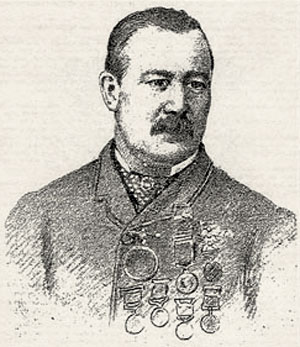
In Exwick Cemetery, close to the entrance on Exwick Road, lies the grave of a man who arguably saved more lives than anyone else in Victorian Exeter. Frank Shooter was not a soldier, nor a civic dignitary, nor a man of wealth or influence. He was the bathing superintendent at Head Weir, a post he held for thirty‑seven years, and during that time he pulled hundreds from the River Exe, taught thousands to swim, and became one of the city’s most recognisable and admired figures.
Born in Exeter in 1847, Shooter grew up in a large family in South Street, the son of Edwin Shooter, a master carver, and Sarah, who later kept the Masons Arms in West Street. His early life was unremarkable, but by the early 1870s he had emerged as a natural waterman with a strong sense of responsibility for those who used the river. His first recorded rescues came in 1872, when he saved two men within days of each other, prompting the Flying Post to remark that he seemed “particularly well‑qualified” for his post at the newly established Head Weir Bathing Ground.
Shooter had been appointed superintendent in 1871 after the previous incumbent was dismissed for misconduct. The bathing place itself had only opened in 1864 on what had once been a willow bed, and as swimming grew in popularity, Shooter’s role expanded rapidly. He organised the first swimming matches in 1872, and from 1873 the annual August competition became a fixture of Exeter’s sporting calendar. He taught children and adults alike, supervised school events, and turned the bathing ground into a lively centre of recreation at a time when healthy leisure for the working classes was increasingly encouraged.
His life‑saving record was extraordinary. The Royal Humane Society awarded him a bronze medal in 1873, followed by a clasp the next year for another rescue carried out fully clothed. More medals followed, and by the mid‑1880s his reputation had spread well beyond Exeter. He was invited to demonstrate rescue techniques at Dawlish, supervised events in Plymouth, and even saved a man who fainted during a swimming match in the Sound. The city council, recognising both his skill and the dangers of the river, made his post a year‑round appointment in 1875 and steadily increased his pay.
By 1884, a public testimonial committee had been formed to press for a gold medal, and the council itself petitioned the Royal Humane Society on his behalf. In January 1885, Shooter was honoured at a ceremony in the Guildhall, where he received the gold medal and a purse of £135 — a substantial sum raised by public subscription. The speeches were long and florid, as Victorian speeches tended to be, but the sentiment was genuine: Shooter had saved hundreds of lives, and the city knew it owed him a debt.
He was also a showman. His most famous trick — diving into the Exe and resurfacing while smoking a cigar — delighted crowds and became part of local folklore. His children were drawn into the life of the bathing ground, competing in races and even staging mock rescues for the entertainment of spectators. His wife, too, played her part, assisting with the extended hours for ladies’ bathing. The family lived for a time in Stepcote Hill, later at the Fireman’s Arms, and eventually in Church Road, St Thomas.
Shooter’s later years were marked by both continuity and change. He opened a gymnasium in Bampfylde Street in 1889, teaching boxing, fencing and physical culture, and was praised for his patience as an instructor. He continued to supervise the bathing ground until 1908, long after the riverfront had begun to alter with the growth of the city. His sons pursued varied careers — one became a hairdresser, another a publican, and one, Frank Junior, achieved brief notoriety by entering a lion’s cage at a travelling menagerie for a wager, much to the Mayor’s disapproval.
When Shooter died in July 1917, the Flying Post recorded that his funeral took place “within sight of the place he loved so well, and where the best part of his life was spent.” His grave, enclosed within a walled plot, looks across towards the river where he had carried out his rescues and taught so many to swim. It is a fitting resting place for a man whose heroism was local, practical and sustained — the kind that rarely makes national headlines but leaves a deep imprint on a community.
In a cemetery filled with soldiers, sailors and imperial administrators, Shooter’s memorial stands as a reminder that courage takes many forms. His legacy is not measured in battles won or campaigns served, but in the hundreds of lives he saved and the thousands he taught to swim. Exeter was safer, healthier and more confident in the water because of him, and his story remains one of the most remarkable in the city’s social history.

