

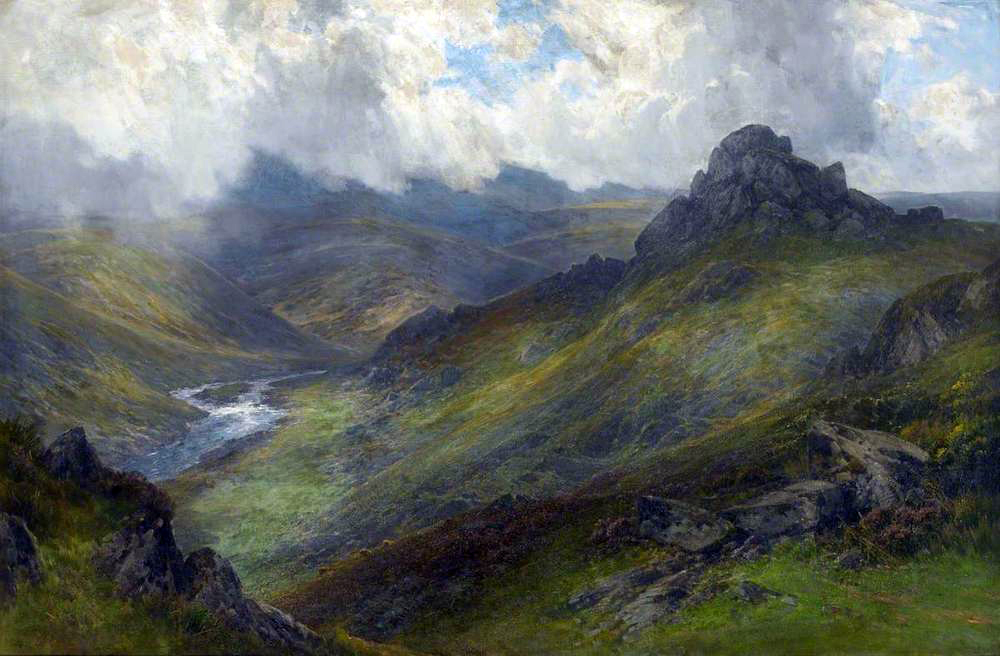
Among the notable figures commemorated in Exwick Cemetery is Frederick John Widgery, one of Exeter’s most recognisable artists and a former Mayor of the city. His paintings of Dartmoor, the Exe valley and the Devon coastline helped to define how the region imagined itself in the late nineteenth and early twentieth centuries. He belonged to a remarkable artistic family: his father, William Widgery, had risen from a self‑taught sign‑painter to a respected landscape artist, and Frederick inherited both his talent and his deep affection for the Devon countryside.
Born in 1861, Widgery trained first at the Exeter School of Art before moving to Antwerp and then to the Académie Julian in Paris, where he absorbed the techniques and discipline of continental art schools. On returning to Exeter he quickly established himself as a prolific painter of moorland scenes, coastal views and atmospheric studies of changing weather. His work captured the ruggedness of Dartmoor, the soft light of the Exe estuary and the shifting moods of the South West’s coastline. Many of his paintings were reproduced as postcards, prints and illustrations, helping to popularise Devon as a destination for visitors long before mass tourism took hold.
Widgery was not merely an artist but a civic figure. He served as a councillor and was elected Mayor of Exeter in 1903, a role in which he proved energetic and well‑liked. His dual identity as both artist and public servant gave him a distinctive place in the city’s life. He was involved in local cultural institutions, supported the museum and art school, and contributed to the shaping of Exeter’s public image at a time when the city was modernising yet still conscious of its long history.
His paintings often reveal a sensitivity to the character of place rather than a desire for dramatic effect. He had an eye for the quiet, everyday beauty of Devon — a lane under soft rain, a moorland tor emerging from mist, fishing boats drawn up on a shingle beach. These scenes resonated with local people because they recognised them; Widgery painted the landscapes they walked through, worked in and felt attached to. His work remains widely collected, and many examples can be found in Exeter’s Royal Albert Memorial Museum and in local collections across the county.
Widgery died in 1942, having lived through a period of immense change in Exeter, from the Victorian expansion of the city to the devastation of the Baedeker air raids. His grave in Exwick Cemetery is a reminder of a man who helped to shape how Devon saw itself, both through his public service and through the hundreds of paintings that continue to define the region’s visual identity. For many, his work remains the quintessential expression of the Devon landscape — familiar, atmospheric and rooted in a deep affection for the place he called home.

