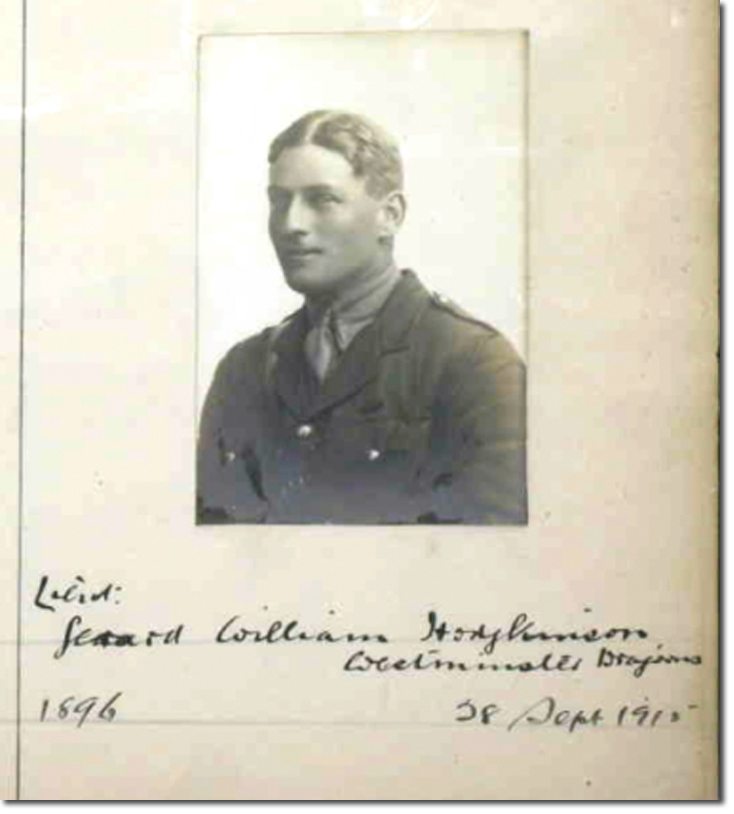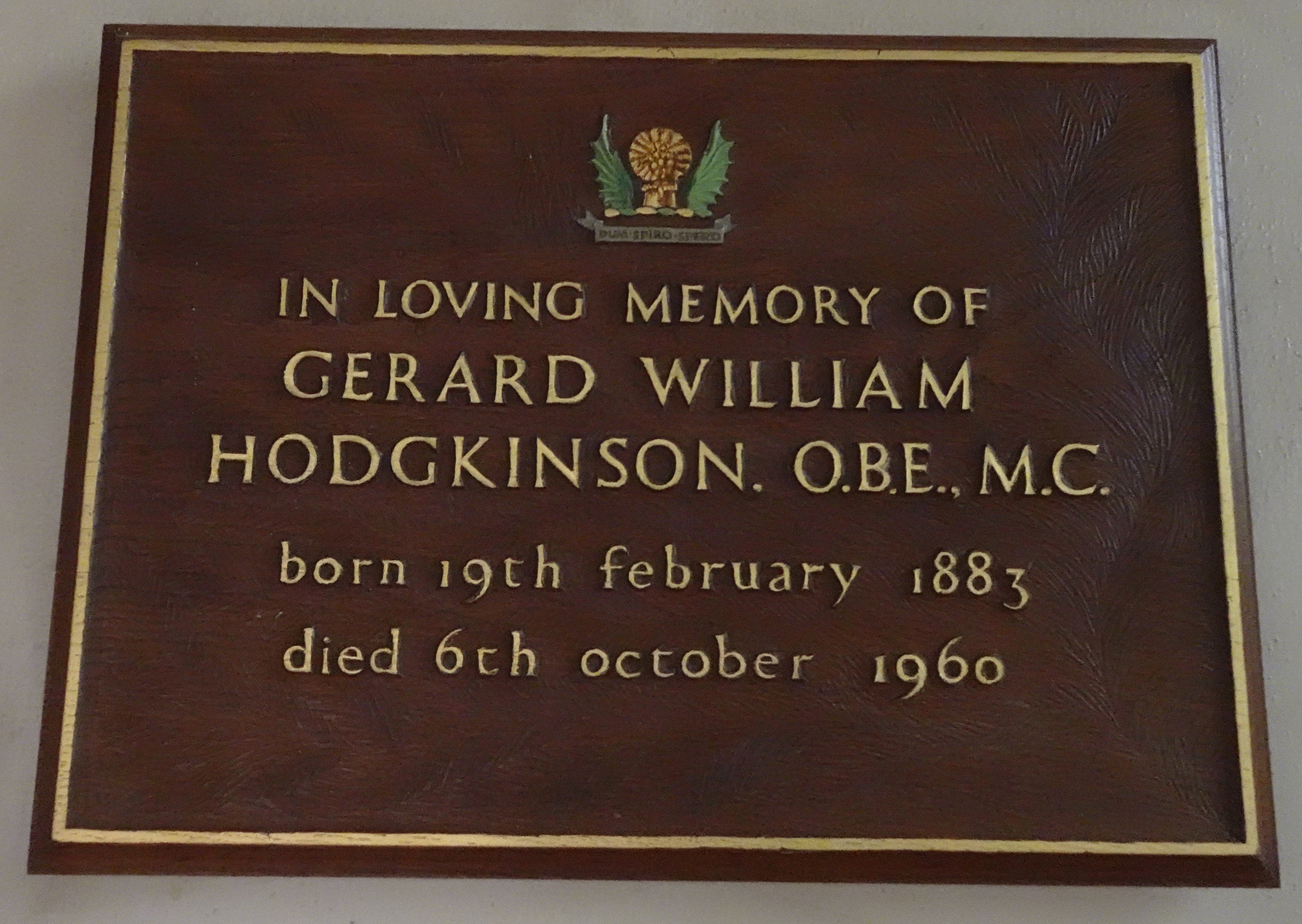
This dedication of Captain Gerard William Hodgkinson MC, OBE, is found in St Mary Magdalene Church. He was born into the paper-making family of Wookey Hole, Somerset, and educated at Eton College between 1896 and 1900. His early life reflected the privileges and pursuits of his class: he joined the family business, played nineteen First Class matches for Somerset County Cricket Club between 1904 and 1911, and served as Master of the Taunton Vale Harriers from 1906 to 1911. He also joined the West Somerset Yeomanry, signalling an early interest in military service. In 1907 he married Florence Gladys Mabel Mackenzie-Ashton of Bishops Lydeard, but the marriage was short-lived; she died in 1913, shortly after petitioning for divorce. That same year, Gerard left Somerset for Nairobi, beginning a new life as a settler farmer in British East Africa.
In Kenya he established himself at Sotik and leased over 7,000 acres at Nyeri, part of the wave of British settlement that followed the construction of the Uganda Railway. His life as a settler was one of both opportunity and hardship: the land was vast, but farming in the highlands demanded resilience, and the community of European settlers was small and tightly knit. It was from this base that he entered the First World War, joining the East African Mounted Rifles in August 1914, just days after war was declared. His service took him from mounted patrols to the Royal Flying Corps, where he earned the Military Cross and Bar for his courage as a pilot in the East African theatre. His knowledge of Swahili and of the region’s geography made him a valuable officer, bridging the worlds of settler and soldier.
After the war, Hodgkinson remained tied to East Africa. His military record notes his “extensive knowledge of Central Africa and South Somaliland and the Swahili language,” and he returned to the region in 1918 before his final discharge in 1921. In Johannesburg he married his second wife, Norah Beryl “Mollie” Shaw, with whom he had a son, Colin, in 1920. For a time, his life seemed firmly rooted in Africa, balancing farming, family, and the camaraderie of the settler community. Yet the pull of Somerset remained strong. When his father died in 1925, Gerard returned to England to inherit the family’s paper mill and the Wookey Hole Caves tourist attraction. Once again, he found himself at the helm of a local enterprise that had defined his family’s identity for generations.
Back in Somerset, Hodgkinson resumed the life of a country gentleman. He became Master of the Mendip Foxhounds between 1929 and 1932, and in 1937 married his third wife, Olive Treloar, with whom he had a daughter, Sheila. The 1939 Census records him as managing director of the family business, living at Wookey Hole. Yet his African years had left their mark: he was no longer simply a Somerset squire, but a man who had flown over the bush, spoken Swahili, and commanded men in one of the most difficult campaigns of the Great War. His outlook was broader, his experiences more varied, than those of many of his contemporaries.
At the outbreak of the Second World War, Hodgkinson once again answered the call to arms, rejoining the Royal Air Force and serving in France and Italy. In 1945 he was awarded the OBE, adding to his MC and Bar, as well as the Croix de Guerre and Palm. On retirement he was granted the honorary rank of Wing Commander. His service in two world wars, in both Africa and Europe, gave him a military career of unusual breadth, rooted in his early years as a settler but culminating in high recognition from Britain and her allies.
After the war, he returned to Wookey Hole, where he continued to manage the family enterprises until his death in 1960. His ashes were scattered at Ebbor Gorge, close to the caves and mill that had defined his family’s place in Somerset. After his death, Olive took over as managing director of the caves, eventually selling the attraction to Madame Tussauds in 1973. In this way, the Hodgkinson story came full circle: from Somerset to East Africa and back again, with the family’s fortunes tied to both the colonial frontier and the limestone caves of home.
Gerard Hodgkinson’s life illustrates the interplay between local roots and imperial horizons. Educated at Eton, a cricketer and huntsman in Somerset, a settler farmer in Kenya, a decorated pilot in East Africa, and later a country squire and businessman, he embodied the mobility and contradictions of his generation. His years in Africa gave him a perspective that few of his Somerset peers could share, yet in the end it was to Wookey Hole that he returned, where his story was anchored and where his memory remains.