

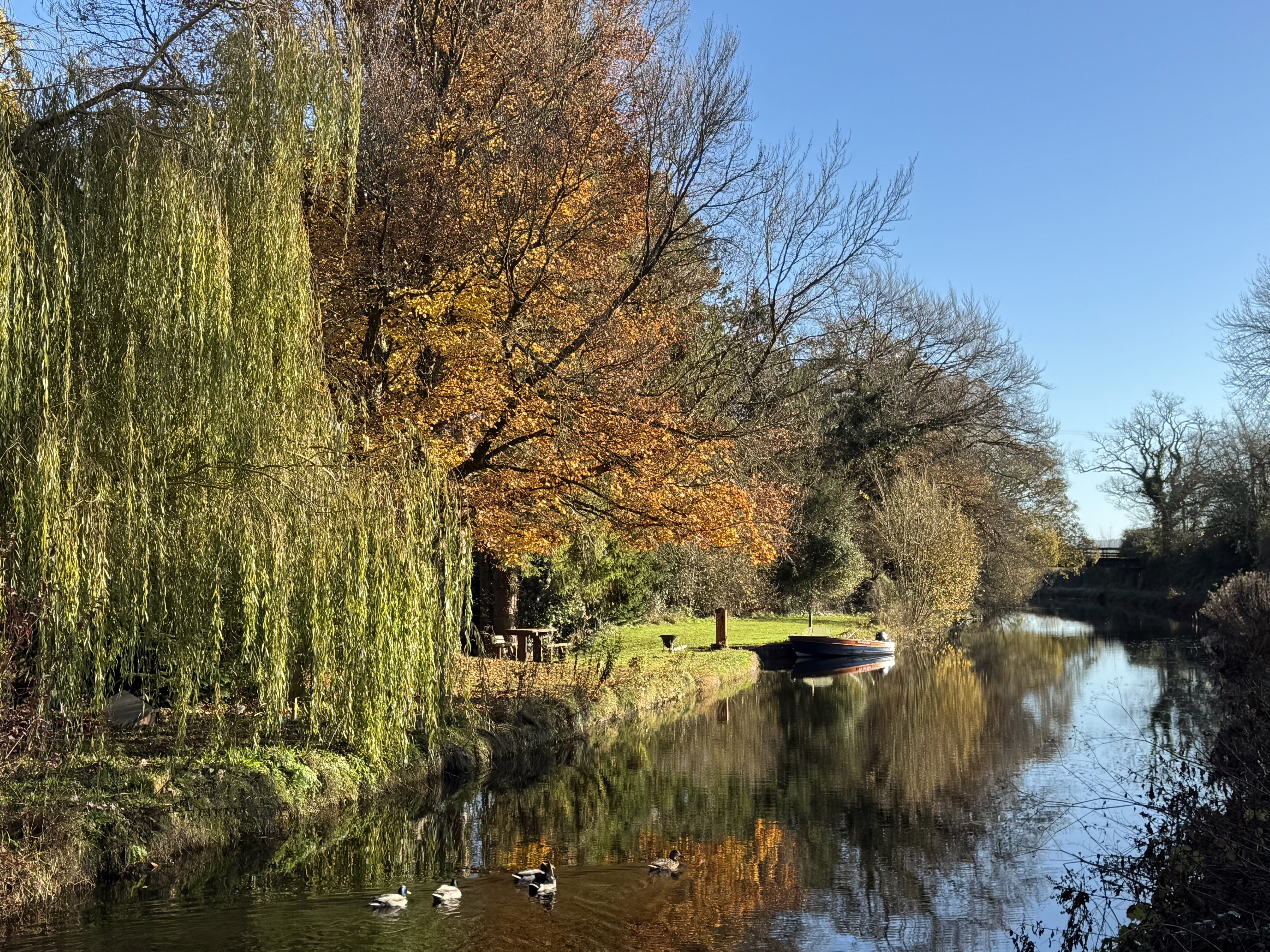
The Grand Western Canal was conceived in the late eighteenth century as part of the wider enthusiasm for inland waterways that characterised the canal mania years. Its promoters envisaged a route that would connect the Bristol Channel with the English Channel, thereby avoiding the hazardous voyage around Land’s End and opening up safer and cheaper communication for trade. Early surveys by engineers such as James Brindley and Robert Whitworth laid the groundwork, but it was John Rennie’s survey of 1794 that gave the scheme its most coherent form, reinstating branches to Cullompton and Tiverton. Parliament authorised construction in 1796, but the outbreak of war with France and financial difficulties delayed progress for more than a decade. Work finally began in 1810, and by 1814 the first section to Tiverton was opened, though at a cost far exceeding the original estimates.
The canal was cut through varied and often difficult terrain, requiring deep excavations, clay puddling to line porous soils, and the construction of bridges and embankments. Costs spiralled, with the Tiverton section alone consuming more than £244,000, far above the £220,000 originally authorised for the entire project. The workforce of itinerant navvies brought both energy and disruption to the rural communities along the line. Their presence was marked by occasional disorder, most notably a riot at Sampford Peverell in 1811, when grievances over pay and conditions led to violence and the death of one man. Such incidents illustrate the social tensions that accompanied the intrusion of industrial enterprise into quiet villages.
The stretch between Halberton and Sampford Peverell was among the most challenging and revealing parts of the canal. At Halberton the planned line ran directly through the village, and engineers were forced to divert the canal northwards. This diversion required deep cuttings through hard rock and porous sand, all of which had to be carefully lined with clay puddle to prevent leakage. The expense and delays made the Halberton lot the most costly of the entire project. Several accommodation bridges were built to maintain local communications, and the high embankments north-east of the village remain as testimony to the scale of the undertaking. By contrast, the Sampford lot was less advanced by 1813, with several works unfinished, though wharves were constructed to serve local trade once the canal opened. The riot of 1811 underscored the uneasy relationship between the navvies and the villagers, a reminder that the canal was not only an engineering project but also a social intrusion.
Despite the difficulties, the canal was navigable by August 1814, and the arrival of the first barge laden with coal at Tiverton immediately reduced the price of fuel in the town. Wharves at Sampford Peverell, Whipcott, and Halberton facilitated trade in lime and stone from the quarries at Canonsleigh, and the Tiverton basin soon became a busy hub of kilns and carts. Yet the canal never fulfilled its grand ambition of reaching Taunton and linking with the Bridgwater and Taunton Canal. The Halberton–Sampford section epitomises both the ambition and the limitations of the project: technically ingenious, socially disruptive, and financially burdensome. It remains a vivid reminder of the canal age in Devon, where industrial vision met the realities of rural landscape and community.

