

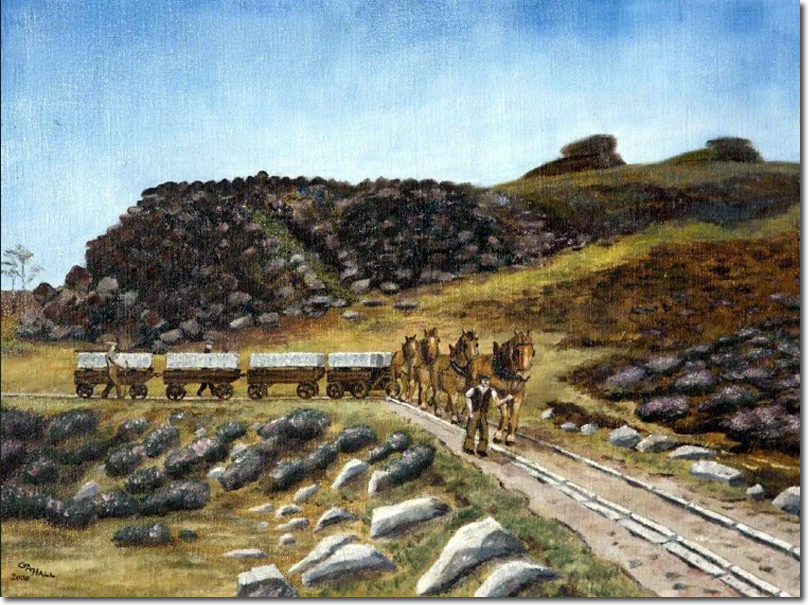
The Haytor Granite Tramway was constructed in 1819–1820 to move granite from the Haytor quarries on Dartmoor to the Stover Canal at Ventiford. From there the stone travelled by barge to Teignmouth and out to sea. The tramway formed the central link in a transport chain developed by the Templer family, whose commercial interests in granite and ball clay shaped the landscape of the Bovey Basin and the eastern edge of Dartmoor.
Unlike later railways, the Haytor line used granite rather than iron. Each rail was a dressed granite block with a longitudinal groove cut to guide the wheels of the wagons. The blocks were laid with precision, forming a durable track capable of carrying heavy loads down from the quarries. Horses provided the motive power, hauling the wagons downhill to the canal basin and returning them empty to the moor.
The quarries at Haytor produced large quantities of high‑quality granite. Much of it was used in major building projects, including London Bridge, the British Museum, the National Gallery and the old General Post Office. The tramway allowed the stone to be moved efficiently at a time when road transport was slow and expensive. Its construction demonstrated both the ambition and the engineering competence of the Templer enterprise.
The line descended from the quarries across Haytor Down, passed Holwell Tor and continued through the lower slopes towards the canal. Several sections survive in excellent condition, with the granite rails still in place. The remains of the quarries, including unfinished blocks showing feather‑and‑tare marks, illustrate the working methods used by nineteenth‑century stonecutters.
Competition from Cornish quarries and the high cost of extraction eventually reduced the profitability of the Haytor operation. By the mid‑nineteenth century the tramway had fallen out of use, and the quarries were abandoned. The line, however, remains one of the most distinctive industrial monuments on Dartmoor. Its survival is due largely to the durability of its materials and the relative isolation of the moorland landscape.
Today the tramway is a visible reminder of the period when Dartmoor granite had a national market and when the Templer family’s transport system linked the moor to the coast. The granite rails, the quarry faces and the line of the Stover Canal together form a coherent industrial landscape, illustrating a short but significant phase in the economic history of the region.
Dartmoor Granite Railway at Haytor, Devon — painting by Gordon Hall. Courtesy of Newton Abbot Town & GWR Museum. Source on Art UK

