

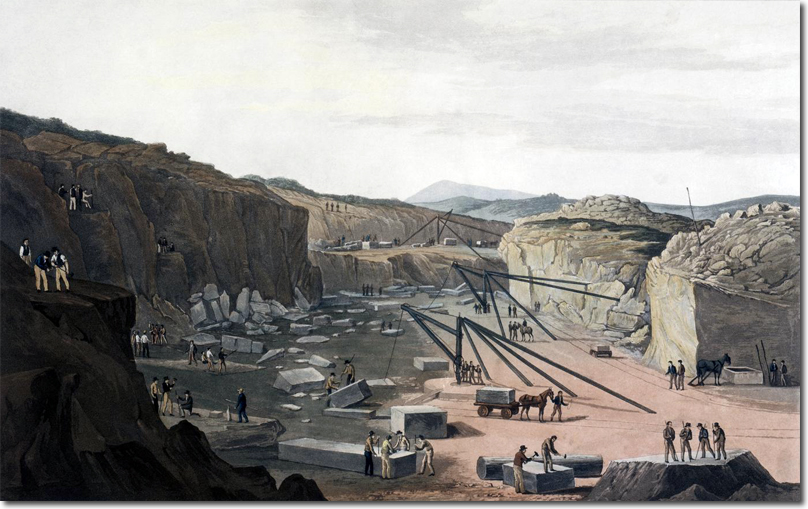
The Haytor granite quarries were worked from the late eighteenth century and reached their main period of activity between c.1815 and the early 1840s. They supplied stone for the Haytor Granite Tramway, completed in 1820, and for the Stover Canal, which carried the granite to Teignmouth for coastal shipment. The quarries formed the upper section of the Templer transport system linking Dartmoor to the sea.
The workings consist of several excavated faces cut directly into the granite outcrops. The quarry walls show the feather‑and‑tare method used throughout the period, with drilled holes and wedge marks visible on many surfaces. Unfinished blocks remain where they were cut, providing direct evidence of extraction stages and the preparation of stone for loading onto the tramway.
The lower levels of the principal quarry are now flooded. The surrounding faces retain cut marks, working platforms and channels cut for drainage. Surviving iron fittings and other working features indicate the layout and methods used by the quarrymen during the operational years.
Once detached and shaped, the granite blocks were moved to the tramway. The line ran from the quarries across Haytor Down and descended to Ventiford, where the stone was transferred to the Stover Canal. Horses hauled the wagons, and the gradient of the route allowed heavy loads to be moved with relative efficiency. This system remained in use until the early 1850s.
The quarries declined from the 1840s onwards. Competition came from Cornish granite sources with easier access to coastal shipping, particularly the De Lank quarries near St Breward, which could move stone by cart to Wadebridge and then by sea. These lower transport costs, combined with the expense of working the Dartmoor stone and maintaining the tramway and canal, made the Haytor operation commercially uncompetitive. Quarrying had ceased by the mid‑nineteenth century.
The Haytor quarries remain a significant industrial site on Dartmoor. They provide clear physical evidence of nineteenth‑century granite extraction and of the transport system developed by the Templer family. Together with the tramway and the Stover Canal, they form a connected industrial landscape illustrating the methods and commercial pressures of the period.
Interior view of the Haytor granite quarries — photograph courtesy of the Science Museum. Source on Science Museum Group Collection

