Herbert Walter Gee was born in 1866, the son of the Rev. W. Gee of East Coker, later of 8 Waterden Place, Guildford. His education followed the established preparatory path for boys intended for academic distinction and administrative service. He attended Mr Curteis’s school at Hillside, Godalming, before entering Sherborne School (Harper House) in 1880. He remained there until 1884, serving as a Scholar, a member of the Sixth Form, and a School Prefect. From Sherborne he proceeded to New College, Oxford, continuing the course expected of candidates for the higher branches of the Indian Civil Service.
Gee entered the Indian Civil Service in 1885, placing tenth out of forty‑one candidates in the competitive examination. He went to India in 1887 and began the sequence of district appointments typical of a young ICS officer. In January 1890 he was made Assistant Commissioner in charge of the Rajanpur Sub‑Division of the Dera Ghazi Khan District, invested with the powers of a Collector and authorised to try, as a Magistrate, all cases not punishable by death. His administrative work was accompanied by scholarly interests: in December 1891 he published a monograph on fibrous manufactures in the Punjab, describing the principal fibrous plants, their localities and their uses.
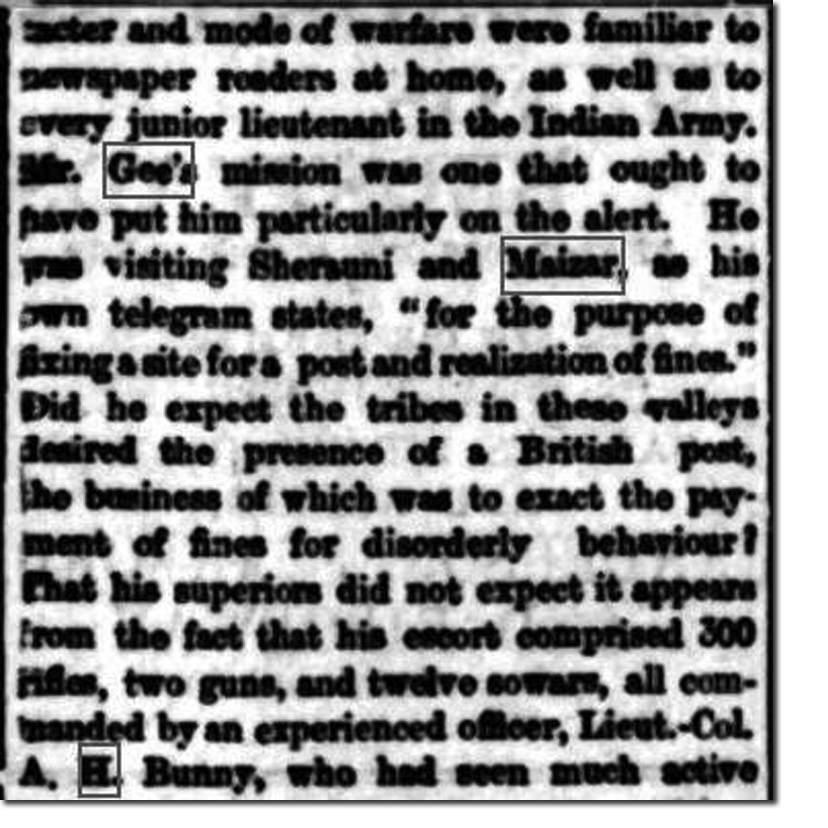
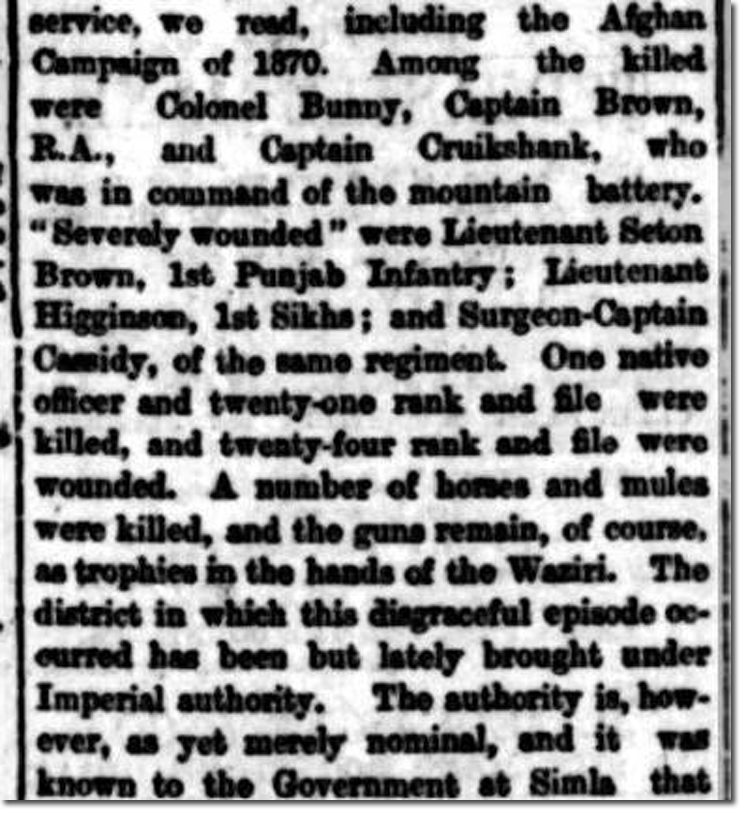
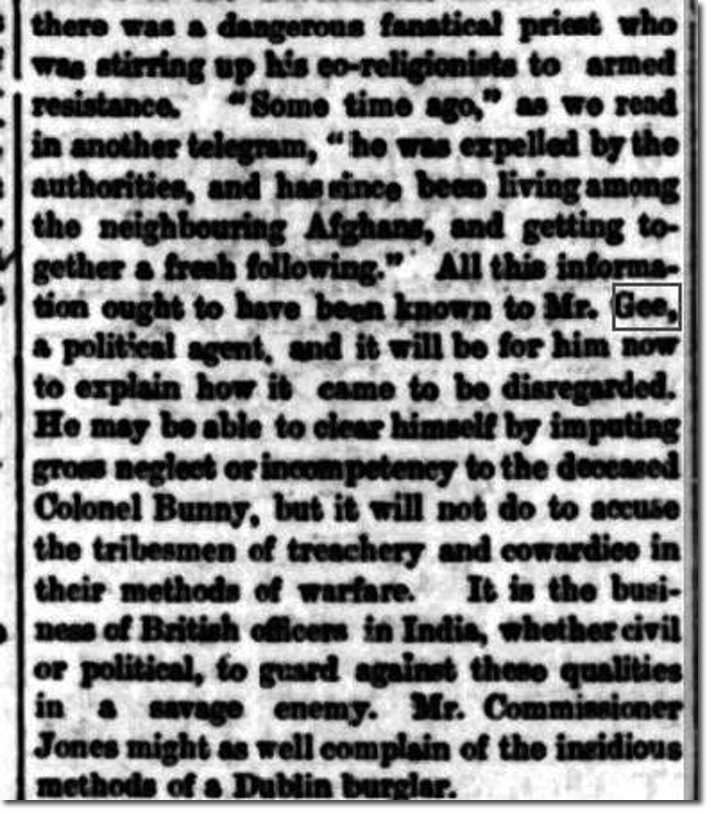
In April 1896 Gee was appointed Political Officer in the Tochi Valley, a frontier posting requiring negotiation, intelligence work and constant personal risk. The dangers of the appointment were widely recognised. During the Tochi Valley Expedition of 1897 he served as Chief Political Officer, operating in a region where relations with tribal groups were volatile and often deceptive. In June 1897 a British detachment visiting Maizar was ambushed in what contemporary reports described as an act of “basest treachery”. The Maliks had been in friendly intercourse with Gee and had parted from him on apparently cordial terms. His visit to Maizar had been pre‑arranged, and two Maliks were sent ahead by him. One brought food for Gee, the British officers and the Mohammedans; then, without warning, fire was opened from all sides. All the British officers except Gee were hit almost immediately. Lieutenants Higginson and Seton Browne were reported to be recovering, and Surgeon‑Captain Cassidy, though seriously wounded, was not believed to be in danger. Gee survived the attack and continued in his post, a fact noted in a Punjab summary which recorded that “H. W. Gee, who was so treacherously attacked at Maizar last year, still holds the post of Political Officer in the Tochi Valley.”
In 1899 Gee was appointed Deputy Commissioner (2nd Grade) of Dera Ismail Khan, a senior administrative position carrying responsibility for civil order, revenue, judicial oversight and frontier relations. His career trajectory was that of an able ICS officer expected to advance further within the service, combining administrative competence with frontier experience.
Gee died at Dera Ismail Khan on 4 February 1901 of pneumonia, aged thirty‑five. His household and personal effects, including a four‑seated trap by Cosser described as “quite new”, were auctioned on 13 April 1901. His career, though brief, reflected the demands placed upon civil and political officers in the Punjab: administrative responsibility, scholarly engagement, and service in districts where negotiation and danger were inseparable.
Gee died in 1901, ending a career that had combined academic distinction with service in one of the most challenging administrative environments of the British Empire. His connection to East Coker through his father, the Rev. W. Gee, places him within the wider history of the parish’s contribution to imperial administration during the late nineteenth century.