

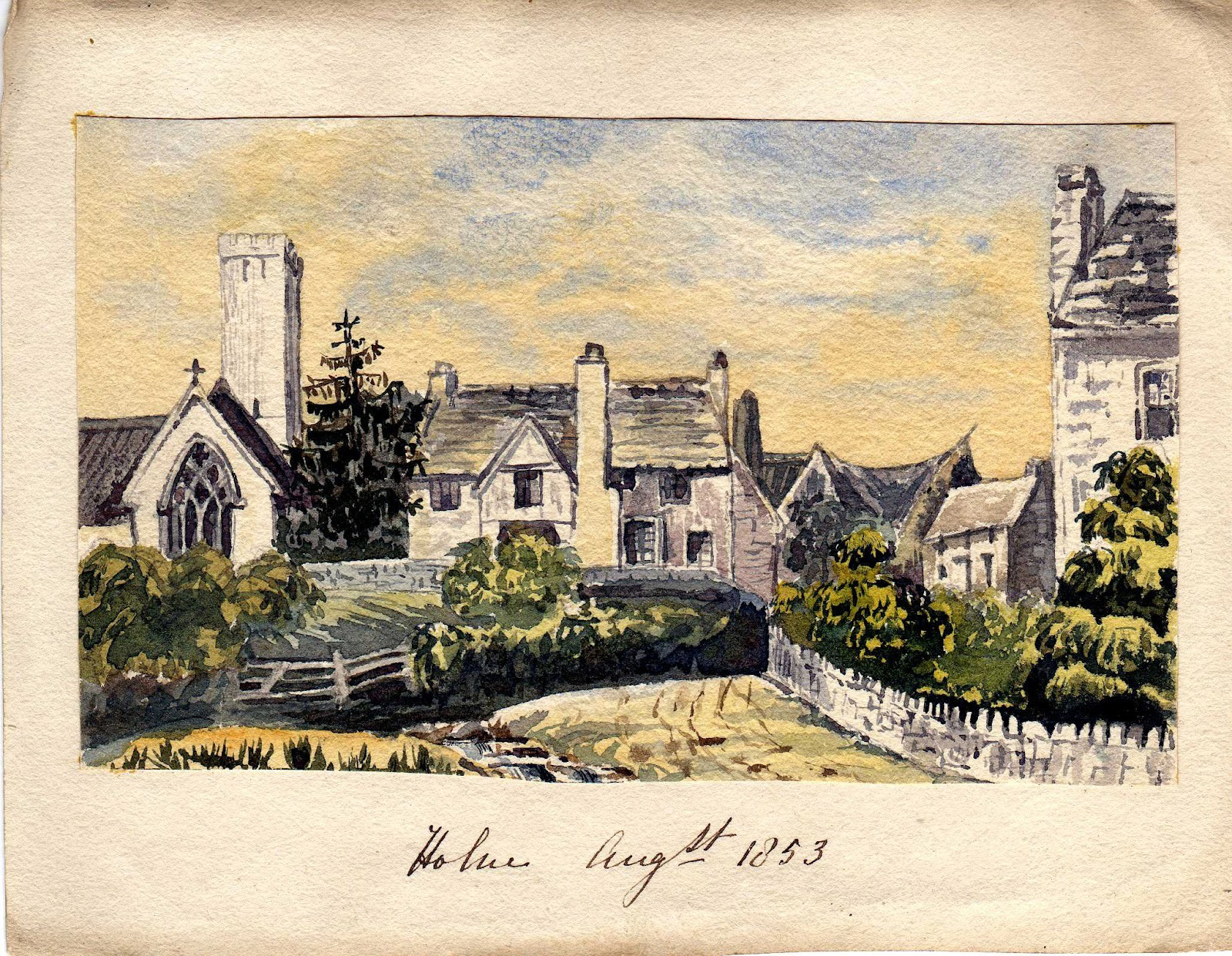
Holne is a parish village whose history is deeply rooted in the rhythms of Dartmoor’s rural life. Recorded in the Domesday Book of 1086 as “Holla,” the name derives from the Anglo-Saxon word for holly, reflecting the abundance of holly trees that once grew here. From its earliest days, Holne was a farming community, its people working the green fields and moorland edges, shaping the landscape with hedges, boundaries, and granite walls that still mark the parish today.
For centuries, much of Holne belonged to Buckfast Abbey, whose monks managed the land and oversaw the agricultural economy. The parish covers around 5,000 acres, of which only half has ever been cultivated. The rest is moorland, woodland, and rough pasture, providing grazing for sheep and cattle. The River Dart runs through Holne Chase, a dramatic wooded valley that has long been central to the parish’s identity. Farming, spinning, and weaving were the backbone of the local economy, with sheep providing wool for cloth and the fertile fields supporting small-scale mixed agriculture.
Holne’s rural character is reflected in its buildings. The parish church of St Mary the Virgin, built around 1300, was raised by local masons using granite rubble from Dartmoor. The Church House Inn, originally built in 1329 as a longhouse to house stonemasons working on the church, later became a retreat for Buckfast Abbey clergy and eventually the parish inn. These structures show how closely village life was tied to both agriculture and the church, with inns, farms, and cottages forming the heart of the community.
Life in Holne was shaped by the land. The moor provided peat for fuel, granite for building, and rough grazing for livestock. The enclosed fields supported crops and dairying, while the deep lanes and hedges gave shelter from the Atlantic winds. Rural traditions such as the dole table in the churchyard, where food and alms were distributed to the poor, remind us of the parish’s role in sustaining its people through charity and community support. Seasonal fairs, church feasts, and agricultural cycles marked the rhythm of life for generations.
By the nineteenth century, Holne remained a small farming parish, with a population of just under 400. The Dawson family of Holne Chase House developed the estate as a hunting seat, but the majority of villagers continued to live by farming, spinning, and rural trades. The village produced figures of national importance, such as Charles Kingsley, born in the vicarage in 1819, whose writings often reflected his concern for rural poverty and social reform. Yet Holne itself remained a quiet agricultural community, tied to the land and the moor.
Today Holne is still a small village, with a population of around 250, but its rural history is visible everywhere: in the granite cottages, the hedged fields, the ancient yew in the churchyard, and the moorland that surrounds it. Farming continues, though tourism now plays a role, with walkers and visitors drawn to the parish’s scenery and history. Holne’s story is one of continuity, a place where the rural past is still present in the landscape and in the life of the community.
Image Courtesy of Nick Balmer

