

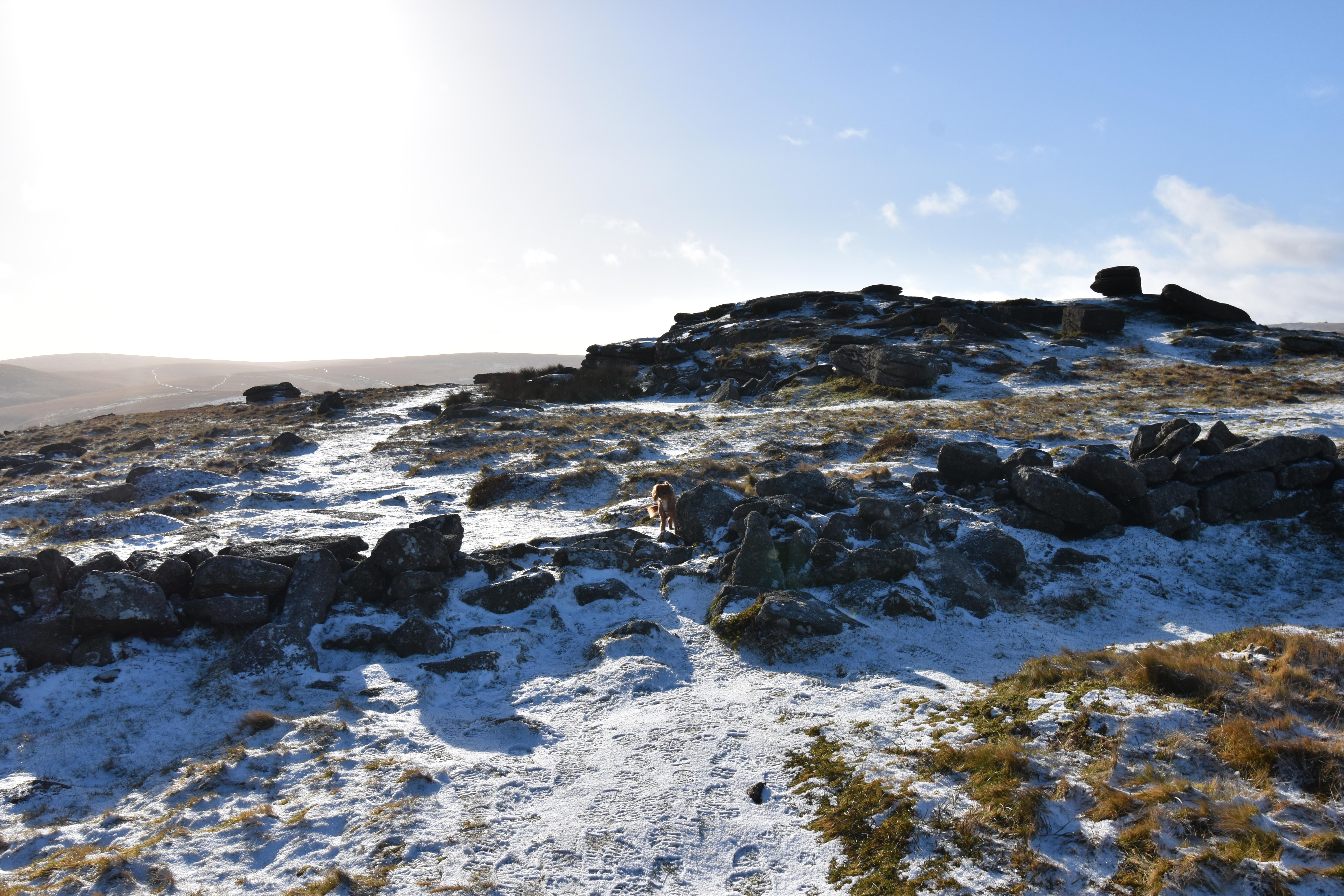
Irishman’s Wall is one of the most distinctive linear features on the high ground above Belstone, running across the flank of Cosdon and cutting a long, straight line through the moorland. It is not a wall in the usual sense, nor is it complete, but its length and its stark presence have encouraged a wide range of explanations over the years. Some of these theories are grounded in documentary evidence, others in local memory, and others still in the imaginative folklore that attaches itself to any unusual feature on Dartmoor. The result is a structure whose origins remain uncertain, but whose story is richer for the variety of interpretations it has attracted.
The most widely repeated explanation is that Irishman’s Wall was an attempt at nineteenth‑century land improvement. According to this view, a landowner or tenant farmer employed a group of Irish labourers to build a boundary wall across the moor, perhaps as part of a scheme to enclose or “reclaim” the high ground for grazing. The story usually ends with the labourers abandoning the work when the weather turned, or when the scale of the task became clear, leaving the wall unfinished. This explanation fits the name neatly and matches the period when enclosure and improvement schemes were common across Dartmoor. However, there is no firm documentary evidence linking the wall to a specific landowner or group of workers.
A related theory suggests that the wall was intended to mark the boundary of a proposed new enclosure, but that the project was halted before completion. In this version, the wall represents the first stage of a larger plan to divide the moor into grazing plots. The straightness of the line and the substantial size of the stones support the idea of a deliberate, organised construction rather than a casual or temporary boundary. The fact that the wall stops abruptly has been taken as evidence that the scheme was abandoned, perhaps due to cost, weather, or changing land‑use priorities.
Another explanation places the wall in the context of Dartmoor’s long history of rabbit warrening. Some have suggested that Irishman’s Wall may have been part of a boundary or drift wall associated with a warren, designed to funnel or contain rabbits. This theory is less widely accepted, as the wall’s position and scale do not match the typical layout of known warrens, and there is no clear evidence of associated pillow mounds or warren structures nearby. Nevertheless, the idea persists because warrening was such a dominant activity on parts of the moor for centuries.
A more speculative theory proposes that the wall is much older than the nineteenth century and may even have prehistoric origins. Dartmoor is rich in Bronze Age reaves—long, straight boundary banks that divided the landscape into fields and territories. Some have noted that Irishman’s Wall shares the straightness and alignment of these reaves, and have suggested that it may be a later rebuilding or reworking of an ancient boundary. The difficulty with this theory is that the wall is built of large, deliberately placed stones rather than earth and rubble, and its construction style does not match known prehistoric examples. Still, the possibility that it follows an older line cannot be entirely dismissed.
Folklore offers a different set of explanations. One story claims that the wall was built by an Irishman who wagered that he could construct a wall across the moor in a single day. He began at dawn, worked furiously, and reached the point where the wall now ends just as the sun set. The abrupt termination of the wall is thus explained as the moment the wager expired. This tale is typical of Dartmoor folklore: it provides a memorable narrative for an otherwise puzzling feature, even if it has no historical basis.
Another folkloric version suggests that the wall marks the route taken by an Irish drover or traveller who became lost on the moor. In this telling, the wall is a symbolic or commemorative feature rather than a practical one, built to mark the path he took or the place where he perished. This story is less common, but it reflects the way the moor’s more remote features often become associated with tales of wandering, hardship and misadventure.
A more practical explanation is that the wall was never intended to be a boundary at all, but simply a convenient way of clearing stones from the surrounding ground. Farmers and labourers often piled unwanted granite into linear heaps, especially when attempting to improve rough grazing. The scale and straightness of Irishman’s Wall make this less likely than in other cases, but the idea persists because it offers a simple, functional explanation for a structure that otherwise seems overbuilt for its purpose.
Finally, there is the possibility that the wall served multiple purposes over time. It may have begun as a clearance line, later been extended as part of an enclosure scheme, and eventually acquired its name and stories as local memory filled in the gaps. Dartmoor’s landscape is full of features that have been reused, repurposed and reinterpreted across centuries, and Irishman’s Wall may be another example of this layered history.
In the absence of firm documentary evidence, no single theory can be confirmed. The most plausible explanations remain the nineteenth‑century enclosure attempt or the clearance‑line theory, but the wall’s name and its abrupt ending have ensured that folklore continues to play a part in how it is understood. What is certain is that Irishman’s Wall is a striking feature of the Belstone landscape, a reminder of the many ways people have tried to shape the moor, and of the stories that grow up wherever human effort meets the intractable granite of Dartmoor.

