Reverend James Forbes served as vicar of Bovey Tracey from 1628 to 1665, a tenure that spanned one of the most volatile periods in English ecclesiastical history. His ministry coincided with the Civil War, the rise and fall of the Commonwealth, and the eventual Restoration of the monarchy. In a time when the Church of England was under siege — its bishops imprisoned, its liturgy suppressed, its buildings stripped of imagery — Forbes stood firm. His loyalty to the Crown and to the traditional church was not merely personal; it was theological, historical and deeply felt. The Parish Church of St Peter, St Paul & St Thomas of Canterbury still bears the marks of his convictions.
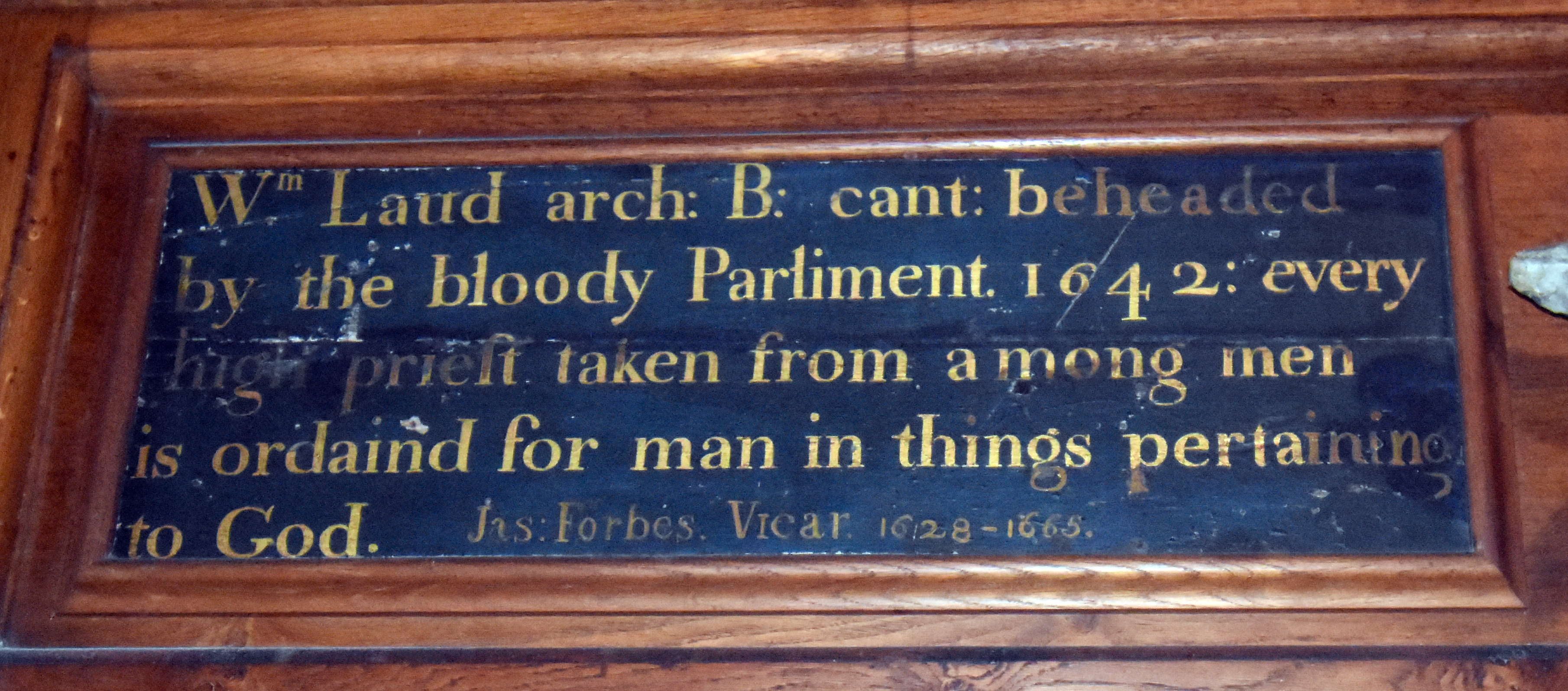
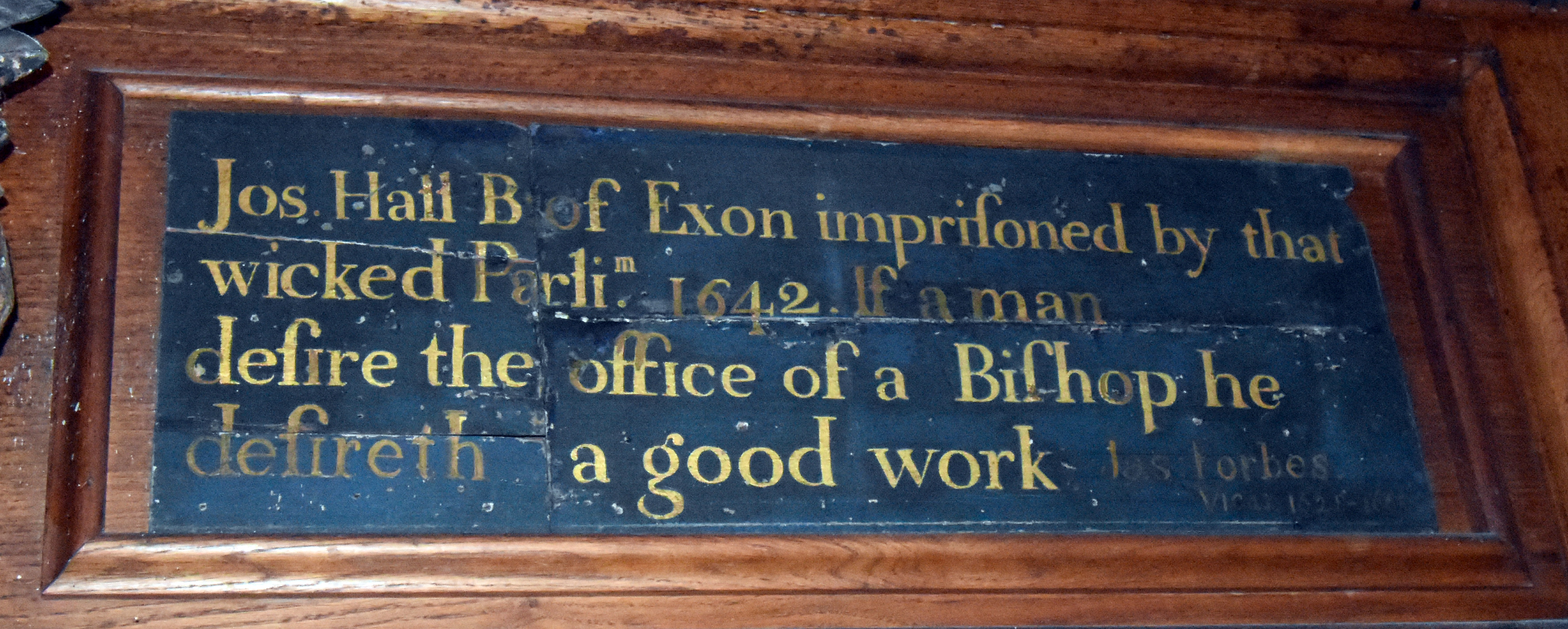
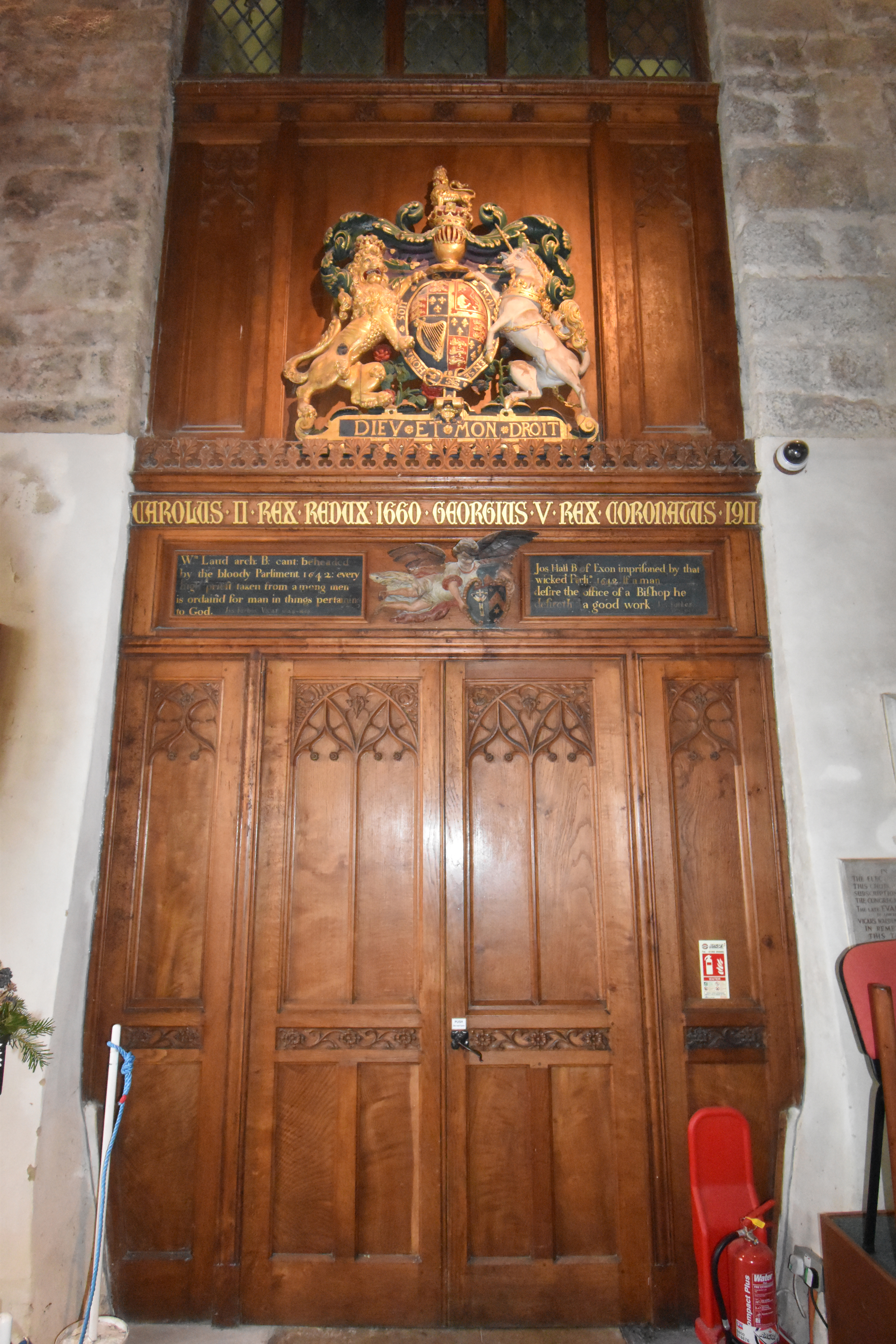
Two surviving plaques inside the church speak directly to Forbes’s worldview. One commemorates Archbishop William Laud, executed in 1645, with the stark inscription: “Wm Laud arch: B: cant: beheaded by the bloody Parliment. 1642: every high priest taken from among men is ordaind for man in things pertaining to God.” The other laments the imprisonment of Bishop Joseph Hall of Exeter: “Jos. Hall Bp of Exon imprisoned by that wicked Parliᵐᵗ 1642. If a man desire the office of a Bishop he desireth a good work.” Both are signed “Jas. Forbes,” and together they form a theological protest against the dismantling of episcopal authority. Forbes saw the episcopacy not as a political convenience but as a divinely ordained structure, and these inscriptions are his defence of that belief — carved not in pamphlets or sermons, but in wood and gold, for all to see.
His royalist sympathies were equally visible. The west screen, which now fills the arch between the tower ringing chamber and the nave, incorporates the restored Coat of Arms of Charles II, commemorating the king’s coronation in 1660. The arms had originally hung above the chancel screen and survived the iconoclasm of the Commonwealth, almost certainly due to Forbes’s protection. A black rose painted on the flank of the lion is thought to have been added by Forbes himself — a discreet tribute to Charles I, whose execution he regarded as a martyrdom. He also commissioned boards condemning the Commonwealth government of Oliver Cromwell, a bold act in a parish where loyalties were not uniformly royalist. These gestures were not mere defiance; they were part of a broader theological and political vision in which monarchy, episcopacy and liturgical tradition were inseparable.
Forbes’s most famous act of preservation involved the church’s brass eagle lectern, a late‑15th‑century piece believed to be East Anglian work. Traditionally, Peter’s Pence — the annual tax sent to Rome — was placed in the eagle’s beak and retrieved from the tail. By Forbes’s time, the practice had long ceased, but the lectern remained a potent emblem of continuity. During the Civil War, when Parliamentarian troops were known to destroy or melt down such objects, Forbes is said to have hidden the lectern by sinking it in a pond. Its survival is due as much to his courage as to its craftsmanship. Today, it stands not only as a fine example of medieval metalwork but as a symbol of one man’s determination to protect the sacred from political destruction.
The political tensions of the time are also visible in the story of his wife, Maria Forbes. When she died in 1655, the Commonwealth committee of sequestrators sitting at Exeter refused to allow her burial inside the church — a punitive measure aimed squarely at her husband. Her tomb still stands outside the south wall of the chancel, weathered but dignified. Its position is a stark reminder of the personal cost borne by clergy who remained loyal to the Crown during the Interregnum.
Forbes’s ministry coincided with a period when many medieval churches were stripped of their screens, imagery and fittings. That Bovey Tracey’s church retains so much of its medieval fabric — including its 15th‑century rood screen, its carved bosses, its Beer‑stone font and its richly carved pulpit — is partly due to the care taken by clergy and parishioners during his tenure. The rood screen suffered damage during the Commonwealth, particularly to its upper figures, but its structure and painted dado survived. Later restorations in the 19th century were able to build on what Forbes and his contemporaries had preserved.
His influence extended beyond objects. Forbes shaped the parish’s identity during a period when the Church of England itself was fractured. His refusal to conform to Commonwealth religious policy led to his ejection, yet he remained a figure of local loyalty and respect. After the Restoration, his convictions were vindicated, and the church once again displayed the royal arms that had been removed or concealed during the Interregnum. The later commemorations of Charles II and George V on the west screen echo this long tradition of royal association — a tradition rooted in Forbes’s own steadfastness.
Today, visitors to the Parish Church of St Peter, St Paul & St Thomas of Canterbury encounter Forbes’s legacy in tangible and lasting ways: the brass eagle lectern he saved, the royal arms he protected, the tomb of his wife placed outside the chancel by political decree, the Civil War plaques he composed, and the survival of medieval woodwork that might otherwise have been lost. These are not grand gestures, but signs of a man who stood by his principles and looked after his church in difficult times. His story is part of the building now — not just in the objects he preserved, but in the character of the place itself.