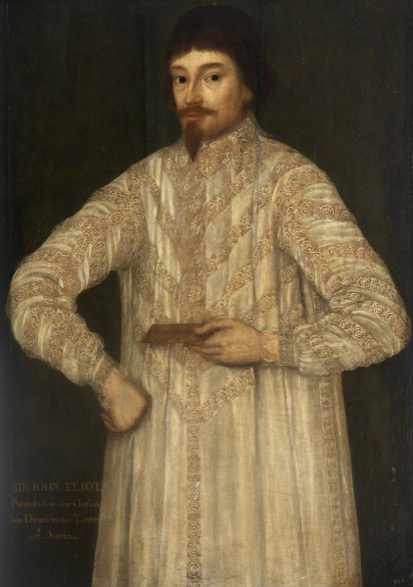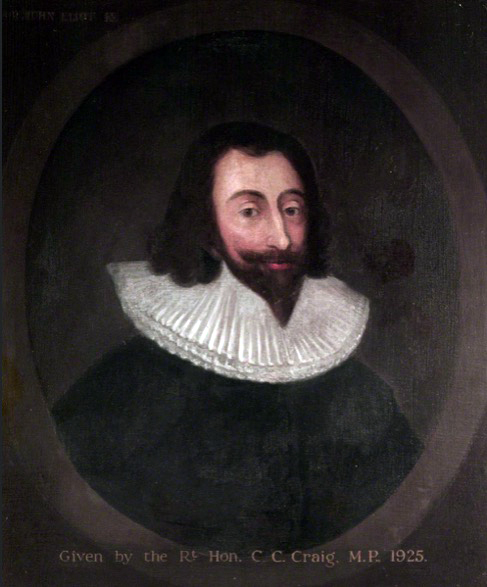
Sir John Eliot (1592–1632) stands as one of the most forceful and controversial parliamentarians of the early Stuart age. Born into a minor gentry family rooted in east Cornwall, Eliot’s lineage traced back to Devon, but his family’s fortunes became tied to St German’s when his great‑uncle leased the manor of Cuddenbeak and converted the old episcopal palace into the mansion later known as Port Eliot. The estate passed to Eliot’s father Richard in 1577, and although Richard played little part in local government, his hospitality and standing ensured the family’s prominence in the district.
Eliot attended Exeter College, Oxford, the traditional choice for West Country gentlemen, though he left without taking a degree. His father’s death in 1609 made him a royal ward, but his marriage to Radigund Gedy earlier that year curtailed Crown influence during his minority. The Cuddenbeak property had already been settled on the young couple, and Eliot made it his principal residence, leasing out Port Eliot instead.
Tradition holds that Eliot first encountered George Villiers—later the powerful duke of Buckingham—while travelling abroad, a story impossible to verify but not implausible. When Eliot entered his estate fully in 1613, it comprised around 400 acres, much of it tied up in his mother’s jointure until 1617. His local influence nevertheless secured his election for St German’s in the 1614 Parliament, though he made no recorded contribution.
Knighted in 1618, Eliot became a Cornish magistrate in 1621. In December 1622 Buckingham appointed him vice‑admiral of Devon, a post that greatly enhanced his standing. Eliot threw himself into the role with characteristic energy, but his forceful approach soon led to trouble. In 1623 he captured the pirate John Nutt and attempted to extract payment for an outdated pardon, refusing to return a seized merchant ship without reward. This defiance of the Admiralty Court resulted in his imprisonment. Buckingham, preoccupied with affairs of state, secured his release only months later.
Eliot returned to Parliament in 1624, this time for Newport, and quickly emerged as a vigorous and eloquent Member. He championed the anti‑Spanish war policy favoured by Buckingham and Prince Charles, spoke forcefully on monopolies, impositions, and the decay of trade, and played a prominent role in debates over recusancy and national defence. His speeches—often lengthy, passionate, and meticulously prepared—won him attention, though not always approval, from his colleagues.
Yet Eliot’s relationship with Buckingham was never straightforward. Though initially aligned with the duke, his own convictions frequently diverged from government policy. He resisted unrealistic financial demands, criticised mismanagement of naval affairs, and grew increasingly uneasy with Buckingham’s dominance. The disastrous Cadiz expedition of 1625, the suffering of billeted troops, and the rise of Buckingham’s clients such as James Bagg II deepened his disillusionment.
By the time of the 1626 Parliament Eliot had become one of Buckingham’s most formidable critics. His speeches attacked the dangers of overmighty favourites and the corruption of royal counsel, themes that would define his later career. His role in the impeachment of Buckingham marked a fatal breach. Eliot then turned his attention to the Crown’s continued collection of Tunnage and Poundage without parliamentary grant. He argued that the levy was unlawful, that it breached the Petition of Right, and that ministers who advised or enforced it were subverting the laws of England. His resolutions of 1629, declaring those who promoted or paid such unauthorised taxation to be enemies of the kingdom, brought the session to a violent close. Charles I responded by imprisoning Eliot in the Tower of London, where he refused to submit or seek the king’s pardon. He died there in 1632, a martyr in the eyes of later constitutionalists.
Eliot’s legacy is inseparable from St German’s and the Port Eliot estate. His life reflects the tensions of early Stuart politics—between Crown and Parliament, prerogative and liberty, loyalty and conscience. His writings, including the Negotium Posterorum, shaped later interpretations of the constitutional struggles that preceded the Civil War. Today he remains one of Cornwall’s most significant political figures, a man whose fierce integrity and uncompromising principles left a lasting mark on English parliamentary history.