

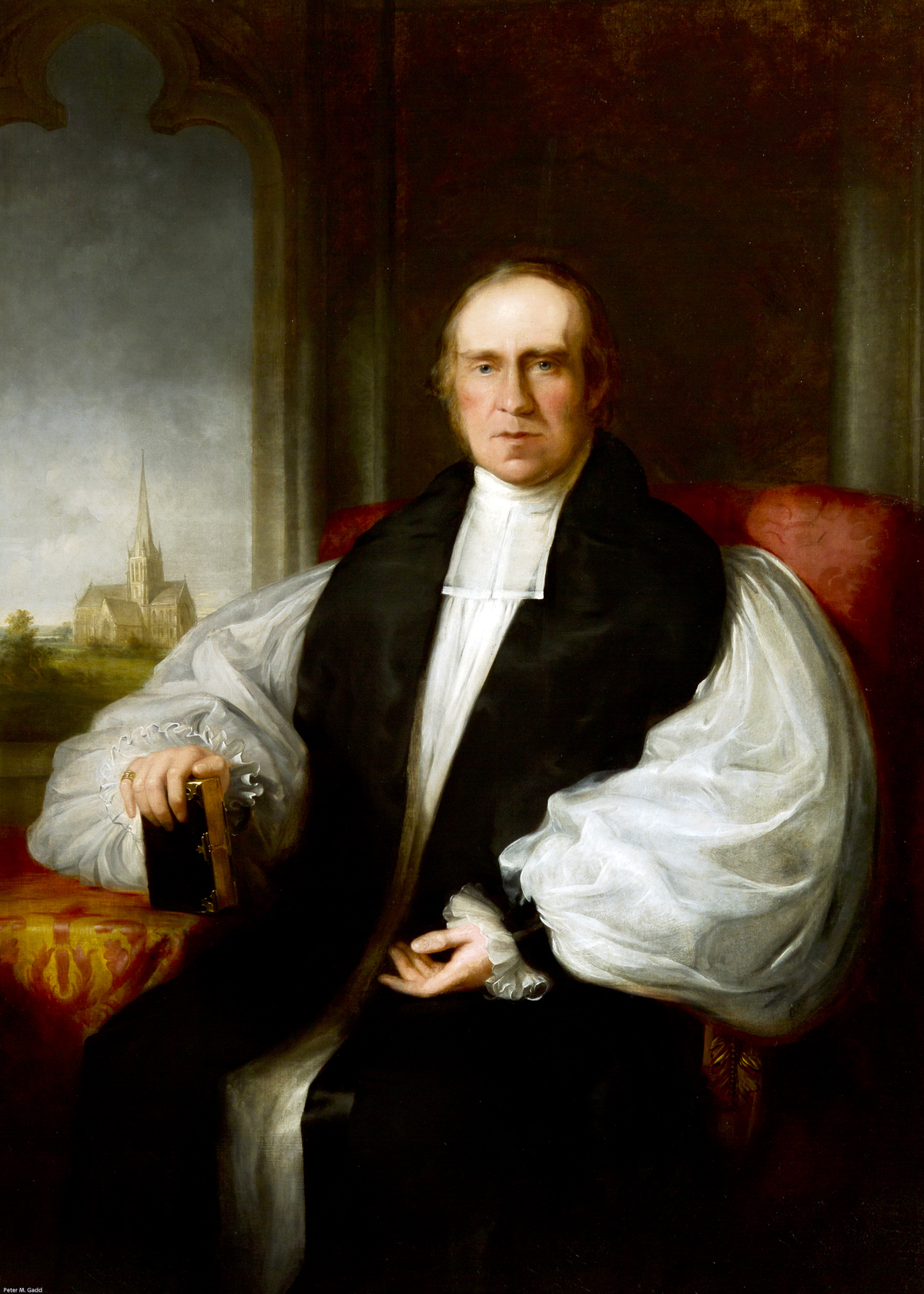
John Medley, later the first Bishop of Fredericton, was born in London on 19 December 1804, the son of George Medley and his wife Henrietta. Dedicated from childhood to the Anglican priesthood by his widowed mother, he received a thorough education at schools in Bristol, Bewdley, Hammersmith and Chobham, mastering Hebrew, Latin and Greek before entering Wadham College, Oxford, in 1822. He graduated with honours in 1826, was ordained deacon in 1828 and priest in 1829, and began his ministry in the diocese of Exeter. His early career was marked by intellectual seriousness and a growing commitment to the principles that would later define the Tractarian movement. In 1838 he became vicar ofSt Thomas Church, Exeter, and in 1842 was appointed prebendary of Exeter Cathedral.
Medley’s years in Exeter coincided with the rise of the ecclesiological movement, and he became one of its most active proponents. He collaborated with Hubert Kestell Cornish on a translation of St John Chrysostom’s homilies for the Tractarian “Library of the Fathers,” and in 1841 published Elementary remarks on church architecture, a work that reflected his belief in the theological significance of Gothic design. His earlier essay The episcopal form of church government (1835) and his volume Sermons (1845) expressed a Tractarian and anti‑Erastian view of the Church as a sacred and autonomous body, grounded in apostolic succession and centred on the sacraments of baptism and the Eucharist. At St Thomas he oversaw a major refitting in 1842, introducing a new reredos, stone altar and richly carved font, and bringing to the church the medieval lectern from Exeter Cathedral. His work at St Thomas and his involvement in the Exeter Diocesan Architectural Society placed him at the forefront of the Gothic Revival in Devon.
On 25 April 1845 Medley was appointed the first Bishop of Fredericton, the first Tractarian to be raised to the episcopate. He was consecrated at Lambeth Palace on 4 May and enthroned in Fredericton on 11 June. His appointment was likely supported by William Ewart Gladstone and John Taylor Coleridge, both treasurers of the Colonial Bishoprics Fund. Medley arrived in New Brunswick at a moment of theological tension, following John Henry Newman’s secession to Rome. His reputation as a high‑churchman aroused suspicion among evangelicals, particularly in Saint John, where the Reverend John William Dering Gray opposed his authority. Many Anglicans in the province had inherited Congregational traditions from the American colonial church and were wary of episcopal claims. Medley, however, had the support of Archdeacon George Coster and a body of loyalist clergy who upheld a high‑church sacramental theology.
One of Medley’s principal tasks was to heal divisions within the New Brunswick church. He urged clergy and laity to abandon the party spirit that set high‑churchmen and low‑churchmen against one another, insisting that those who shared the same creeds and articles should not refuse fellowship. His approach was one of coexistence rather than compromise, though he did not conceal his disapproval of what he regarded as low‑church laxity in worship and sacramental doctrine. Through annual visitations, which he began soon after his arrival, he travelled to the most remote settlements, meeting clergy and parishioners, founding new congregations and encouraging more frequent celebration of Holy Communion. He encountered a province in which two‑thirds of the settlements had no priest, where baptisms and Christian burials were often unknown, and where church buildings resembled New England meeting‑houses. Medley set out to build new churches, train ordinands and restore the dignity of Anglican worship.
Medley arrived with £20,000 from the Colonial Bishoprics Fund and £1,500 from the Exeter Diocesan Architectural Society for the construction of a cathedral. He regarded the cathedral as essential to his mission, a symbol of episcopal authority and a model for the diocese. In 1846 he brought the young architect Frank Wills to Fredericton, who had already prepared plans based on St Mary’s, Snettisham, in Norfolk. William Butterfield later modified the design and provided the tower, sanctuary and furnishings. The cornerstone was laid in 1845 and Christ Church Cathedral was consecrated in 1853. Together with St Anne’s Chapel of Ease, also designed by Wills, the cathedral inaugurated a period of Gothic church building throughout the diocese. Medley composed introits, anthems and hymns, conducted the cathedral choir and served as the first president of the Fredericton Choral Society, shaping the cultural as well as the ecclesiastical life of the province.
Medley’s influence extended beyond architecture and music. He insisted on the elimination of pew rents and all forms of class distinction in parish life, even refusing to consecrate churches that retained them. He re‑established a school for the daughters of poorer families and encouraged the training of clergy. His theological position was firmly rooted in the via media: he rejected both Roman additions to the faith and the doctrinal minimalism of Geneva. He repudiated transubstantiation, purgatory and papal supremacy, yet affirmed the real presence of Christ in the Eucharist as a mystery to be approached with reverence rather than defined by dogmatic precision. His defence of ritualism was grounded in a belief that reverent worship, whether high or low, was preferable to what he saw as the “dead level of cold worldliness” that reduced worship to a mere performance.
As an ecclesiastical statesman, Medley sought to strengthen the independence of his diocese. He pressed for the creation of a diocesan synod with legislative authority, corresponding regularly with Gladstone on the subject. Evangelical opposition delayed the project, but a synod was finally organised in 1867 and granted a charter in 1871. In 1879 the diocese joined the provincial synod of Canada and Medley was elected metropolitan, the highest office in the Canadian church. He believed strongly in the autonomy of the Canadian church and resisted any notion of an established church in the colonies. He declined to take his seat in the Legislative Council of New Brunswick and opposed attempts by lieutenant governors to make clerical appointments without his nomination.
Medley attended the second Lambeth Conference in 1878, where he called for the repeal of the Public Worship Regulation Act, which had led to the prosecution of ritualist clergy in England. Although his motion was defeated, his address was widely circulated and contributed to the eventual relaxation of the Act. In 1881 he appointed Hollingworth Tully Kingdon as his coadjutor, and in 1888, at the age of eighty‑four, he attended his final Lambeth Conference. His later years were marked by declining health and the death of his son Charles Steinkopff Medley, a loss from which he never fully recovered. He gave his last sermon in July 1892 and died in Fredericton on 9 September 1892.
Small in stature but strong‑willed and intellectually rigorous, Medley left a transformed diocese: unified, architecturally renewed and firmly rooted in the Anglican tradition. His legacy in Exeter survives in the fabric of St Thomas and St Andrew’s, Exwick, and in the early work of the Exeter Diocesan Architectural Society. In Canada his influence is visible in the cathedral he built, the churches he inspired and the ecclesiastical structures he helped to establish. William Ewart Gladstone, who had supported his appointment, later remarked that “his was the wisest head that wore a mitre,” a judgement that reflects the breadth of Medley’s achievement and the enduring impact of his long episcopate.

