

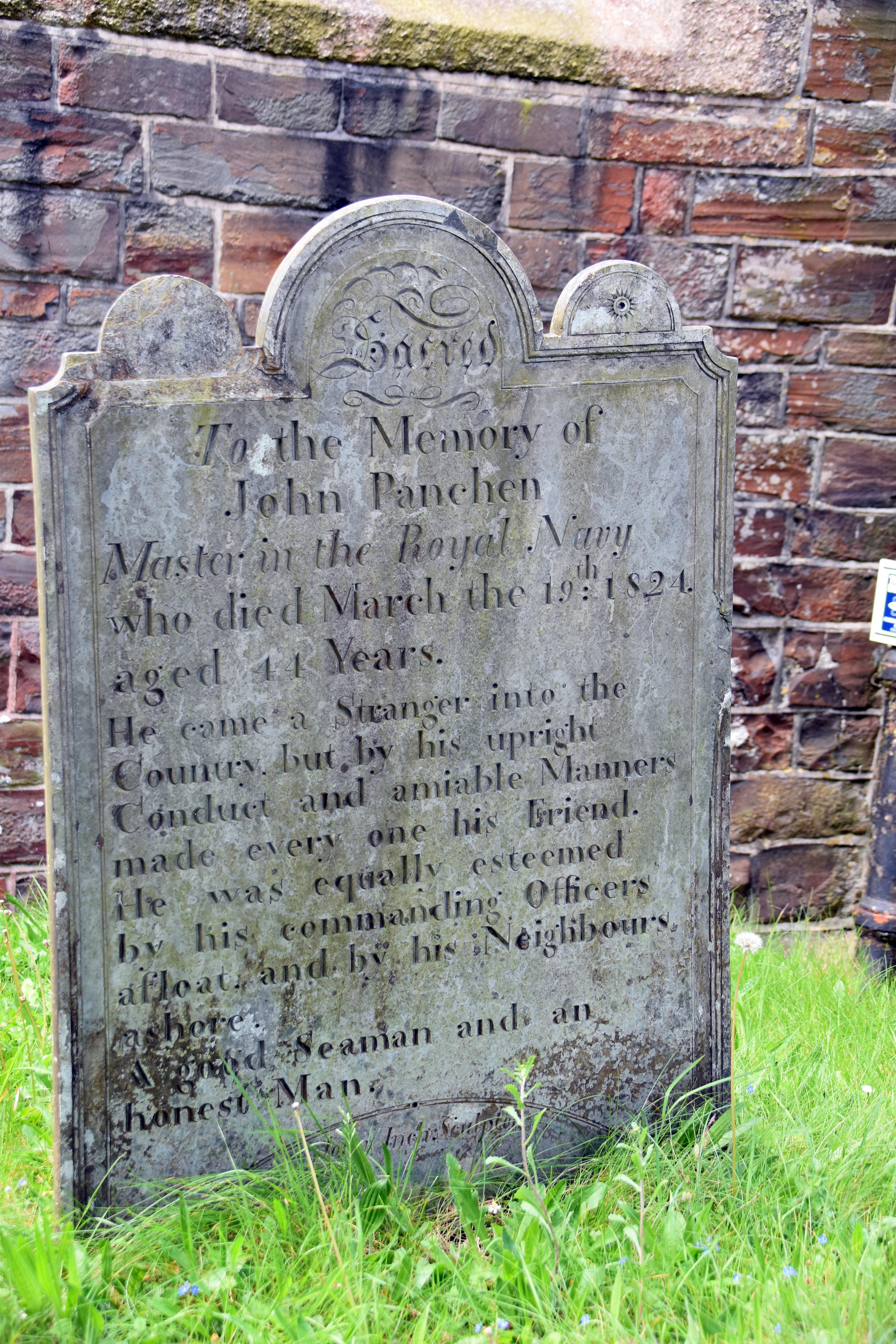
The grave of John Panchen, Master in the Royal Navy, stands in a prominent position just outside St Andrew’s Church, Stratton. The headstone records his death on 19 March 1824 at the age of 44 and preserves a rare, detailed assessment of his character and career. The full inscription reads: “To the Memory of John Panchen Master in the Royal Navy who died March 19th 1824 aged 44 years. He came a Stranger into the Country but by his upright conduct and amiable manners made every one his friend. He was equally esteemed by his commanding officers afloat and by his neighbours ashore. A good seaman and an honest man.” The wording provides almost all that is known about him, but it is sufficient to place him within the wider context of the late‑eighteenth and early‑nineteenth‑century Navy and the local community that received him.
The description of Panchen as a “stranger” indicates that he was not native to Stratton or the immediate district. The Royal Navy of the Napoleonic period drew men from across Britain, Ireland and the wider empire, and the reference to his arrival in the country suggests that he may have come from overseas. The Navy was relatively colour‑blind in its treatment of professional seamen, particularly warrant officers and masters, whose technical skills were essential to the running of a ship. Advancement depended heavily on competence and reliability rather than origin, and Panchen’s rank as Master implies long service, proven seamanship and the trust of his commanding officers.
The inscription emphasises that he was “equally esteemed by his commanding officers afloat and by his neighbours ashore”. This pairing underlines the continuity between his naval and civilian reputations. At sea he would have been responsible for navigation, the handling of the ship, and the day‑to‑day management of the deck department. Ashore, in a small Cornish community, he appears to have been judged by the same standards of reliability and conduct. The phrase “a good seaman and an honest man” is concise but telling, combining professional competence with personal integrity in a way that would have been readily understood by contemporaries.
After the end of the Napoleonic Wars many naval officers and warrant officers found themselves on half‑pay or retired, seeking employment in civilian roles that could make use of their maritime and organisational experience. Local tradition suggests that Panchen worked on the Bude Canal after leaving the Navy. The canal, constructed to bring sea sand inland for agricultural use, required men familiar with water transport, logistics and the management of labour. A former naval master would have been well suited to such work, and his presence in Stratton fits the pattern of naval personnel settling in coastal and near‑coastal communities after the wars.
The inscription also hints at health problems in his later years. The suggestion that illness was an issue, and that he may not have been used to the local climate, is consistent with the experience of men who had spent long periods in different environments and then returned to the damp, variable weather of the south‑west. His death at 44 was early even by the standards of the time, but not unusual for someone whose working life had included hard service at sea and exposure to disease in crowded ships and foreign stations.
The location of his grave, close to the church and in a prominent position, indicates the regard in which he was held by the parish. Burial space in such locations was limited and generally reserved for those of status or particular local standing. For a man described as a stranger to be buried there suggests that any initial difference of origin was outweighed by his conduct and contribution to the community. The stone therefore records not only an individual life but also the capacity of a small Cornish town to absorb and value an incomer whose background lay in the wider world of the Royal Navy.
John Panchen’s grave is thus a small but significant piece of evidence for the social history of the Navy and of Stratton. It shows how a naval professional could move from warship to canal, from global service to local employment, and how reputation built at sea could translate into respect ashore. The inscription preserves the judgement of his contemporaries in plain language and provides a rare, personal link between the parish churchyard and the maritime history of the early nineteenth century.

