

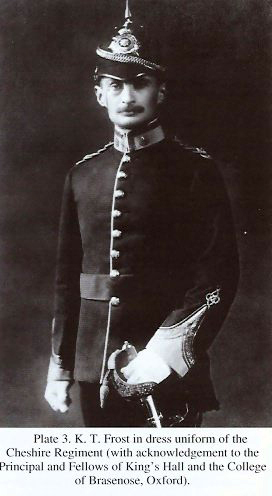
Among the memorials in the Parish Church of St Peter, St Paul & St Thomas of Canterbury, one name stands out for the extraordinary breadth of the life behind it: Lieutenant Kingdon Tregosse Frost, scholar, archaeologist, lecturer, and one of the earliest British officers to fall in the First World War. His memorial in the church is modest, but the story it represents is anything but. Frost’s life bridged the worlds of classical scholarship and military service, and his death — long misrecorded, and his grave unidentified for nearly eighty years — is one of the most poignant narratives connected with the parish.
Frost was born on 12 March 1877 in Launceston, Cornwall, the eldest son of Denis Tregosse Frost, a solicitor, and Sophia Margaret Frost. He grew up with two younger brothers and received an education that reflected both family ambition and his own intellectual gifts. After schooling in Bath, he went on to Brasenose College, Oxford, where he was a Junior Hulme Exhibitioner. He took his BA in 1900, MA in 1905 and Lit. B. in 1907. His academic promise was quickly recognised. From 1900 to 1901 he studied at the British School at Athens, and between 1902 and 1904 he taught at Isleworth Training College.
His early career took him far from home. Between 1904 and 1905 he worked in Egypt with the pioneering archaeologist Sir Flinders Petrie, and in 1905 he was elected a Fellow of the Royal Geographical Society. He then served in the Egyptian Ministry of Education before returning to England to work at the Bodleian Library. In 1909 he became Lecturer in Archaeology and Ancient History at Queen’s University, Belfast — a post he held until the outbreak of war. He also took part in excavations at Haraga shortly before 1914, and objects from that dig later found their way into Worcester Museum, donated by a Miss D. M. Frost, almost certainly a relative.
Frost’s scholarly interests were wide-ranging. In 1909 he co‑authored a catalogue of Roman coins for the University of Tasmania, and in the same year he published an article in the Journal of Hellenic Studies proposing that Minoan Crete was the Atlantis described by Plato — the first scholar to make that argument. He travelled widely across the Sinai peninsula and the ruined cities east of Jordan, and was said to be equally at home “under the suns of Syria and among the snows of the Caucasus.” Professor Henry of Queen’s University later wrote that Frost was “a brilliant lecturer in archaeology and ancient history,” and his death was felt as a personal loss to the university as well as to the wider academic world.
But like so many of his generation, Frost’s life was overtaken by war. A keen member of the Queen’s University Officers’ Training Corps, he was commissioned into the 3rd (Special Reserve) Battalion of the Cheshire Regiment in 1913. When war broke out in August 1914, he was recalled as a reserve officer and attached to ‘C’ Company of the 1st Battalion. He landed in France on 16 August — one of the earliest British officers to reach the front.
He was killed just eight days later, on 24 August 1914, during the desperate fighting at Audregnies. The action was chaotic, ammunition was running low, and units were struggling to hold their positions. Frost volunteered to identify a body of troops seen moving on the flank — a task requiring both courage and clarity under fire. He did not return. A wounded officer of the 4th Dragoon Guards later reported seeing him “fighting like a demon, having refused to surrender.” Wounded several times, he continued resisting until he was killed. He was twenty‑five years old.
For decades, Frost’s fate remained uncertain. He was listed as missing, then presumed dead. The Commonwealth War Graves Commission recorded his death as 4 September, and his name was inscribed on the La Ferté‑sous‑Jouarre Memorial to the Missing. His grave, meanwhile, lay in Wiheries Communal Cemetery, marked only as “Unknown British Officer 1914.” It was not until the 1990s that researcher Alan Gregson, through painstaking comparison of burial returns and battlefield reports, identified the grave as Frost’s. On 24 August 1994 — exactly eighty years after his death — a new headstone bearing his name was unveiled, though it still carries the cautious phrase “Believed to be.”
Frost’s family placed a memorial to him in the Parish Church of St Peter, St Paul & St Thomas of Canterbury, linking his story to the life of the town. The church contains many memorials to local families, but Frost’s stands apart for the sheer range of the life it commemorates: a gifted scholar, a Fellow of the Royal Geographical Society, a lecturer in ancient history, an excavator in Egypt, a writer on Plato and Atlantis — and a young officer who died in the first days of a war that would reshape the world.


