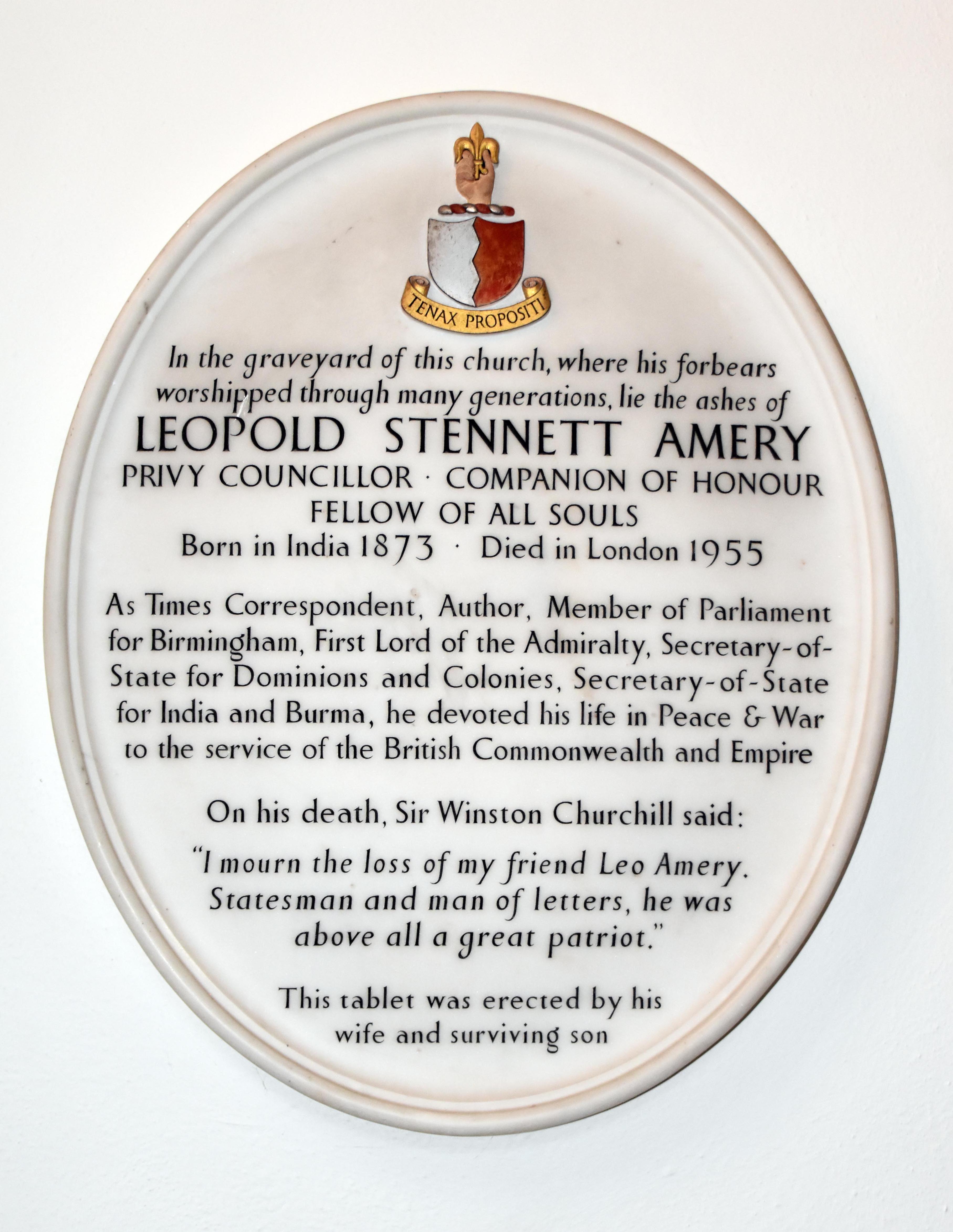
Leopold Stennett Amery was born on 22 November 1873 in Gorakhpur, British India. His father, Charles F. Amery, worked for the Indian Forest Department and maintained the family home at Middle Coombe, Lustleigh. His mother, Elizabeth Leitner, was Hungarian and from a noted Jewish scholarly family. The Amerys had been connected to the area since the seventeenth century, descending from Nicholas Amery of Bridford. Lustleigh remained the family’s anchor, and it is where Leo chose to be commemorated.
At Harrow School Amery was academically outstanding and physically formidable. He was known as “The Pocket Hercules”, excelling in boxing, cross‑country running and gymnastics. He and Winston Churchill were contemporaries; Churchill once pushed Amery into a swimming pool, and Amery immediately retaliated. Both boys were inspired by Edward Whymper’s mountaineering lecture at the school, though only Amery pursued climbing seriously.
Amery left Harrow in 1892 with multiple scholarships, entering Balliol College, Oxford, where he took a first in Classics. His father had abandoned the family and fled to America, leaving Amery financially dependent on scholarships. He possessed exceptional linguistic ability, speaking English, Hindi, French, German, Italian, Bulgarian, Turkish, Serbian, Hungarian and Arabic.
His introduction to mountaineering came at Christmas/New Year 1891–92 when Harrow master R. C. Gilson took him to Wasdale Head. His first climbs were Deep Ghyll and routes on Pillar Rock. Soon after, O. G. Jones invited him to attempt Oblique Chimney on Great Gable’s Ennerdale face. Conditions were severe: ice, fresh snow, darkness and a badly cut hand. Jones led the chimney with great skill; Amery followed. They descended in a blizzard via Windy Gap and Sty Head. Amery later wrote: “How we managed to avoid broken limbs has ever been a mystery.”
Amery’s first Alpine season was in 1894, climbing the Rothorn, Weisshorn, Dent Blanche and Matterhorn. In 1895 he climbed in the Göschener Alps, making high‑level traverses. Over the next two decades he climbed in Zermatt, Arolla, the Dolomites, the Drakensberg, Canada, New Zealand and the North Albanian Alps. He completed major classics including the Zmutt Ridge on the Matterhorn, the Cima Grande, the Gletschhorn, Aiguille de la Za and the Vajolet Towers. He took up skiing in 1904 and later became President of the Ski Club of Great Britain.
His mountaineering career included incidents beyond climbing. In Albania he struck an official who had physically pushed him, using an umbrella. Amery then secured an official apology through diplomatic pressure. In 1907 he was invited by Tom Longstaff to join the first planned Everest expedition, though the India Office blocked the attempt.
After Oxford he became a Fellow of All Souls, then moved into journalism with the Manchester Guardian and later The Times, organising war correspondence during the Boer War. He refused editorships of both the Observer (1908) and The Times (1912), choosing instead to pursue politics. He contested seats in Wolverhampton and Bow and Bromley before being elected MP for Birmingham South (later Sparkbrook) in 1911, a seat he held until 1945.
During the First World War Amery served in Flanders and the Near East (1914–1916), then became Assistant Secretary to the War Cabinet and Imperial War Cabinet (1917). He served on the staff of the War Council at Versailles and on Lord Milner’s personal staff. He was author of the final draft of the Balfour Declaration, committing Britain to establishing a “Jewish National Home” in Palestine. He later became First Lord of the Admiralty (1922) and Secretary of State for the Colonies and Dominions (1924), which included responsibility for the Palestine Mandate.
Out of government after 1929, Amery climbed Mount Amery (3329m) in Canada in 1930 with Ed Feuz and Brian Meridith. During the 1930s he held directorships, including with German metal firms, giving him insight into German rearmament. He met Hitler and Mussolini, concluding that confrontation with fascism was inevitable. In 1938, aged 64, he climbed in the Julian Alps, including the Slovene Route on Triglav and Kugy’s Route on Skrlatica.
Amery played two decisive roles in Parliament. In 1939, during the fall of Poland, he urged Arthur Greenwood to “Speak for England”. In the 1940 Norway Debate he attacked Chamberlain’s government, quoting Cromwell: “You have sat too long here for any good you have been doing. Depart, I say… In the name of God, go!” Chamberlain resigned soon afterwards and Churchill became Prime Minister. Amery’s intervention was one of the decisive parliamentary blows that made this change unavoidable.
During the war Amery served as Secretary of State for India. He and Churchill had long disagreed over Indian policy, yet remained friends. Amery declared that Churchill knew as much about India “as George III did of the American colonies”. Churchill once said that if Amery had been “two inches taller and his speeches half as long he might have been Prime Minister”. Despite disputes, Churchill wrote warmly to him as late as 1945 while Amery was President of the Alpine Club.
Amery became Alpine Club President in 1944 and was involved in the formation of the British Mountaineering Council. His papers show extensive correspondence with leading climbers and administrators, including Colonel Strutt, Arnold Lunn, Graham Brown and others. He continued climbing into his seventies, visiting Switzerland regularly.
His later years were overshadowed by the treason of his son John Amery, who broadcast for Nazi Germany and attempted to recruit POWs. John was captured in 1945, pleaded guilty at the Old Bailey and was executed. Leo and his younger son Julian attempted unsuccessfully to secure clemency.
Amery lost his seat in 1945 and declined a peerage. He was made a Companion of Honour. He died in September 1955. His memorial in Lustleigh Church records Churchill’s tribute to him as a patriot, linking a major imperial and wartime figure back to the Dartmoor parish where his family had lived for centuries.