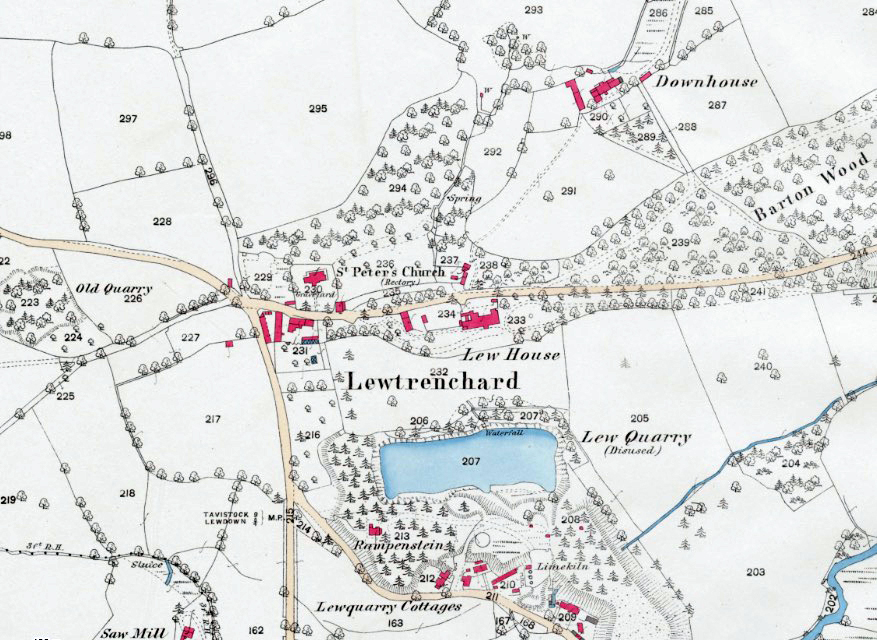
Lewtrenchard is a small village and civil parish in West Devon, lying on the northern slopes of the valley of the River Lew. The parish name preserves two distinct elements: “Lew”, recorded as a manor in Domesday Book, and “Trenchard”, taken from the medieval lords of the manor in the thirteenth century. The settlement never grew into a town, but its position between Okehampton and Launceston, and later on the main Exeter–Launceston road, gave it a modest through‑traffic and a local market function. Much of the modern village of Lewdown, strung out along the former turnpike and later the A30, lies within the historic bounds of Lewtrenchard parish.
Lewdown itself developed as a roadside settlement on the turnpike, with inns, cottages and small businesses serving travellers and the surrounding farms. For many years it held a cattle fair on the Wednesday before the third Thursday in April, drawing stock and dealers from the neighbouring parishes of Marystowe, Thrushelton and Coryton. Administratively, Lewdown was divided between those parishes, but in practice it formed a single linear village whose economic life was closely tied to Lewtrenchard. The eventual bypassing of Lewdown in the early 1990s, when a new dual carriageway A30 was driven to the north, ended the constant flow of through‑traffic that had shaped its character since the coaching era.
The parish church of St Peter stands slightly apart from the main road, close to the manor and the wooded valley. It was originally dedicated to St Petroc and, in architectural terms, is a modest West Devon church with a granite ashlar upper tower and a series of carved bench ends comparable to those in many Cornish churches. These bench ends had been displaced by deal box‑pews installed by an earlier generation, but were restored to their proper positions in the later nineteenth century. The interior now presents a layered record of local piety and family history, with monuments from the seventeenth to the nineteenth centuries commemorating members of the Gould and Baring‑Gould families.
The long incumbency of Sabine Baring‑Gould in the late nineteenth and early twentieth centuries left a particularly strong mark on both church and village. Already in holy orders and a prolific writer, he inherited the Lewtrenchard estate in 1872 and, on the death of his uncle Charles Baring‑Gould, was able to present himself to the living in 1881. As “squire‑parson” he restored St Peter’s, re‑ordered the interior, reinstated the bench ends and introduced new fittings. The present rood screen, carved by the Pinwill sisters and completed in 1915, was designed to resemble the screen installed in 1523–24 and carries twenty‑three painted panels, eleven depicting scenes from the life of Christ and twelve showing Westcountry saints, executed by his daughter Margaret (“Daisy”) Baring‑Gould.
Other furnishings reflect his taste for continental religious art. Above the altar hangs a copy of the “Adoration of the Magi” by the Swiss painter (Melchior‑)Paul von Deschwanden, whose work he admired; another version of the same composition is in Fribourg. In the chancel is the effigy of Beatrice Gracieuse Baring‑Gould, who died in 1876 aged three, carved in 1879 by Knittel of Fribourg and brought to Lewtrenchard as part of his wider programme of restoration. Earlier Gould and Baring‑Gould monuments from Staverton were also transferred to St Peter’s, so that the church now serves as a consolidated memorial space for the family as well as the parish.
The wider landscape of the parish contains other features of note. Below the church, in what is now known as the Forgotten Garden of Lewtrenchard, lies a Holy Well covering a spring that feeds a small pool. The earliest surviving reference to it is an entry in the parish register for 1830 by the curate Caddy Thomas, recording that the “Holy Well behind the church has been re‑erected and formerly its water was used for the font”. The structure has been restored in recent years and forms part of a network of paths and garden features laid out in the nineteenth century and later overgrown. The valley of the Lew, with its woods and watercourses, provided both practical resources and a romantic backdrop to the manor and church.
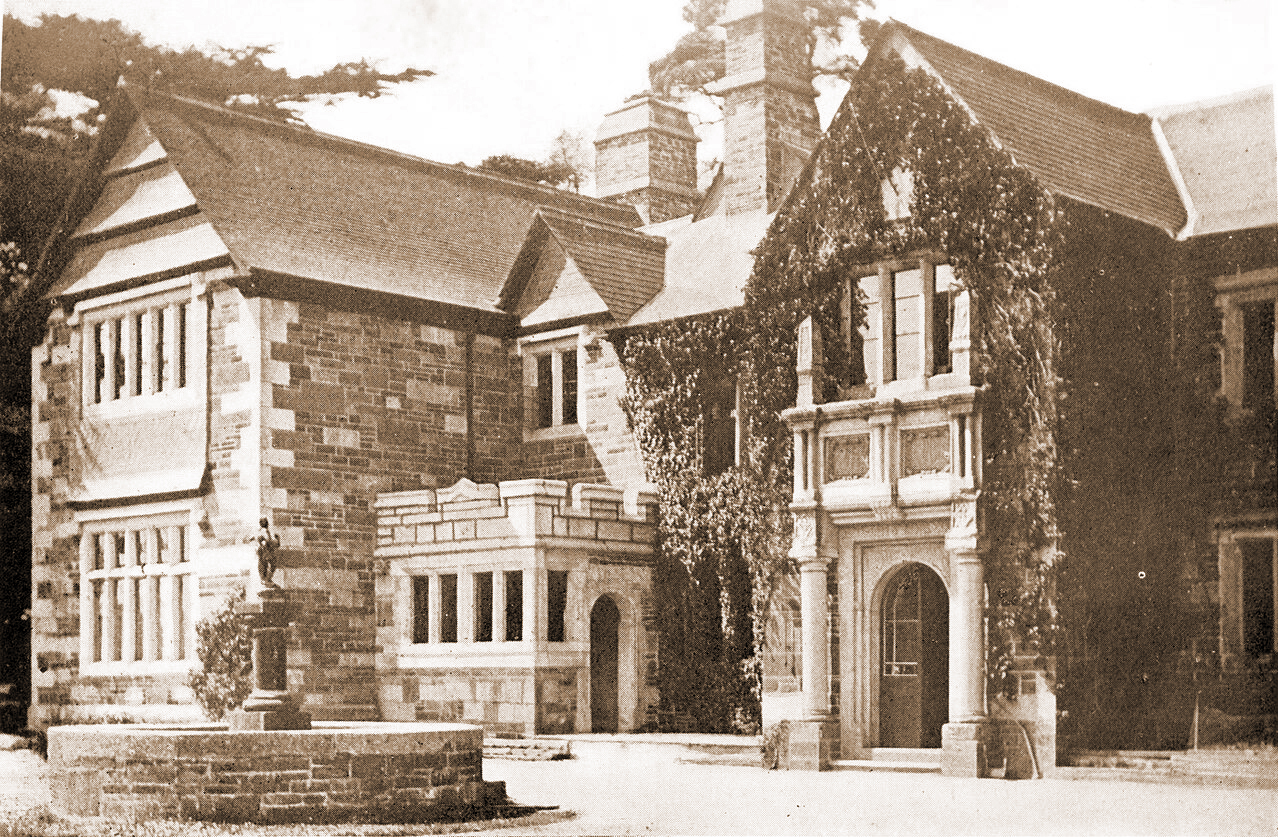
Lew House, often called Lewtrenchard Manor, stands close to the church and was substantially rebuilt in the early seventeenth century, a datestone giving 1620. In the Victorian period Sabine Baring‑Gould altered it extensively, adding wings, staircases and decorative work to create a house that matched his idea of a Jacobean manor. As squire he managed an estate of some 3,000 acres, including farms, cottages and woodland. The house has since been preserved largely in the form he gave it and now operates as a hotel, but it still reads as the centre of the old parish community, visually linked to the church and the valley.
The parish economy was never large, but it was varied. A manganese mine in the parish once produced around 10,000 tons per annum, providing employment and a modest industrial element in an otherwise agricultural landscape. Lew Trenchard School was founded in 1842, reflecting the mid‑nineteenth‑century concern with elementary education and the role of the Church of England in providing it. Farms, smallholdings and estate cottages formed the bulk of the settlement pattern, with Lewdown acting as the main roadside focus for shops and services.
Administratively, Lewtrenchard has been drawn into wider groupings as local government has been reorganised. It now forms part of the Lewdown Group of parishes, along with Coryton, Marystowe and Thrushelton, within the Ward of Bridestowe in the West Devon district. Parish registers for Lewtrenchard survive from 1706 and are held at the Devon Record Office, providing a continuous record of baptisms, marriages and burials over three centuries. Together with the surviving buildings, memorials and landscape features, they allow the history of this small West Devon parish to be traced in some detail from the medieval manor of Lew to the present‑day village and its surroundings.