Few novels achieve greatness with so little apparent effort as J. L. Carr's A Month in the Country . Published in 1980, the book is barely more than one hundred pages long, yet it is frequently regarded as one of the finest British novels of the twentieth century. On the surface very little happens. A damaged First World War veteran spends a summer uncovering a medieval wall painting in a Yorkshire church whilst an archaeologist excavates a nearby field. Yet beneath this simple premise lies an extraordinary meditation on memory, friendship, loss and the fleeting nature of happiness.
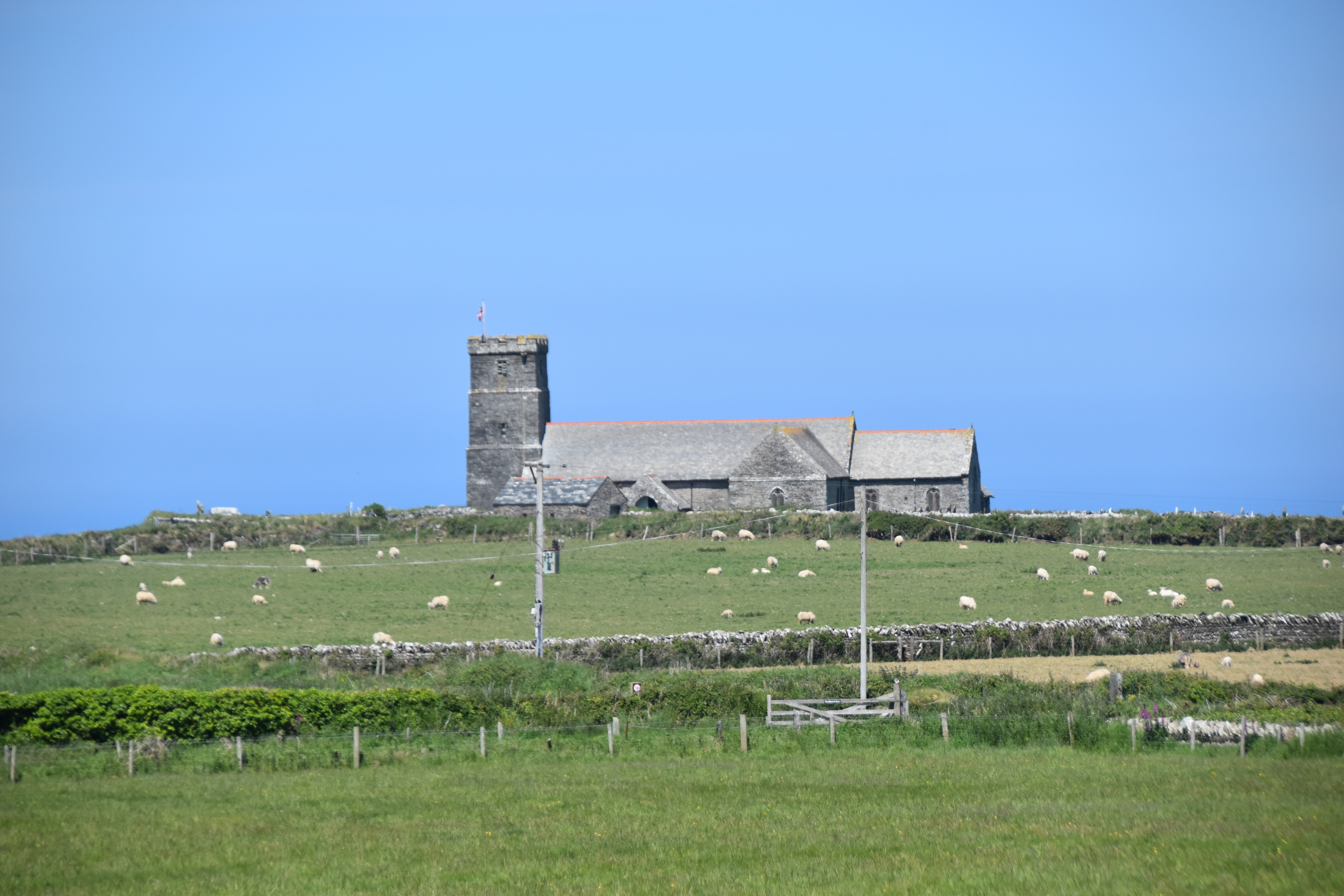
The novel also possesses an unexpected connection with Tintagel. The dust jacket of the first edition featured a photograph of St Materiana's Church standing isolated against the Cornish landscape. At first glance this might seem an odd choice for a novel set in Yorkshire. However, the connection becomes clearer when one examines the origins of the story and the historical discoveries taking place around Tintagel during the years in which Carr was developing his ideas.
In the 1950s excavations took place in the field immediately north of St Materiana's Church. Archaeologists discovered an early Christian cemetery containing unusual burials together with evidence for a sixth-century ecclesiastical enclosure and associated structures. The discoveries attracted considerable interest and discussion at the time. Questions were raised about the identity of those buried there and about the nature of the early Christian community connected with Tintagel's Dark Age settlement.
These discoveries appear to have helped inspire one of the novel's central themes. In A Month in the Country , the archaeologist Charles Moon is engaged in excavating a mysterious medieval grave outside the churchyard. As with the discoveries at Tintagel, the excavation becomes about more than simply recovering human remains. It is a search for the stories of forgotten people who once lived, worshipped and died in a particular landscape.
The choice of St Materiana's for the first edition cover therefore seems highly appropriate. The church stands on a site where archaeology, memory and the passage of time intersect in precisely the way Carr explores throughout the novel. Just as Carr's characters uncover traces of the past hidden beneath layers of soil and whitewash, archaeologists at Tintagel were revealing evidence of an earlier Christian world hidden beneath the fields surrounding the church.
The novel is set during the summer of 1920. Its narrator, Tom Birkin, is a veteran of the First World War who arrives in the rural village of Oxgodby to restore a medieval wall painting concealed beneath centuries of limewash. Although Carr never uses the term directly, modern readers quickly recognise that Birkin is suffering from what would now be described as post-traumatic stress disorder. He bears both physical and psychological scars from his wartime experiences and finds himself abandoned by an unfaithful wife.
The restoration work gradually becomes a form of healing. As Birkin removes the layers covering the medieval painting, he slowly begins to recover a sense of purpose and self-worth. The church becomes both a workplace and a sanctuary. Carr is careful never to make this process sentimental. Recovery comes through routine, meaningful work, companionship and immersion in a supportive community rather than through any dramatic revelation.
Another important figure is Charles Moon, the archaeologist excavating a grave in a nearby field. Like Birkin, he is quietly burdened by memories of the war. The friendship that develops between the two men forms one of the emotional centres of the novel. Their shared experiences are often implied rather than stated openly, which gives much of the book its emotional power.
Part of the novel's enduring appeal lies in Carr's extraordinary economy of language. He reveals character through small observations, brief conversations and seemingly insignificant incidents. Entire lives are sketched in a handful of lines. Landscapes are described with just enough detail to make them vivid without becoming overwrought. The result is a book that feels far larger and richer than its modest length would suggest.
The church itself is central to the story. The medieval mural that Birkin uncovers depicts the Last Judgement, a subject common in medieval churches but largely hidden or destroyed following the Reformation. Carr uses the painting not merely as an archaeological curiosity but as a symbol of lost worlds gradually emerging into view. The village church becomes a repository of memory in much the same way that St Materiana's preserves traces of Roman Cornwall, Norman craftsmanship, medieval devotion and more recent generations whose memorials line the walls.
In 1987 the novel was adapted for the cinema in a film directed by Pat O'Connor. The adaptation has acquired a devoted following and is widely regarded as one of the finest literary films produced in Britain during the late twentieth century.
The casting now appears particularly remarkable. Tom Birkin was played by a young Colin Firth in his first leading film role. Charles Moon was portrayed by Kenneth Branagh in his first feature film appearance. Both actors would subsequently become major figures in British cinema and theatre, but at the time neither possessed the public profile they would later achieve.
The film remains remarkably faithful to the tone of Carr's novel. Rather than attempting to manufacture drama, it embraces the quiet rhythms of rural life and the gradual growth of friendship between damaged individuals. The Yorkshire landscape is photographed beautifully and much of the film's emotional impact comes from moments of silence, reflection and observation rather than overt action.
One of the adaptation's greatest strengths is its understanding that A Month in the Country is fundamentally a story about time. The narrator recalls the events decades after they occurred, recognising that the summer of 1920 represented a brief period of contentment that could never be recaptured. Like the medieval mural beneath the whitewash or the grave concealed beneath the soil, the memories remain vivid but belong to a world that has vanished.
This theme helps explain why the novel resonates so strongly with places such as St Materiana's Church. Both the church and Carr's story concern the traces left behind by earlier generations. Whether those traces consist of a medieval painting, an ancient grave, a Roman inscribed stone or a weathered memorial, they remind us that landscapes accumulate human stories over centuries. Most eventually fade from memory. Occasionally, through archaeology, restoration or literature, they briefly re-emerge into view.
For visitors to St Materiana's, the connection adds an additional layer of interest to an already remarkable site. The church is linked not only to the legends of Arthur and Tristan, nor solely to the history of Tintagel's early Christian community, but also to one of modern Britain's most admired novels. The appearance of St Materiana's on the first edition dust jacket was therefore more than a picturesque choice. It provided a visual link between Carr's themes of memory, archaeology and rediscovered lives and one of the places that helped inspire them.