

The Newman family originated as merchants at Dartmouth, where they were active from the fifteenth century onwards. Their commercial interests included the Newfoundland fish trade, the shipment of fish to Portugal, the importation of wine from Portugal to England, and the operation of privateers based at Dartmouth. They maintained premises and warehouses in Viana do Castelo and Oporto, and their business extended to shipping and the supply of provisions to Wellington’s army during the Peninsular War.
The scale of these activities created the family fortune from which later land purchases were made. Their Newfoundland operations included fish factories and plantations, while their Portuguese connections supported the wine trade. By the early nineteenth century the family had established a substantial mercantile network linking Dartmouth, Newfoundland and Portugal, and it was from this background that the Coryton branch emerged.
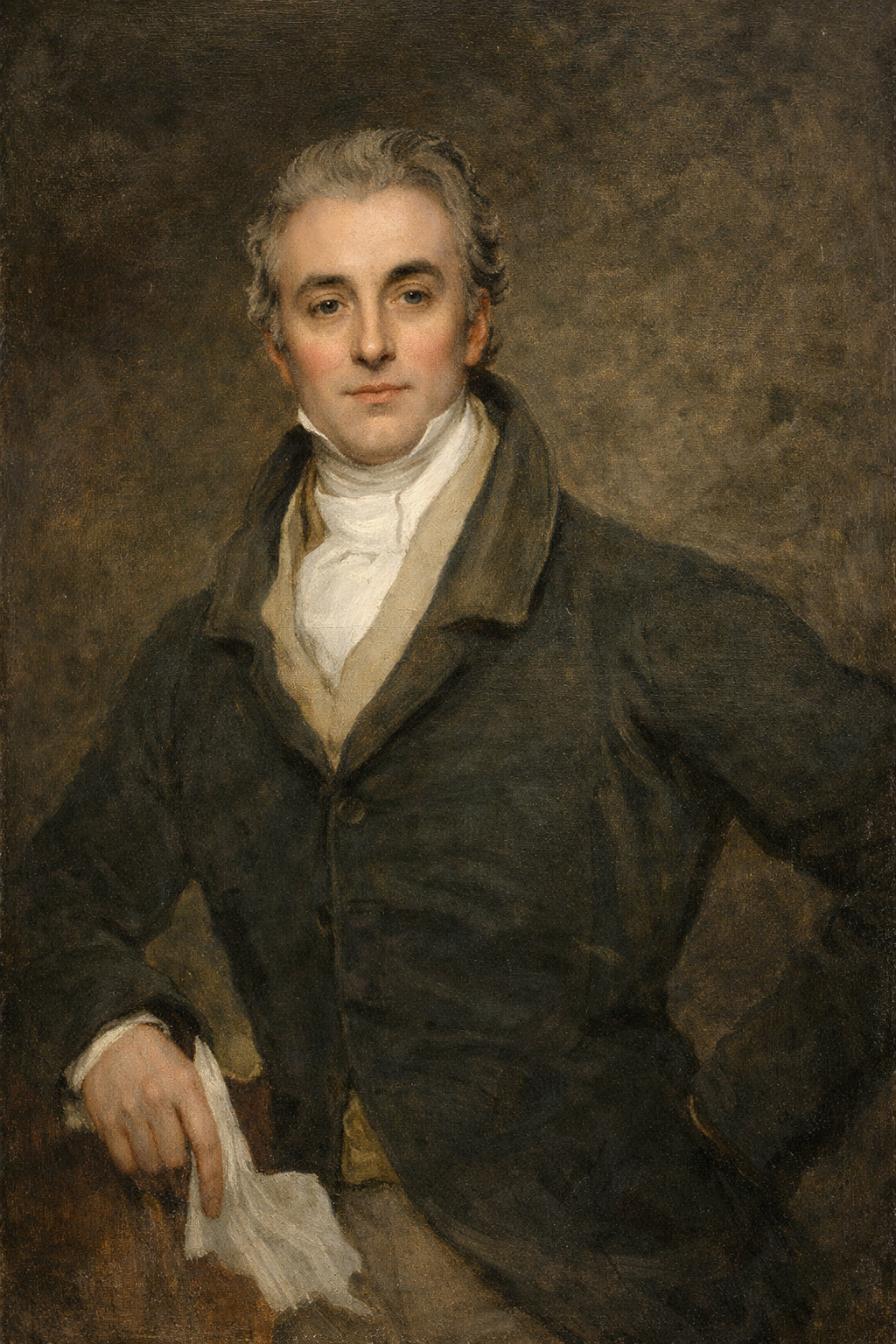
In 1809 the Coryton estate near Tavistock was purchased by Lydston Newman, one of the senior members of the Dartmouth family. On his death in 1829 the estate passed jointly to his nephews, Sir Robert William Newman, 1st Baronet, and his brother Thomas Newman. Sir Robert’s portrait is therefore connected to Coryton through inheritance, although his principal residence was at Mamhead. The later Coryton Newmans descend from this line and became the resident family on the estate.
The Coryton branch established itself locally during the nineteenth century. Members of the family lived on the estate, managed its lands and were involved in parish affairs. Their presence is recorded in memorials, stained glass and documentary sources, including Thomas Newman’s volume The History of Coryton (1940), which provides an account of the parish and the family’s role within it.
St Andrew’s Church contains several phases of work associated with the Newmans. In the 1840s additions were made to the medieval structure, including a south porch, a north transept and a probable vestry. These works reflect the early period of the family’s residence at Coryton following the inheritance of the estate.
In 1885 a major restoration was carried out with Newman support. The north transept was replaced by a two‑bay north aisle constructed over the family vault, and a date plaque with the Newman arms was installed. A new chancel arch in the Early English style was built in polyphant stone, and a matching polyphant arcade was added on the north side of the nave. New roofs were provided for the nave and aisle, and the chancel received a ribbed roof with carved bosses. Benches and a pulpit with blind tracery were installed, and the earlier commandment boards were retained at the east end of the aisle. A brass to Thomas Newman, dated 1894, was fixed to the north wall.
Several stained glass windows commemorate members of the family. Two windows in the north aisle, signed Kempe and Tower, commemorate Elizabeth Newman (d. 1909). A nave window by Kempe commemorates Ralph Newman (d. 1896). The east window, also by Kempe, commemorates Lionel Newman (d. 1902). These windows form a record of the later nineteenth‑century members of the Coryton branch.
The Newman family’s involvement at Coryton is therefore documented through the purchase and inheritance of the estate, their residence in the parish, their support for the nineteenth‑century alterations to St Andrew’s Church, and the memorials and stained glass associated with them. Their origins in the Dartmouth merchant community and their connection with the Newfoundland–Portugal trade provide the wider context for their establishment in West Devon.

