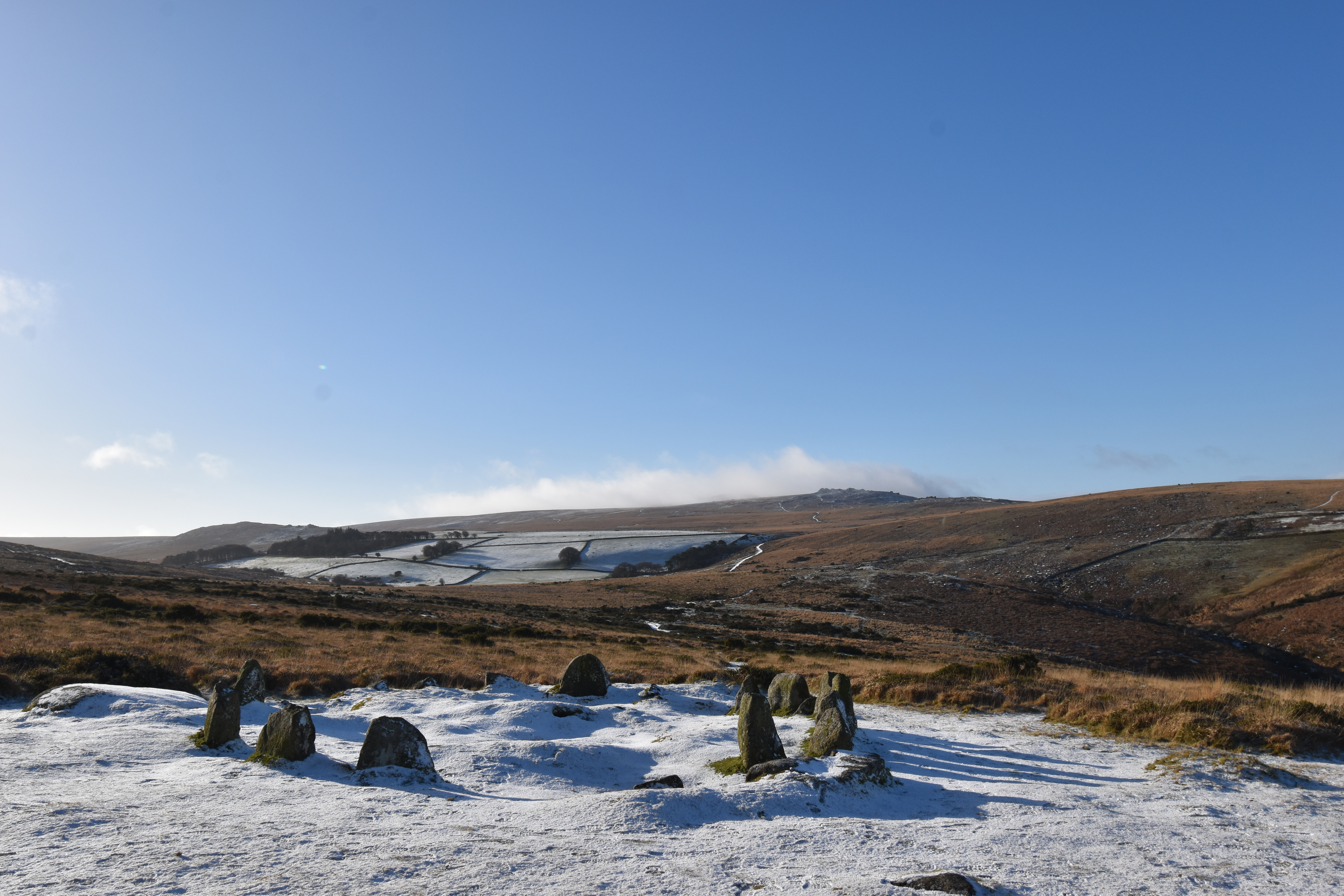
The Nine Maidens stone circle above Belstone is one of the most discussed prehistoric sites on the northern edge of Dartmoor, not because it is large or elaborate, but because it is unusually complete for a small moorland ring and because so many different explanations have been attached to it over the years. The circle consists of a tight ring of small granite uprights, most of them little more than knee‑high, set on a slight rise with open views towards Cosdon and the Taw valley. Its modest scale has never stopped people from speculating about its purpose, and over time a whole set of theories has grown up around it, ranging from the archaeological to the folkloric.
The most straightforward explanation is the archaeological one: that the Nine Maidens is a Bronze Age ceremonial circle, part of the wider pattern of ritual and funerary monuments that spread across Dartmoor between roughly 2200 and 1500 BC. In this view the circle is one of many small rings that marked places of gathering, commemoration or seasonal observance. Its size is typical of the region, and its position on a slight plateau fits the pattern of circles placed where they could be seen from a distance. Some archaeologists have suggested that the ring may once have been associated with a cairn or a burial feature, now lost or eroded, and that the stones served as a boundary or focus for ritual activity.
A related theory proposes that the circle functioned as a kind of territorial marker. Dartmoor in the Bronze Age was a landscape of small, enclosed farmsteads, reaves, and grazing territories. Stone circles may have acted as neutral meeting points between communities, or as markers of shared land. The Nine Maidens sits close to the watershed between the Taw and the East Okement, and some have argued that it marks a boundary between prehistoric territories. This idea is supported by the presence of other ritual features in the area, including the nearby stone rows and cairns on Cosdon.
Another line of interpretation focuses on astronomy. Some researchers have suggested that the circle may have been aligned with particular solar or lunar events, such as midsummer sunrise or midwinter sunset. The problem is that the stones are too low and the circle too small to provide clear sightlines, and the surrounding tors complicate any attempt to identify deliberate alignments. While it is possible that the builders were aware of seasonal changes in light and shadow, there is no strong evidence that the Nine Maidens was constructed as an astronomical observatory. Most modern archaeologists treat this theory with caution.
The most enduring explanation, at least in local memory, is the folkloric one: that the stones are a group of maidens turned to stone for dancing on the Sabbath. This story appears in several versions across Dartmoor and Cornwall, and the Belstone circle fits the pattern neatly. The number “nine” is traditional rather than literal; the circle actually contains more stones than that, but the name has stuck. In some tellings the maidens were accompanied by a fiddler, who was also petrified and now stands as a lone stone some distance away. In others the maidens were punished for dancing to the devil’s tune. These stories are not ancient, but they reflect the way rural communities explained the presence of prehistoric monuments long after their original purpose had been forgotten.
A variation on the folkloric theme suggests that the circle was a place of supernatural danger. Some nineteenth‑century writers claimed that the stones were “restless” and that their number could never be counted the same way twice. Others said that the circle was haunted by the spirits of the maidens, or that the stones moved at night. These tales belong more to Victorian romanticism than to genuine tradition, but they show how the site captured the imagination of visitors long before archaeology provided more sober explanations.
Another theory, less common but still occasionally mentioned, is that the Nine Maidens served as a meeting place for early medieval or later gatherings, perhaps even as a moot site. There is no evidence for this, but the idea persists because the circle is close to long‑used routes across the moor and because stone circles elsewhere in Britain were sometimes reused by later communities. If this happened at Belstone, it has left no trace, but the possibility cannot be entirely dismissed.
A more speculative suggestion is that the circle was part of a wider ritual landscape connected to water. The Taw rises only a short distance away, and some researchers have argued that prehistoric communities placed ceremonial monuments near the sources of rivers as part of a belief system that linked water, fertility and the ancestors. The Nine Maidens’ position above the young Taw fits this pattern, though the evidence is circumstantial.
Finally, there is the simple idea that the circle may have served multiple purposes over time. Prehistoric monuments were not static; they were reused, reinterpreted and reshaped by successive generations. The Nine Maidens may have begun as a ceremonial ring, later taken on territorial significance, and eventually become the focus of folklore. Its meaning would have shifted as the landscape around it changed, and as the people who lived on the moor found new ways to explain the stones.
In the end, no single theory can fully explain the Nine Maidens. The archaeological evidence points to a Bronze Age ceremonial function, but the circle’s modest size and exposed position leave room for other interpretations. What is clear is that the site has held meaning for more than three thousand years, from the people who first set the stones upright to the villagers and visitors who still walk up to the ring today. The theories themselves are part of the story: each one reflects a different way of understanding the landscape, and together they show how a small circle of stones can carry a surprising weight of history, imagination and memory.