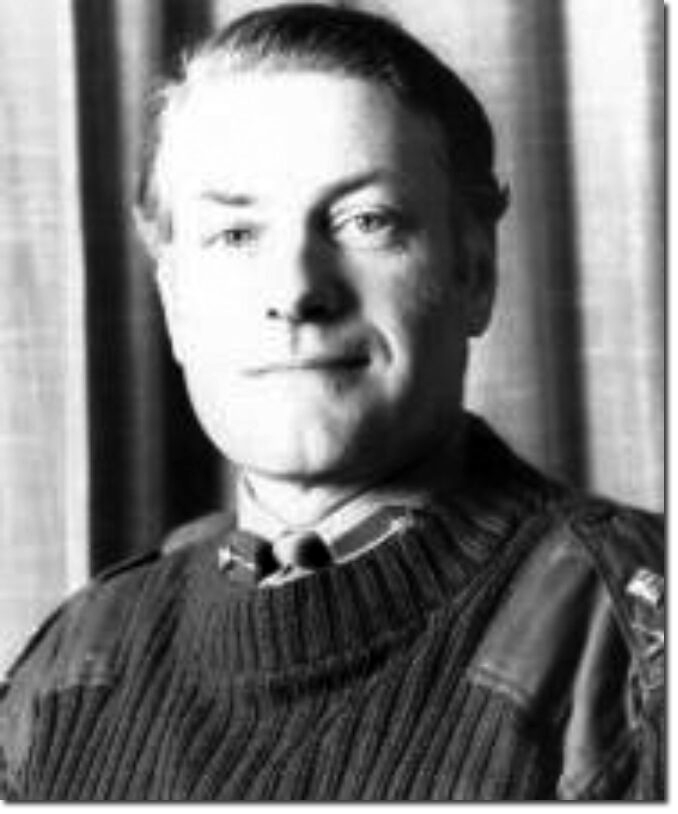
Peter John Hall Leng was born in Sunderland in 1925 and educated at Bradfield College. He was commissioned into the Scots Guards in 1944 and joined the 2nd Battalion in the Guards Armoured Division during the final advance into the Netherlands and Germany. In April 1945 he received an immediate Military Cross for determination and leadership at Visselhövede and Ottingen, where he took command of two platoons after their officers were killed, secured all objectives and captured more than sixty prisoners. He was wounded the following month during the advance on Hamburg.
After the war Leng’s career progressed steadily but without early glamour. He was regarded as independent-minded and sometimes solitary, but his ability was recognised. His first major break came in 1959 when he was appointed Military Assistant to the Chief of Defence Staff, Earl Mountbatten of Burma. He returned to 2nd Scots Guards as second-in-command in 1962 and, on promotion to brevet lieutenant-colonel in 1964, transferred to the Royal Anglian Regiment to command the 3rd Battalion in Berlin and later in Aden, where the security situation was deteriorating rapidly.
Promoted brigadier, Leng commanded 24th Infantry Brigade in the United Kingdom Strategic Reserve before moving to the Ministry of Defence in 1970 as Deputy Military Secretary. In 1973 he was appointed Commander Land Forces Northern Ireland at the height of the IRA bombing and shooting campaign. Incidents reached 12,000 that year. Leng approached the problem with originality and determination, forming an effective partnership with Lieutenant-General Sir Frank King. He initiated intensive study periods involving senior commanders, scientists and technical specialists to develop new counter-terrorist procedures and equipment. His physical stamina allowed him to spend extensive time with soldiers and police on the ground, assessing conditions directly and making changes where necessary. By the time he left Northern Ireland in June 1975, bombing and shooting incidents had fallen to a fifth of their previous level.
Leng became Director of Military Operations at the Ministry of Defence in 1975, responsible for implementing the final Labour Defence Review, which reshaped the Army into a primarily continental force. The 1976 sterling crisis imposed severe constraints on training and activity. His promotion to lieutenant-general and appointment to command 1st (British) Corps in Germany in 1978 was widely interpreted as placing him in contention for the post of Chief of the General Staff. Although Germany had not been his main sphere since the war, he executed Exercise Spearpoint—one of the largest manoeuvres held on the North German plain—with notable success, attracting favourable comment in NATO circles.
In 1981 Leng was promoted to full general and appointed Master-General of the Ordnance, becoming a member of the Army Board. He faced another Defence Review, this time under John Nott, but the Falklands conflict intervened before many of the proposed cuts could be implemented. Leng played a significant role in the rapid improvisation that enabled the Army to contribute effectively to the campaign.
He retired from the Army in 1983 and became chairman of the Racecourse Association, where he was instrumental in securing live broadcasting of races in betting shops. He remained in the post until 1989, after which he retired to Dorset.
Leng married Virginia Rosemary Pearson; the marriage was dissolved in 1981. He then married Flavia Tower, daughter of Lieutenant-General Sir Frederick Browning and Daphne du Maurier. He was survived by his second wife and five children from his first marriage. General Sir Peter Leng died on 11 February 2009 at the age of 83.
He is buried in East Coker Cemetery close to its Chapel.