

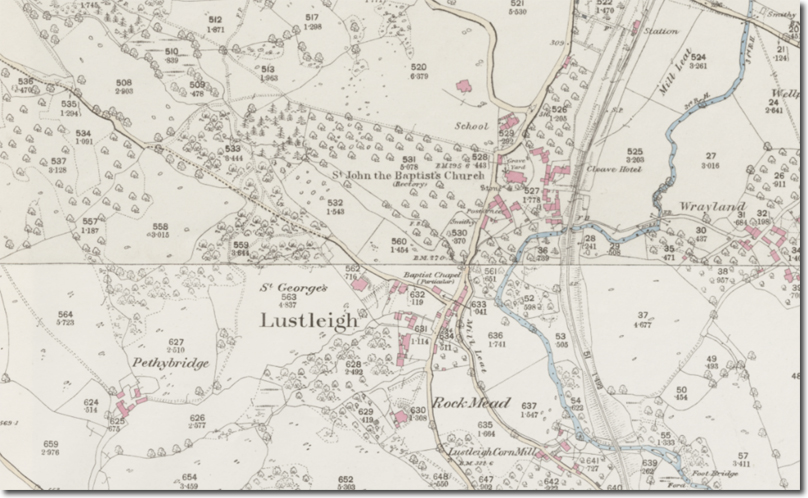
Pethybridge and Lustleigh occupy a small but well‑defined section of the Bovey valley, with settlement patterns that developed from scattered farmsteads into a recognisable village core by the early modern period. The landscape is shaped by steep valley sides, narrow lanes and small enclosures typical of eastern Dartmoor. The earliest documentary references point to a community organised around agriculture, woodland management and the movement of livestock between the valley and the moor.
Lustleigh’s medieval centre formed around the church, its manor and associated holdings. The church’s thirteenth‑century chancel and later fifteenth‑century additions indicate a stable and reasonably prosperous parish. The settlement remained small, with cottages and farmhouses grouped around the orchard and lanes leading towards the Bovey. Pethybridge, lying to the north‑east, developed as a minor hamlet on the rising ground above the river, its name reflecting a bridge or crossing point associated with the Pethy or Petty family recorded locally in the seventeenth century.
Throughout the seventeenth and eighteenth centuries the area’s economy was based on mixed farming, orcharding and woodland work. The steep lanes between Hisley, Pethybridge and Lustleigh were used by packhorse trains carrying goods between the Bovey valley and the moorland edge. The presence of narrow lanes, gateposts and controlled access points reflects a working rural landscape rather than a planned village. Houses in Pethybridge and Lustleigh from this period show typical Dartmoor construction: granite walls, thatch or slate roofs, and small windows set deep into the masonry.
By the nineteenth century Lustleigh had become a more coherent village, with the orchard functioning as a communal space and the churchyard expanding to accommodate new burials. The arrival of improved roads and later the railway at nearby Bovey Tracey increased access, though Lustleigh itself remained relatively isolated. Pethybridge retained its character as a small cluster of cottages on the hillside, with limited expansion due to the constraints of terrain and property boundaries.
Socially, the parish maintained the typical structure of rural Devon: farmers, labourers, craftsmen and smallholders forming the bulk of the population. The manor and larger farms provided employment, while seasonal work in orchards and woods supplemented incomes. The nineteenth century saw the establishment of local institutions such as the 1825 schoolroom founded by Reverend William Davy, reflecting the gradual formalisation of education and parish administration.
On the eve of the First World War Lustleigh and Pethybridge remained small, self‑contained communities. The built environment consisted of the church, the orchard, scattered farms, the lanes linking Hisley and Pethybridge, and a modest number of cottages. The war would draw men from the parish into military service, but the physical and social structure of the area in 1914 still reflected centuries of gradual, incremental development rather than rapid change.

