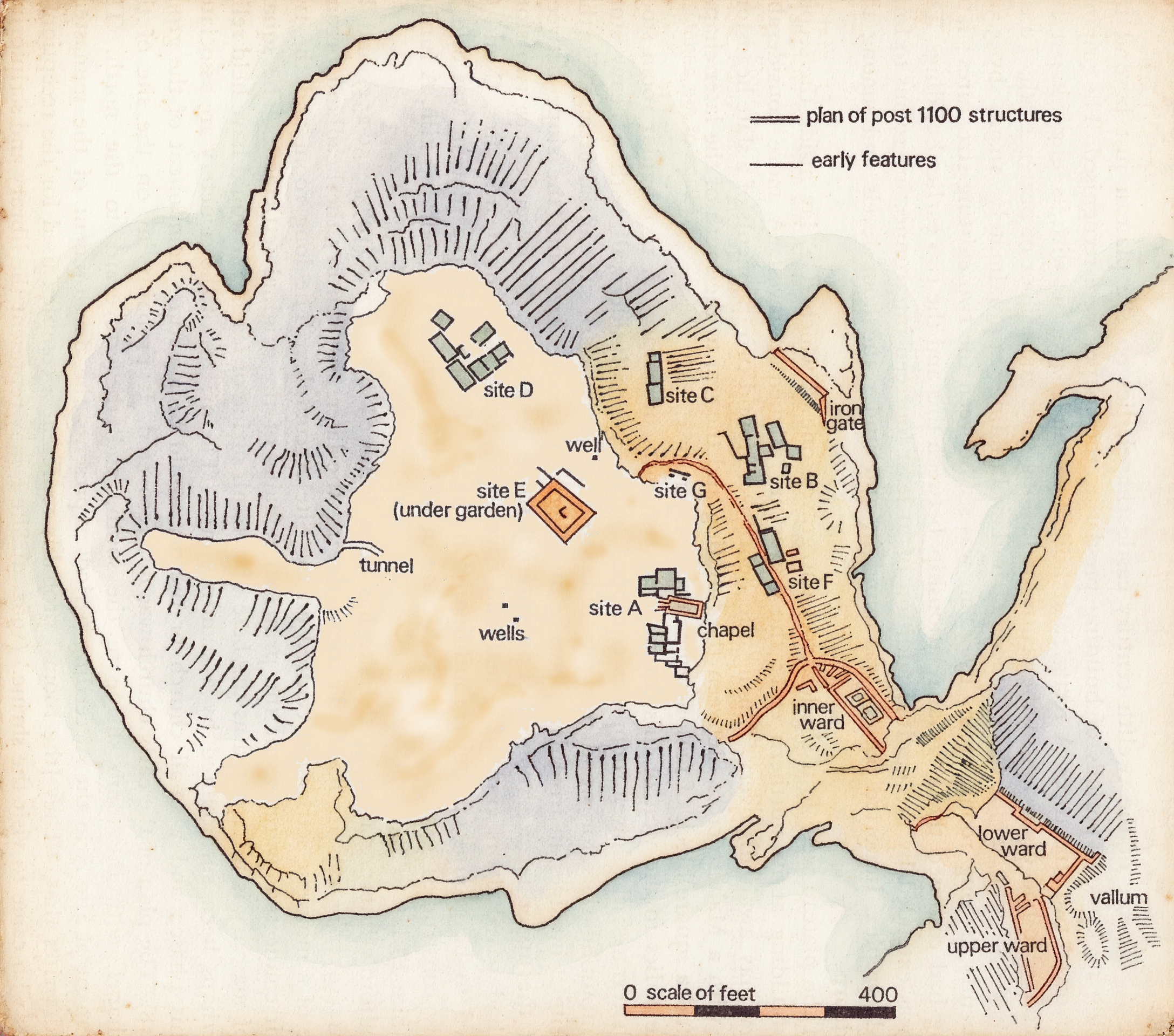
If you wanted to design a castle that nobody could possibly have needed, you could hardly do better than Tintagel. It stands on a cliff with no road worth guarding and no harbour of any consequence, and the sea does most of the work of defending it, which in practice means that nothing has ever needed defending. Yet in the 1230s one of the richest men in England laid out good money to build a castle here, and he did it on a site which, by every sensible measure, was a bad bargain. The puzzle of Tintagel is not why a castle was built there in the end, but why Richard of Cornwall wanted one, and the answer turns out to have very little to do with soldiering.
Richard was the younger brother of Henry III and the second son of King John, which is to say that he was born close enough to the throne to be dangerous and far enough from it to need something of his own. Henry made him Earl of Cornwall in 1227, and the county brought him a fortune in tin and lead. In May 1233 he bought the island of Tintagel from a local man called Gervase de Tintagel, whose father had adopted the name for the family only a generation earlier. It is not clear that Gervase had much idea what he was selling, and Richard evidently did not care what it cost. The earls already had a perfectly good seat at Launceston, with the roads and the markets and the administration that go with a county town, and no reasonable person would have needed a second castle on a distant cliff. What Richard wanted was not a fortress but a place that would say something about him.
The place he chose had been made famous a century earlier by a book. Geoffrey of Monmouth, writing about 1138, had made Tintagel the stronghold of Gorlois, Duke of Cornwall, whose beautiful wife Ygerna was desired by Uther Pendragon. Uther, unable to reach her by honest means, persuaded Merlin to disguise him as her husband, and the guards at Tintagel let him through the gate, so that Arthur was conceived that very night within the walls. It is a ridiculous plot and it was wildly popular. Geoffrey's History spread across Europe, was translated and elaborated and plundered by the romance writers, and by Richard's day an educated nobleman could hardly avoid knowing it. Richard was by all accounts a cultured and literary man, and I find it easy to imagine that he looked at his new purchase and saw not a heap of rock, but a stage on which he could place himself in the middle of the most celebrated story in western Christendom.
There was also something shrewder going on, and this is where the castle starts to look like politics. Richard was a stranger in Cornwall. He was a Plantagenet prince with a French-speaking court who had been dropped on a county that was proud of being different, and the Cornish had long since attached themselves to Arthur in a fierce, proprietorial way. A Frenchman had reported as early as 1113 that the Cornish still expected their king to come back, and had nearly started a brawl in the cathedral at Laon by saying so. For an incoming earl, there was a good deal to be said for presenting himself as the keeper of Arthur's birthplace. It gave him a claim to the county's past that no mere grant of land could confer. There may even have been a message for those outside Cornwall as well. In 1242 Richard received the Welsh prince Dafydd ap Llywelyn at Tintagel, and it is hard not to wonder whether the choice of venue was made with Arthur in mind, since the Welsh claimed him just as warmly as the Cornish did.
I would not insist that it was Arthur alone. Cornwall had another romance almost as celebrated, the doomed love of Tristan and Isolde, whose story ran through the court of King Mark and whose settings, a chapel, a garden and a cave by the sea, were later pinned to features of the island. I suggested in my piece on the old map that several of the features that we now see may have been arranged to match episodes in that story, and it seems to me quite likely that Richard had both legends in mind and was content to have them both. A man who set out to build himself a romance had no reason to be fussy about which one it was.
The castle that resulted is as odd as the reasoning behind it. It was built in two halves, one on the mainland and one on the island, which in those days were linked only by a narrow neck of rock that has since largely eroded away. On the mainland there was a courtyard with a gatehouse, and on the island a second courtyard with a great hall, a kitchen, a chapel and a curtain wall running round the edge of the cliff. Some writers have argued that the buildings were deliberately made to look old-fashioned, so that the castle would seem to be older than it was, which would be a splendid piece of theatre if it is true. What is certain is that the place was not equipped to withstand a siege and that nobody seems to have expected it to be. It was a stage set in stone, designed to be seen from the sea and to be approached by guests who knew the story well enough to appreciate where they were.
And then, rather quickly, the audience stopped coming. Richard's later career took him a long way from Cornwall, since he was elected King of the Romans in 1256 and crowned at Aachen the following year, which is a rather better illustration of his ambitions than a ruined hall on a cliff. His descendants seem to have made little use of Tintagel, the great hall was apparently roofless by the middle of the fourteenth century, and within another hundred years the place was well on the way to becoming a ruin. When the Black Prince became the first Duke of Cornwall in 1337 the castle came to him along with the rest of the estate, but by then it was largely a name on a list of properties. Yet the story which Richard had set out to claim did not need a roof. It went on circulating without any help from the building, and the visitors who came centuries later, the poets and painters of the Romantic age, were responding to Geoffrey's tale of Uther and Ygerna more than to anything that Richard had left them.
That is the neat irony of the whole business. Richard built Tintagel Castle because of a legend, and in doing so he provided the legend with an address. Before 1233 the story had no particular home that anyone could visit, and after it the ruins gave every generation a place to stand and imagine. The castle that the Victorian surveyor on our map labelled King Arthur's Castle was, in the end, as much Richard's creation as Geoffrey's, a thirteenth-century earl's notion of what an Arthurian fortress ought to look like, left to the weather until the world was ready to believe in it.