

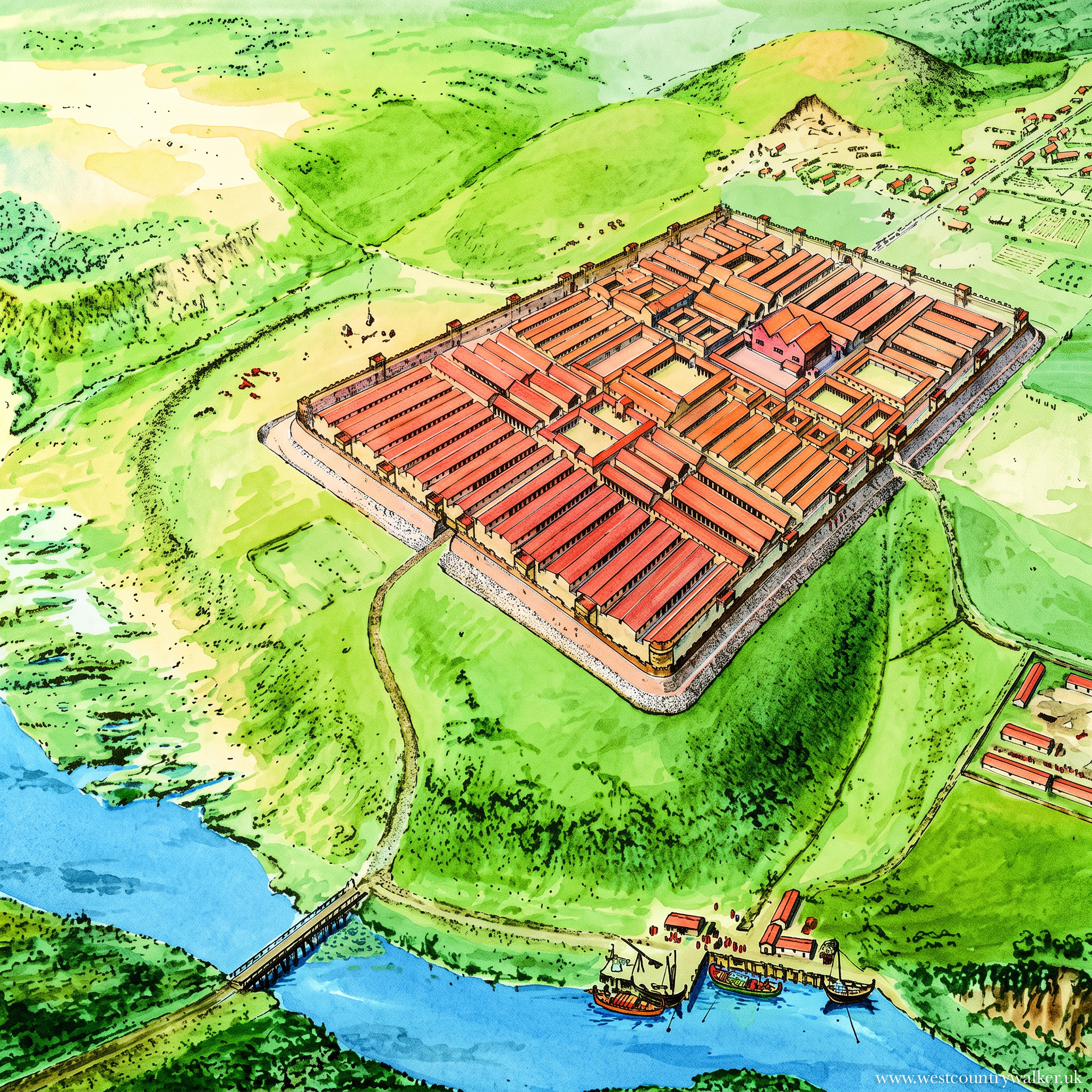
In about AD 50–55 the Roman army founded Exeter, selecting the high ground above the lowest crossing of the River Exe as the base for a new legionary fortress. This position controlled the river, the valleys and the eastern approaches, and the legion adopted the ancient Celtic name Isca, meaning simply “water” or “river”, from which the modern name Exeter eventually developed. The fortress served as the winter headquarters of the Second Augustan Legion during its advance into the South-West, a force generally thought to have been active in subduing the Durotriges and the Dumnonii under the future emperor Vespasian.
The fortress was constructed in the classic playing-card form, a rectangle with rounded corners covering about seventeen hectares. It was defended by a timber and earth rampart fronted by a deep ditch, with gates and towers at regular intervals. Inside lay a dense grid of timber buildings: long barracks for each century of soldiers, separate houses for senior officers, granaries for the corn supply, a hospital, workshops for weapons and armour, and a bath-house for the soldiers’ leisure. The only stone building within the fortress was the bath-house, supplied by an aqueduct entering through the Porta Decumana. Excavation has revealed the hot room and warm room, together with the exercise yard where a cockfighting pit was found. The fortress functioned as a self-contained military town, accommodating around six thousand men.
Legio II Augusta remained at Isca for roughly twenty years, presumably pacifying the Dumnonii, before departing for the Silurian front in South Wales and settling finally at Caerleon. Around AD 75 the fortress was given up and its grounds were converted to civilian purposes. The military bath-house was too large for the local population and was largely demolished, although parts were incorporated into the forum and basilica built on the site. A smaller bath-house was then built to the southeast to serve the new civilian settlement.
With the departure of the legion, Exeter became the civitas capital of the Dumnonii, governing the peoples of Devon and Cornwall. The town, now known as Isca Dumnoniorum, grew up around the former fortress. A new stone forum was laid out at the centre of the old military site, and local people who accepted Roman authority and customs established shops and houses on the surrounding plots. The settlement developed as one of the four towns attributed to the Dumnonii by Ptolemy, and it formed the southern terminus of the Fosse Way in the Antonine Itinerary.
By the late second century the town had expanded beyond the limits of the old fortress. When Isca, like other civitas capitals in Britain, began building town defences around AD 180–200, the new circuit enclosed a much larger area of about ninety-three acres. The rampart and ditch of the legionary base were replaced by a substantial bank and wall, marking Isca as a significant regional centre. Within this enlarged area there is evidence of copper and bronze working, livestock trading, pottery distribution and other commercial activity. A possible stock-yard has been identified, and the discovery of more than a thousand Roman coins demonstrates the importance of Isca as a market for the surrounding countryside.
In the third and fourth centuries the town appears to have been at least modestly prosperous. Costly mosaic floors were laid in several buildings, indicating households of some wealth. The impression, however, is that Isca was not as prosperous as neighbouring towns such as Ilchester and Dorchester, still less the larger towns of Roman Britain. Even so, it remained the administrative and economic centre of the Dumnonii, maintaining its role as the Roman gateway to the South-West.
By the late fourth century Isca Dumnoniorum was in terminal decline. The suburbs were abandoned by about AD 360, and by the 380s the money supply had ceased. The population contracted to the centre of the town, and much of the walled area was given over to farming. Soon after AD 400 urban life had effectively ceased, and Isca became one of the many Romano-British towns that did not survive into the post-Roman period as functioning urban centres.
A great place to learn more about Roman Exeter is at Royal Albert Memorial Museum

