

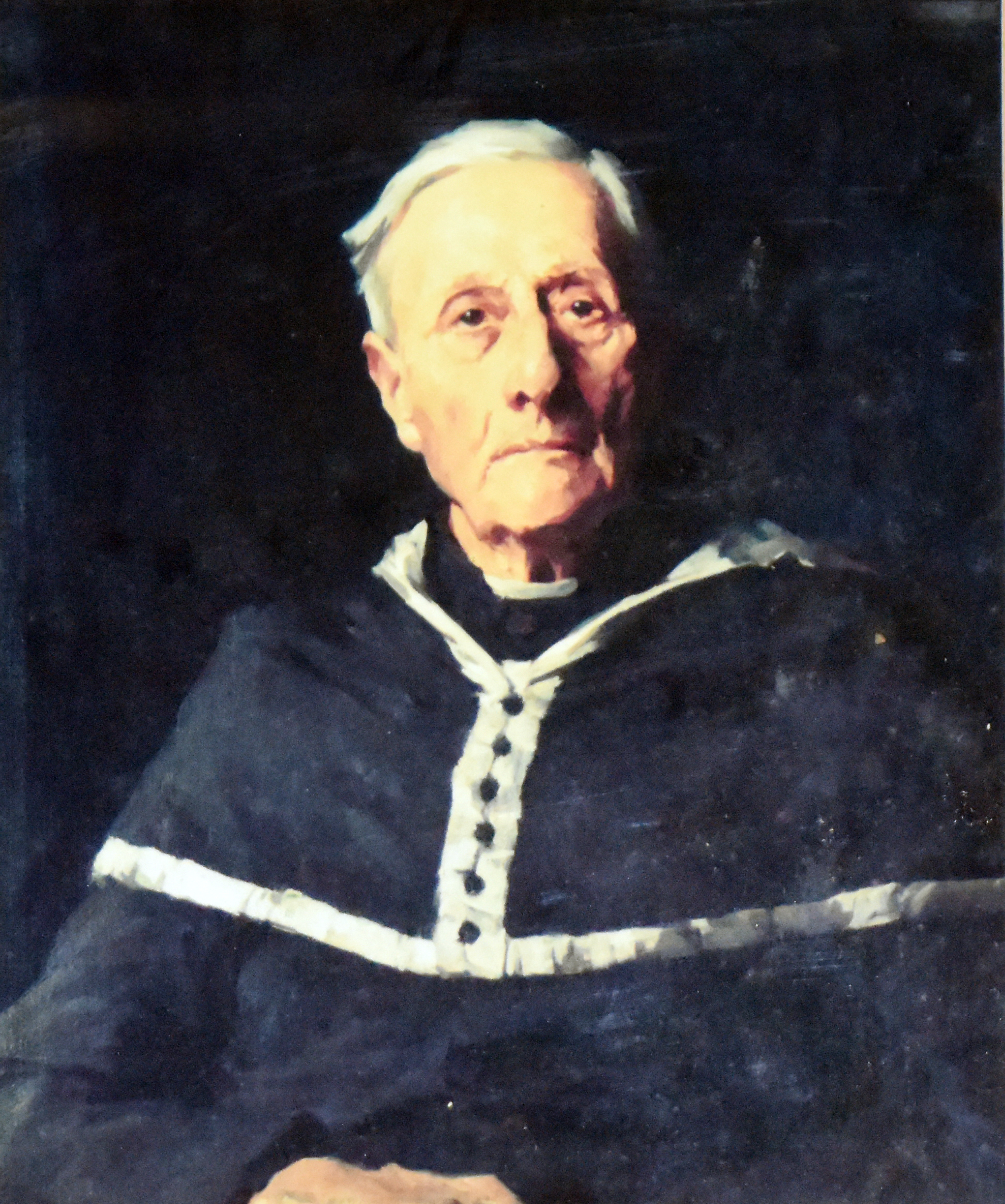
Sabine Baring‑Gould was born in Exeter in 1834, the eldest son of Edward Baring‑Gould, heir to the Lewtrenchard estate, and from early childhood he understood that the small parish in West Devon would one day be the centre of his life. His upbringing was unsettled, spent largely on the Continent as his father moved restlessly between France, Germany and Italy, but the family always returned to Lewtrenchard as the fixed point in their history. The manor, the church of St Peter, the Gould memorials and the wooded valley of the River Lew formed the landscape of his inheritance long before he took holy orders or began writing. When he eventually returned as both squire and rector, he treated the parish not as a posting but as a hereditary responsibility.
After Cambridge and ordination, he served curacies in Yorkshire and Essex, wrote prolifically, married Grace Taylor of Horbury and began the large family that would accompany him back to Devon. His father’s death and the resolution of the estate brought him home in 1880, and in 1881 he was instituted as rector of Lewtrenchard. From that moment until his death in 1924 he lived the dual role of “squire‑parson”, a figure more typical of the seventeenth century than the late Victorian period. He managed the estate, oversaw farms and tenancies, rebuilt cottages, laid out plantations and paths, and at the same time conducted services, visited parishioners, taught in the school and wrote sermons, novels, antiquarian studies and theological works from his study in the manor.
His most visible legacy is the transformation of St Peter’s Church. The building retained its medieval core — a thirteenth‑century chancel, a fifteenth‑century nave and a sixteenth‑century tower — but the interior had suffered from earlier nineteenth‑century alterations. Baring‑Gould, who criticised much contemporary restoration for its destructiveness, set out to recover what he believed to be the church’s proper character. He gathered surviving fragments of the medieval rood screen, broken up in 1883, and used them as the basis for a full reconstruction supervised by his cousin, the antiquary F. Bligh Bond. The resulting screen, with loft, cresting and tabernacle work, dominates the church. The painted panels on the gallery front were executed largely by his daughter Margaret, later Margaret Rowe, in a style intended to harmonise with late medieval devotional art.
The pulpit, carved by the Pinwill sisters, was modelled on the medieval pulpit at Kenton and stands on a wine‑glass stem with painted evangelists. The clergy stalls were reconstructed in 1904–05 using early sixteenth‑century panels of arabesques and profile heads, probably imported from the Continent. A parclose screen was added to the north chancel chapel on a sixteenth‑century model. He introduced a timber eagle lectern from Brittany, a late fifteenth‑ or early sixteenth‑century North Flemish triptych depicting the entombment and scenes from the Passion, and a copy of Paul Deschwanden’s “Adoration of the Magi” above the altar. In the south chancel recess he placed the effigy of his daughter Beatrice, carved in Freiburg in 1879, representing a sleeping child. The east window, erected in 1914, was produced in Munich in a sixteenth‑century idiom and reflects his preference for continental craftsmanship.
The church also became a repository for earlier Gould and Baring‑Gould memorials. Seventeenth‑century slate and brass monuments from Staverton were brought to Lewtrenchard and fixed to the north aisle wall, joining the existing family tablets. Later memorials record his own children, relatives and parishioners, forming a continuous genealogical record from the seventeenth century to the twentieth. The churchyard contains his own grave, placed deliberately within sight of the manor and the valley he had shaped.
Lew House, later known as Lewtrenchard Manor, was rebuilt almost entirely under his direction. Acting as his own architect, he remodelled the house in a romanticised Jacobean style, adding wings, staircases, panelling and plasterwork to create what he believed the ancestral home ought to have been. The estate was treated in the same way: drives were laid out, woods planted, and the gardens below the church — later rediscovered as the “Forgotten Garden” — were formed with paths, water features and viewpoints. The parish landscape became an extension of his historical imagination.
From Lewtrenchard he conducted his extensive folk‑song collecting across Devon and Cornwall. Beginning in the late 1880s, he noted down hundreds of songs from labourers, miners and farm workers, many of them within walking distance of the manor. These were published in Songs and Ballads of the West and “ A Garland of Country Song , and later used by Cecil Sharp, who visited him at Lewtrenchard. The collecting work was not separate from his life as rector: the singers were parishioners or neighbours, and the songs belonged to the same rural culture he was trying to preserve in stone, wood and print.
His literary output was vast. From his study at Lewtrenchard he produced novels, travel books, hagiographies, studies of medieval legend, theological works and essays on folklore. The Lives of the Saints , Curious Myths of the Middle Ages and The Book of Were-Wolves were written alongside parish registers, estate accounts and correspondence. His hymns, including “Onward, Christian Soldiers” and “Now the Day Is Over”, were already well known, but his later work was shaped by the rhythms of the parish and the responsibilities of the estate.
His personality was forceful, imaginative and often autocratic. Parishioners respected him, though some found him overwhelming. He believed that the rector should guide not only worship but education, morals, architecture and the physical environment. The result is that Lewtrenchard today bears the imprint of a single mind to an unusual degree. The church interior, the manor, the estate cottages, the memorials and the gardens all reflect his tastes, his scholarship and his convictions about continuity, tradition and the duties of inheritance.
Sabine Baring‑Gould died at Lewtrenchard in 1924 and was buried in the churchyard of St Peter’s. His grave lies among family memorials and parish burials, close to the manor and the church he had restored and managed for more than forty years. The buildings, fittings and estate structures he commissioned remain the principal evidence of his work in the parish.

