


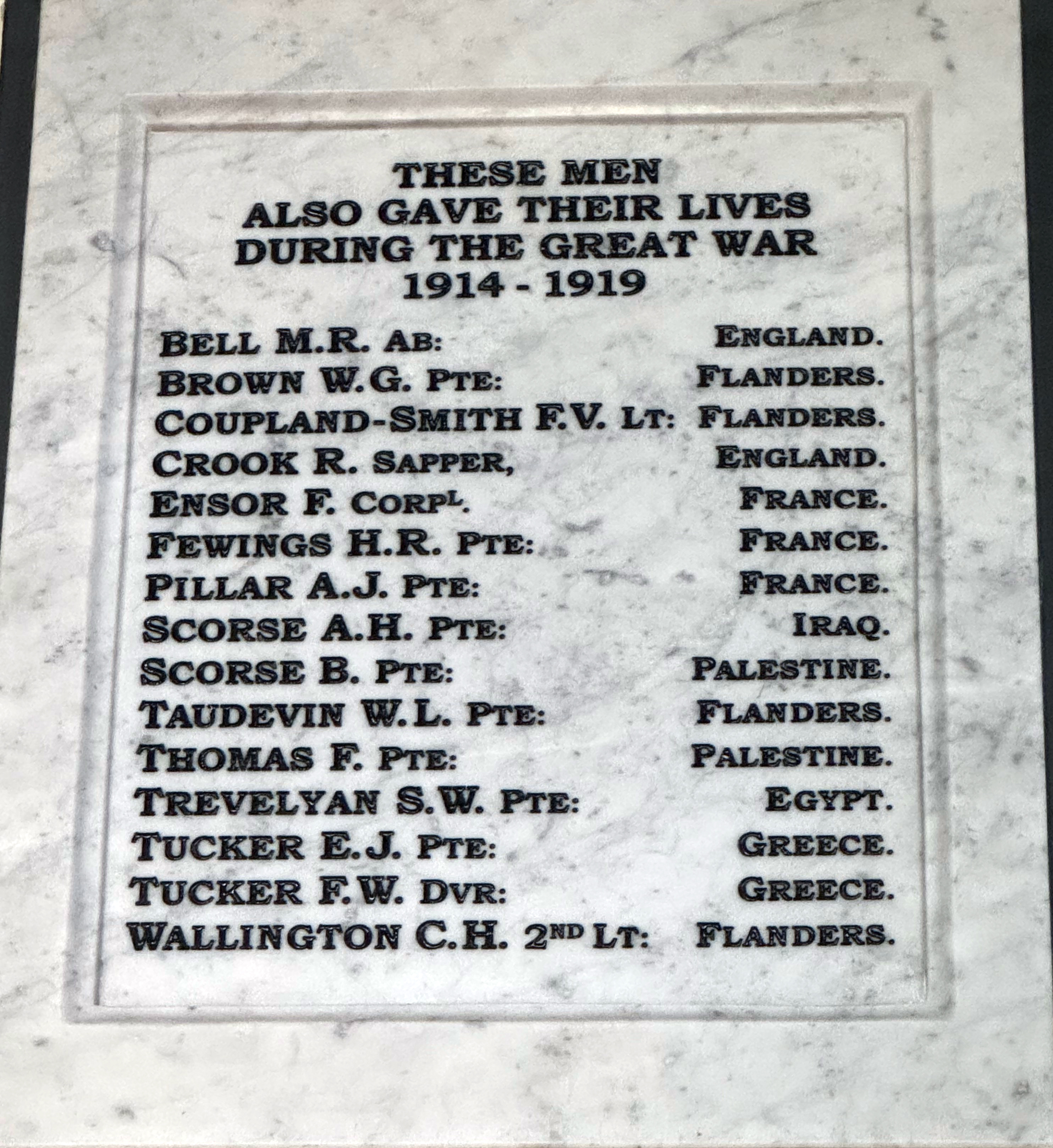
To the Glory of God and in honoured memory of the men from this parish who gave their lives during the Great War 1914–1918, plaques record names such as Bradfield P. Private, France; Cornish T. Gunner, France; Dunn S. Private, Egypt; Gale W. Private, France; Hetherington H.T. Private, France; Hine R.L. Corporal, France; Pillar F.J. Private, France; Taylor W.H. Major, France; and Trevelyan J. Sapper, France, beneath the biblical inscription “Greater love hath no man than this, that a man lay down his life for his friends.” Another plaque continues the roll of honour for those who also gave their lives during the Great War 1914–1919, including Bell M.R. AB, Flanders; Brown W.G. Private, Flanders; Coupland-Smith F.V. Lieutenant, England; Crook R. Sapper, England; Ensor F. Conductor, France; Fewlings H.R. Private, France; Pillar A.J. Private, France; Scorse B. Private, Palestine; Scorse E. Private, Palestine; Taudevin W. Private, France; Thomas F. Private, Egypt; Trevelyan S.W. Private, Greece; Tucker E.J. Private, Greece; Tucker F.W. Driver, Greece; and Wallington C.H. Second Lieutenant, Flanders. These names are not mere inscriptions but lives with stories preserved in biographies, photographs, and memorial records.
Matthew Richardson Bell was born in Denmark Street, Walbottle, Northumberland on 5 December 1895, the son of Matthew Bell, a coal miner, and his wife Mary Richardson. In 1901 the family lived on the north side of Denmark Street, Walbottle, where Matthew senior worked as a hewer. Matthew junior was the third of five children—John, Mary, Matthew, William, and Alice. By 1911 the family remained in Denmark Street, with Matthew working as a pony driver underground at a colliery, his brother John as a putter, and William still at school. Tragedy struck in 1913 when Matthew’s father died, leaving Mary to struggle with debt and ill health, eventually admitted to the Devon County Lunatic Asylum in Exminster in 1914, followed by William in 1915. Alice was sent to another home in Exeter, while Matthew worked as a farm labourer in Devon, described as “a good lad” and “very fond of his mother.” He enlisted in the Royal Navy on 21 August 1911 at Stonehouse, Devon, joining HMS Impregnable. His service record shows postings to HMS Monmouth, which was sunk in 1914, and later to HMS Monarch, HMS Victory I, HMS Vivid I and III, HMS Defiance, and others, serving continuously until 1922. His naval career spanned training ships, shore bases, and active cruisers, with records meticulously listing his service dates. Photographs of HMS Monmouth and HMS Monarch accompany his story, alongside census records showing his family’s residence at St Boniface Road, Ventnor, Isle of Wight, after moving from Northumberland.
Henry Thomas Hetherington was born in Devon in 1892, the son of a railway worker, and grew up in Sampford Peverell. By 1911 he was employed as a farm labourer, living with his parents in the village. He enlisted in the Devonshire Regiment, serving as a private in the 8th Battalion. His gallantry in the field earned him the Distinguished Conduct Medal, awarded for conspicuous bravery under fire. He was killed in action in France in 1916, aged 24, during the Battle of the Somme. His name is inscribed on the Sampford Peverell memorial plaque, marked with the letters “D.C.M.” to distinguish his courage. His grave lies in one of the great cemeteries of the Somme, and his decoration was reported in the Western Times, bringing pride as well as sorrow to his family and neighbours. His story stands out among the parish roll of honour as one of particular bravery, remembered not only for his sacrifice but for the distinction he earned in battle.
Percy Charles Bradfield, born in 1891 in Wokingham and baptised on 13 October, was the son of George Bradfield, a bootmaker, and Elizabeth Edge. He was one of seven children, though two brothers died in infancy. Following his father’s death in 1900, Percy was sent to the St Boniface Home for Boys in Sampford Peverell, Devon, run by the Waifs and Strays Society. Census records list him among 114 “inmates” in 1901. Committee minutes record his admission on 9 March 1900 and departure in October 1906 to apprentice with Mr Keeler, a bootmaker in Taunton. Described as “a good lad, intelligent and trustworthy,” Percy was cordially received. In 1916 the Home Committee sought exemption for him from military service, citing his indispensability, but the tribunal refused. He enlisted later that year at Exeter, joining the 1st/5th Battalion Royal Warwickshire Regiment, part of the 143rd Brigade in the 48th Division. He fought at Ypres and was killed on 5 October 1917, shot in the head by a sniper while serving in a Lewis Gun team. Tributes in the Western Times and the Waifs and Strays Society magazine remembered him as bright, intelligent, and much liked. He was buried at Cement House Cemetery, Langemark-Poelkapelle, Belgium, among thousands who fell at Ypres. His effects included a war gratuity paid to his mother. Percy is commemorated on plaques in Sampford Peverell parish church and Tyne Cot Memorial.
Frederic Vyvyan Coupland-Smith, born in 1897 in Steyning, Sussex, was the only child of Frederic Geoffrey Coupland-Smith and Edith Mary. Educated at Blundell’s School in Tiverton, he was a shy, studious boy with interests in science, mathematics, and natural history. He travelled to Peru with his parents in 1911–12, learned Spanish, and developed a love of South American culture. Later he worked as a missionary in Panama’s Darien region. His military service saw him commissioned as a 2nd Lieutenant in the Royal Field Artillery. He was killed in action on 30 July 1917 in France and Flanders, aged 21, and is commemorated on a plaque in Normanton cemetery, Nottinghamshire, and in Blundell’s archives. His casualty records, CWGC entry, and family tree on ancestry.co.uk preserve his details.
Sidney Dunn’s story is complex, with multiple men of the same name recorded. One Sidney Dunn, born in 1849 in Semley, Wiltshire, son of Frederick John Dunn and Henry Ann Longden, became a grocer, postmaster, and census enumerator. He married Caroline Trevett in 1873 and raised children in Semley, later remembered in photographs outside the Harrow and Hounds inn. Another Sidney Dunn, born in 1894 in Sandford, Devon, son of Frederick John Dunn and Henry Ann Long, enlisted in the Devonshire Regiment, serving in Mesopotamia. Reports describe his wounding, hospitalisation, and eventual death from malaria in Alexandria in April 1918, aged 32, leaving a widow and three children. He was buried in Alexandria (Hadra) War Memorial Cemetery, Egypt, commemorated in memorial notices in the Western Times and on plaques in Sampford Peverell. Yet another record lists Sidney Dunn of the 2nd Battalion Devonshire Regiment, killed in France and Flanders on 19 July 1918, and another in the Gloucestershire Regiment, killed in action on 19 April 1918. These overlapping records reflect the tragic multiplicity of losses borne by families sharing the same name.
Frank Gordon Ensor, born in Keynsham, Somerset in 1896, son of William Ensor and Annie Maria Hook, grew up in Bristol. His family connections included the Waifs and Strays Society and the Watts and Sharpe Society. He worked as a clerk for the Board of Trade and never married. His military service was with the Royal Field Artillery, regimental numbers W/1708 and 17015, serving as Bombardier and Corporal. He died of wounds on 25 August 1916 in France, aged 19, and was buried in Boulogne Eastern Cemetery. His medals included the 1914–15 Star, British War Medal, and Victory Medal. He is commemorated on CWGC records, Blundell’s memorials, and family trees on ancestry.co.uk. His brother Percy Ensor also died in 1918, aged 19, in the Devonshire Regiment, adding to the family’s grief.
Walter John Gale, born in Bampton, Devon in 1894, son of George Robert Gale and Sarah Webber, lived in Lower Town, Sampford Peverell. A general labourer by 1911, he enlisted in 1914 in the 8th Battalion Devonshire Regiment. He was killed in action on 25 September 1915 at Loos, aged 21, and buried in Guards Cemetery, Cuinchy, France. His name is on the Sampford Peverell War Memorial. His brother William also served and was awarded the Military Medal. Walter’s death was reported in the Western Times, noting his enlistment at a recruiting meeting in Sampford Peverell. Other records show Walter Gale killed at Serre on 1 July 1916, with his brother Lewis wounded and later dying of wounds in September 1916. Both are commemorated on the Thiepval Memorial. Another Walter Gale, born in Hintlesham, Suffolk in 1896, served in the 2nd Battalion Suffolk Regiment and was killed on 30 June 1916, commemorated at Thiepval. Yet another Walter Gale, of Thorverton, Devon, served in the 9th Battalion Devonshire Regiment and was killed on 6 January 1916, aged 19, buried in France. These overlapping identities illustrate the widespread sacrifice of men named Gale.
Robert Thomas Hine Robert Thomas Hine was born in October 1896 in Cudnack, near Sampford Peverell, the son of James and Louisa Hine. By the 1911 census he was living with his family in Sampford Peverell, and later worked as a platelayer for the Great Western Railway. He enlisted young, joining the Duke of Cornwall’s Light Infantry, 1st Battalion, and was killed in action on 14 September 1914, aged just 17, during the early battles of the war. A portrait shows him in uniform, commemorated as one of the youngest casualties from the parish. Later records also list a Robert Hine serving with the Royal Fusiliers, killed on 9 October 1917, buried at Cement House Cemetery, Langemark-Poelkapelle, Belgium. His name appears on memorials in Bassingbourn, Cambridgeshire, and Sampford Peverell, reflecting the difficulty of reconciling overlapping records of men with the same name.
Arthur Henry Scorse Arthur Henry Scorse was born in 1900 at Thornford Workhouse, Dorset, to Alice Scorse. He grew up in Sampford Peverell, living with his mother and grandparents at Scotton Cottage. By 1914 he was among the young men who enlisted at a recruiting rally in the village, joining the 2nd Battalion Devonshire Regiment, later transferred to the Border Regiment. He served in Mesopotamia with the British Indian Army, enduring the harsh conditions of heat, disease, and poor logistics. He was wounded and died of his injuries on 25 March 1917, aged 17, while serving with the 2/4th Battalion Devonshire Regiment. He is commemorated on the Doiran Memorial in Greece, alongside thousands who fell in the Salonika campaign. His family’s story, rooted in poverty and the workhouse, reflects the social background of many who served.
Bertie Scorse Bertie Scorse, born in 1881 in Sampford Peverell, was the second child of Alice Scorse. His life was marked by hardship: he married, had children, but later fell into poverty and was admitted to Thurton Workhouse in Norfolk in 1930. His military service included enlistment in 1914, serving with the Imperial Yeomanry in Gallipoli, Egypt, and Palestine. He was awarded the British War Medal and Victory Medal. Later records suggest he also served in World War II. He died in June 1918, aged 37, and is buried in Jerusalem War Cemetery, commemorated by the Commonwealth War Graves Commission. His estate was granted to Lydia Latterly, described as a mother figure. Bertie’s story combines military service with the struggles of civilian life, emblematic of the toll the war took on families.
Wilfred Taudevin Wilfred Taudevin was born in 1883 in Walton-on-the-Hill, Surrey, the youngest son of William and Sarah Taudevin, a builder and decorator. He grew up in Walton Street, active in the parish council, Wesleyan choir, and community life. By 1916, though married, he was called up and enlisted in the London Regiment, serving with the 2nd/4th Battalion, part of the 58th Division. He fought at Bullecourt and Ypres, and was killed in action on 18 October 1917 at Poelcapelle, aged 36. He was buried in Poelcapelle British Cemetery, his widow Edith receiving his gratuity. Records also list a Wilfred Taudevin in the Duke of Cornwall’s Light Infantry, killed on 30 October 1917, commemorated at Tyne Cot. His name appears on memorials in Sampford Peverell and Tyne Cot, alongside fellow parish casualties Percy Bradfield, Robert Hine, and Charles Wallington.
William Henry Taylor William Henry Taylor was born in Sampford Peverell on 2 March 1894, the only child of George Henry Taylor, headmaster of East Devon County School, and Lucy Winslow. Educated at Blundell’s and the Royal Veterinary College, London, he qualified as a vet and joined the Royal Army Veterinary Corps in 1914. He served in France and Belgium, tending wounded men and horses under fire, and was awarded the Military Cross for gallantry in 1916. Promoted to Major, he continued service until 1918. He died on 15 November 1918 at Etaples, Somme, aged 24, and is buried in Etaples Military Cemetery. His name is commemorated on the memorial in the Royal College of Veterinary Surgeons and in Sampford Peverell parish church. His career reflects the vital role of veterinary officers in maintaining the army’s horses, essential for transport and artillery.
James Trevelyan James Trevelyan was born in 1877 in Upnor, Kent, son of William Trevelvan and Eliza Wood. He served as a sapper in the Royal Engineers during the Boer War, awarded the Queen’s South Africa Medal with five clasps. Later he worked as a platelayer for the Great Western Railway, living in Sampford Peverell with his wife and children. Despite being 43 when war broke out, he enlisted in the Devonshire Regiment. He died on 29 December 1916, aged 45, and was buried in Sampford Peverell churchyard. Another James Trevellyan, of the Somerset Light Infantry, died earlier in 1914, commemorated at Le Touret Memorial, while yet another, attached to the Royal Engineers, died in 1942 and was buried in Belgium. These overlapping records show the recurrence of the Trevelyan name in military service, each commemorated locally and nationally.
Stanley Trevelyan Stanley Trevelyan was baptised in Sampford Peverell in 1896, son of William Henry Trevelyan, a railway signalman, and Elizabeth Williams. He joined the Royal Navy in 1914, serving at HMS Vivid I, Devonport, and later aboard defensively armed merchant ships, including USS Leviathan and SS Tantara. His service record shows continuous postings until 1919, rated Able Seaman and Signalman, with “very good” conduct. He was awarded the British War Medal and Victory Medal. Another Stanley Trevelyan, serving in the Royal Marine Light Infantry, died on 14 July 1918 near Alexandria, Egypt, when SS Tatarrax exploded, commemorated by the CWGC. The multiplicity of records reflects the commonality of the name, but each Stanley Trevelyan is remembered on naval memorials, including Plymouth Naval Memorial and Tyne Cot.
Ernest Tucker Ernest Tucker was born in Sampford Peverell in 1885, son of Richard Tucker and Jane Cottam. He worked as a shoemaker, remembered locally as part of the “Boobery Tuckers.” He married Florence Herbert in 1907 and had children. He enlisted in 1916, joining the 3rd Battalion Devonshire Regiment, later transferred to the 1st Battalion. He served in France, was wounded in May 1918, and died of his wounds on 10 July 1918 in Manchester, aged 33. He was buried in Southern Cemetery, Manchester, and awarded the British War Medal and Victory Medal. His brother Richard also died in the war, in Egypt, and the Western Times noted the “sad coincidence” of both brothers’ deaths within a year. Ernest is commemorated on the Whitchurch Roll of Honour and the Doiran Memorial in Greece.
Frederick Tucker Frederick William Tucker was born in Sampford Peverell in 1897, son of Herbert Tucker, a carpenter, and Jane Cottney. He grew up in “Smoke Alley” cottages in Boobery, Tiverton, and worked as a carpenter. He married Florence Bowden in 1911 and had children. He enlisted in the Royal Army Service Corps, serving with the Mechanical Transport section. He died on 18 September 1918 in the Balkan theatre, aged 21, and is commemorated on the Salonika Memorial. His death was reported alongside his brother Ernest’s, both remembered in the Western Times as a tragic double loss. His name is inscribed on Sampford Peverell’s war memorial and CWGC records.
Charles Harold Wallington Charles Harold Wallington was born in 1892 in Horfield, Bristol, son of Charles and Martha Wallington. He worked as a clerk in Birmingham before enlisting in the Royal Warwickshire Regiment. He was killed on 1 July 1916, aged 24, during the Battle of the Somme, and is buried at Ovillers-la-Boisselle. Another Charles Wallington, serving with the Lincolnshire Regiment attached to the King’s Liverpool Regiment, was killed on 10 September 1917 at the Battle of Menin Road Ridge, commemorated at Tyne Cot Memorial. Both names appear on plaques in Sampford Peverell parish church. Their stories reflect the widespread sacrifice of men from across England, remembered locally and nationally.
Thomas Edward Rowe was born in 1892 in Tiverton, the eldest son of John Rowe, a carpenter, and his wife Elizabeth (née Dyer), who had married in 1889 at St Peter’s Church, Tiverton. The family lived in a small cottage on Angel Hill, where John’s father had also worked as a joiner, and where Elizabeth’s family had been employed in the woollen mills. By the 1901 census Thomas was recorded as a scholar, living with his parents and three younger siblings — William, aged 7, Annie, aged 5, and George, aged 3 — all of whom were born in Tiverton. By 1911 Thomas was apprenticed as a wheelwright, working under his uncle at a yard near Westexe, while his younger brother William was employed as a grocer’s assistant and Annie was listed as a dressmaker. The family’s address was then given as 14 Westexe South, Tiverton, a modest terraced house with four rooms.
Thomas enlisted in the Devonshire Regiment in September 1914, joining the 8th Battalion, and was sent to France in July 1915. He was killed in action during the Battle of Loos on 25th September 1915, aged 23. His name is recorded on the Loos Memorial, Pas-de-Calais, and also on the Tiverton War Memorial. According to the Soldiers’ Effects records, his father John received a gratuity of £3 10s and his mother Elizabeth a pension of 10s per week. The Western Times of 8th October 1915 carried a notice of his death, describing him as “a bright and willing lad, much respected by his fellow workmen.” His younger brother George later served in the Royal Navy, surviving the war, and his sister Annie married in 1920, continuing the family line in Tiverton.
Henry Thomas Heyward, born in 1860 in Sampford Arundel, Somerset, was the son of Henry Heyward and Mary Ann Langdon. He grew up in a rural labouring family, moving between parishes in Somerset and Devon, and by the 1881 census was working as a farm servant. He married Rosa in the 1880s and raised a large family, living in cottages around Sampford Arundel, Ashbrittle, and Langford Budville. By 1911 he was settled at Mill House, Sampford Arundel, with several children still at home. His sons of military age were drawn into service during the Great War, while Henry himself continued agricultural work into his sixties. Rosa died in 1930, and Henry followed in 1933, aged 73, buried locally. His name appears on the parish memorial, representing the older generation whose family bore the brunt of wartime loss.
Robert Thomas Hine was born in October 1896 in Cudnack, near Sampford Peverell, the son of James and Louisa Hine. By 1911 he was living with his family in the village and later worked as a platelayer for the Great Western Railway. He enlisted in the Duke of Cornwall’s Light Infantry, 1st Battalion, and was killed in action on 14 September 1914, aged just 17, one of the youngest casualties from the parish. A portrait shows him in uniform, commemorated locally. Later records also list a Robert Hine serving with the Royal Fusiliers, killed on 9 October 1917 and buried at Cement House Cemetery, Langemark-Poelkapelle, Belgium. His name appears on memorials in Bassingbourn, Cambridgeshire, and Sampford Peverell, reflecting the difficulty of reconciling overlapping records of men with the same name.
Arthur Henry Scorse was born in 1900 at Thornford Workhouse, Dorset, to Alice Scorse. He grew up in Sampford Peverell, living with his mother and grandparents at Scotton Cottage. By 1914 he was among the young men who enlisted at a recruiting rally in the village, joining the 2nd Battalion Devonshire Regiment, later transferred to the Border Regiment. He served in Mesopotamia with the British Indian Army, enduring the harsh conditions of heat, disease, and poor logistics. He was wounded and died of his injuries on 25 March 1917, aged 17, while serving with the 2/4th Battalion Devonshire Regiment. He is commemorated on the Doiran Memorial in Greece, alongside thousands who fell in the Salonika campaign. His family’s story, rooted in poverty and the workhouse, reflects the social background of many who served.
Bertie Scorse, born in 1881 in Sampford Peverell, was the second child of Alice Scorse. His life was marked by hardship: he married, had children, but later fell into poverty and was admitted to Thurton Workhouse in Norfolk in 1930. His military service included enlistment in 1914, serving with the Imperial Yeomanry in Gallipoli, Egypt, and Palestine. He was awarded the British War Medal and Victory Medal. Later records suggest he also served in World War II. He died in June 1918, aged 37, and is buried in Jerusalem War Cemetery, commemorated by the Commonwealth War Graves Commission. His estate was granted to Lydia Latterly, described as a mother figure. Bertie’s story combines military service with the struggles of civilian life, emblematic of the toll the war took on families.
Wilfred Taudevin was born in 1883 in Walton-on-the-Hill, Surrey, the youngest son of William and Sarah Taudevin, a builder and decorator. He grew up in Walton Street, active in the parish council, Wesleyan choir, and community life. By 1916, though married, he was called up and enlisted in the London Regiment, serving with the 2nd/4th Battalion, part of the 58th Division. He fought at Bullecourt and Ypres, and was killed in action on 18 October 1917 at Poelcapelle, aged 36. He was buried in Poelcapelle British Cemetery, his widow Edith receiving his gratuity. Records also list a Wilfred Taudevin in the Duke of Cornwall’s Light Infantry, killed on 30 October 1917, commemorated at Tyne Cot. His name appears on memorials in Sampford Peverell and Tyne Cot, alongside fellow parish casualties Percy Bradfield, Robert Hine, and Charles Wallington.
William Henry Taylor was born in Sampford Peverell on 2 March 1894, the only child of George Henry Taylor, headmaster of East Devon County School, and Lucy Winslow. Educated at Blundell’s and the Royal Veterinary College, London, he qualified as a vet and joined the Royal Army Veterinary Corps in 1914. He served in France and Belgium, tending wounded men and horses under fire, and was awarded the Military Cross for gallantry in 1916. Promoted to Major, he continued service until 1918. He died on 15 November 1918 at Etaples, Somme, aged 24, and is buried in Etaples Military Cemetery. His name is commemorated on the memorial in the Royal College of Veterinary Surgeons and in Sampford Peverell parish church. His career reflects the vital role of veterinary officers in maintaining the army’s horses, essential for transport and artillery.
James Trevelyan was born in 1877 in Upnor, Kent, son of William Trevelvan and Eliza Wood. He served as a sapper in the Royal Engineers during the Boer War, awarded the Queen’s South Africa Medal with five clasps. Later he worked as a platelayer for the Great Western Railway, living in Sampford Peverell with his wife and children. Despite being 43 when war broke out, he enlisted in the Devonshire Regiment. He died on 29 December 1916, aged 45, and was buried in Sampford Peverell churchyard. Another James Trevellyan, of the Somerset Light Infantry, died earlier in 1914, commemorated at Le Touret Memorial, while yet another, attached to the Royal Engineers, died in 1942 and was buried in Belgium. These overlapping records show the recurrence of the Trevelyan name in military service, each commemorated locally and nationally.
Stanley Trevelyan was baptised in Sampford Peverell in 1896, son of William Henry Trevelyan, a railway signalman, and Elizabeth Williams. He joined the Royal Navy in 1914, serving at HMS Vivid I, Devonport, and later aboard defensively armed merchant ships, including USS Leviathan and SS Tantara. His service record shows continuous postings until 1919, rated Able Seaman and Signalman, with “very good” conduct. He was awarded the British War Medal and Victory Medal. Another Stanley Trevelyan, serving in the Royal Marine Light Infantry, died on 14 July 1918 near Alexandria, Egypt, when SS Tatarrax exploded, commemorated by the CWGC. The multiplicity of records reflects the commonality of the name, but each Stanley Trevelyan is remembered on naval memorials, including Plymouth Naval Memorial and Tyne Cot.
Ernest Tucker was born in Sampford Peverell in 1885, son of Richard Tucker and Jane Cottam. He worked as a shoemaker, remembered locally as part of the “Boobery Tuckers.” He married Florence Herbert in 1907 and had children. He enlisted in 1916, joining the 3rd Battalion Devonshire Regiment, later transferred to the 1st Battalion. He served in France, was wounded in May 2018, and died of his wounds on 10 July 1918 in Manchester, aged 33. He was buried in Southern Cemetery, Manchester, and awarded the British War Medal and Victory Medal. His brother Richard also died in the war, in Egypt, and the Western Times noted the “sad coincidence” of both brothers’ deaths within a year. Ernest is commemorated on the Whitchurch Roll of Honour and the Doiran Memorial in Greece.
Frederick William Tucker was born in Sampford Peverell in 1897, son of Herbert Tucker, a carpenter, and Jane Cottney. He grew up in “Smoke Alley” cottages in Boobery, Tiverton, and worked as a carpenter. He married Florence Bowden in 1911 and had children. He enlisted in the Royal Army Service Corps, serving with the Mechanical Transport section. He died on 18 September 1918 in the Balkan theatre, aged 21, and is commemorated on the Salonika Memorial. His death was reported alongside his brother Ernest’s, both remembered in the Western Times as a tragic double loss. His name is inscribed on Sampford Peverell’s war memorial and CWGC records.
Charles Harold Wallington was born in 1892 in Horfield, Bristol, son of Charles and Martha Wallington. He worked as a clerk in Birmingham before enlisting in the Royal Warwickshire Regiment. He was killed on 1 July 1916, aged 24, during the Battle of the Somme, and is buried at Ovillers Military Cemetery, La Boisselle, close to where he fell. His name is inscribed on the Sampford Peverell memorial, linking the village to the great cemeteries of the Western Front. Another Charles Wallington, serving with the Lincolnshire Regiment but attached to the King’s Liverpool Regiment, was killed on 10 September 1917 during the Battle of the Menin Road Ridge. He is commemorated on the Tyne Cot Memorial in Belgium, and also remembered in Sampford Peverell parish church. The duplication of names reflects the tragic recurrence of sacrifice within families and across regiments, and both men are honoured locally as part of the same community of loss.
Thomas Frederick, born in Devon in the early 1890s, was the son of a local labourer. By 1911 he was working as a farm hand in Sampford Peverell. He enlisted in the Devonshire Regiment and was later posted to Egypt, where British and Indian forces fought against the Ottoman Empire. He died of disease in 1917, aged 25, and is buried in Alexandria War Memorial Cemetery. His name is inscribed on the parish plaque, a reminder of the global reach of the war and the vulnerability of men far from home.
Henry Richard Fewlings was born in Tiverton in 1895, the son of a carpenter. He joined the Devonshire Regiment and was sent to France in 1916. He was killed in action during the Battle of Arras in April 1917, aged 22. His grave lies in the Faubourg d’Amiens Cemetery, Arras. The parish memorial records his name alongside his neighbours, showing how the war claimed men from every trade and family.
William George Brown was born in Sampford Peverell in 1890, the son of a railway worker. He enlisted in the Devonshire Regiment and was sent to Flanders. He was killed in action during the Third Battle of Ypres in 1917, aged 27. His name is commemorated on the Tyne Cot Memorial in Belgium. His story reflects the fate of many Devon men who fell in the mud of Passchendaele.
Richard Crook was born in Devon in 1892. He became a sapper in the Royal Engineers, responsible for building and maintaining trenches, roads, and railways. He died in England in 1918, aged 26, from wounds sustained in France. He is buried in Sampford Peverell churchyard. His inclusion on the memorial reminds us that not all casualties died overseas — many returned home only to succumb to their injuries.
Thomas Cornish was born in Hillfarrance, Somerset in 1897, the son of Eli Cornish, an agricultural labourer, and Elizabeth M. Cornish. By the 1911 census the family were living in Higher Town, Sampford Peverell, where Thomas worked as a farm boy alongside his father. He enlisted in the Royal Field Artillery, serving as Gunner in “A” Battery, 50th Brigade. His service number was 135576. He was sent to France in 1916, part of the artillery units supporting the infantry in the Arras sector. He was killed in action on 30 March 1917, aged 20, and is buried in Faubourg d’Amiens Cemetery, Arras, Pas-de-Calais, France. His name is inscribed on the Sampford Peverell parish memorial, remembered as one of the village’s own sons who carried the burden of war far from home. His parents remained in Higher Town, and his death was noted in local records as a grievous loss to the family. His story reflects the fate of many young men from rural Devon and Somerset, whose lives were cut short in the artillery duels of the Western Front.
Frederick James Pillar was born on 15 September 1893 in Halberton, the eldest of five children of James Pillar, a railway plate layer, and Eliza Bell, daughter of an agricultural labourer from Chevithorne. Baptised in Halberton a month later, he grew up in Lower Town, Sampford Peverell, in a row of cottages where his maternal grandfather Richard Bell also lived. By the 1901 census Frederick was recorded with his parents, brothers Albert and Walter, and sister Elda. He worked as a railway porter before enlisting in the Coldstream Guards. Serving with the 1st Battalion, he was killed in action on 13 April 1918, aged 24, during the German Spring Offensive. He has no known grave and is commemorated on the Ploegsteert Memorial in Belgium. His name is inscribed on the Sampford Peverell parish memorial, remembered alongside his cousin Arthur Pillar, who also fell in the war.
Arthur John Pillar was born on 5 January 1900 in Sampford Peverell, the younger son of William Henry Pillar, a railway packer, and Mary Grace Young, daughter of a Burlescombe wheelwright. His father William had been baptised in St John’s Church, Sampford Peverell, in 1862, the first child to use the newly restored medieval font, a detail noted in the parish register. Arthur grew up in Boobery, Sampford Peverell, and by 1911 was still at school, living with his parents. He enlisted in the Devonshire Regiment, 1st/5th Battalion, and was sent to France in 1918. He died of wounds on 13 September 1918, aged just 18, and is buried in St Sever Cemetery Extension, Rouen, France. His headstone bears the inscription “Rest in peace for evermore.” Arthur’s cousin Frederick James Pillar had died earlier that year, and their names together on the Sampford Peverell memorial reflect the double loss borne by the Pillar family.
Together these names, drawn from farms, cottages, schools, and workshops, form a roll of honour that ties Sampford Peverell to the battlefields of France, Flanders, Egypt, Palestine, Salonika, and beyond. Each man’s story, whether fully detailed or only partially recovered, contributes to the collective memory of a parish that bore its share of the war’s burden. Their lives, intertwined with the rhythms of village life, speak more deeply of sacrifice than any inscription can hold, and in the quiet of the church their names still speak.

