

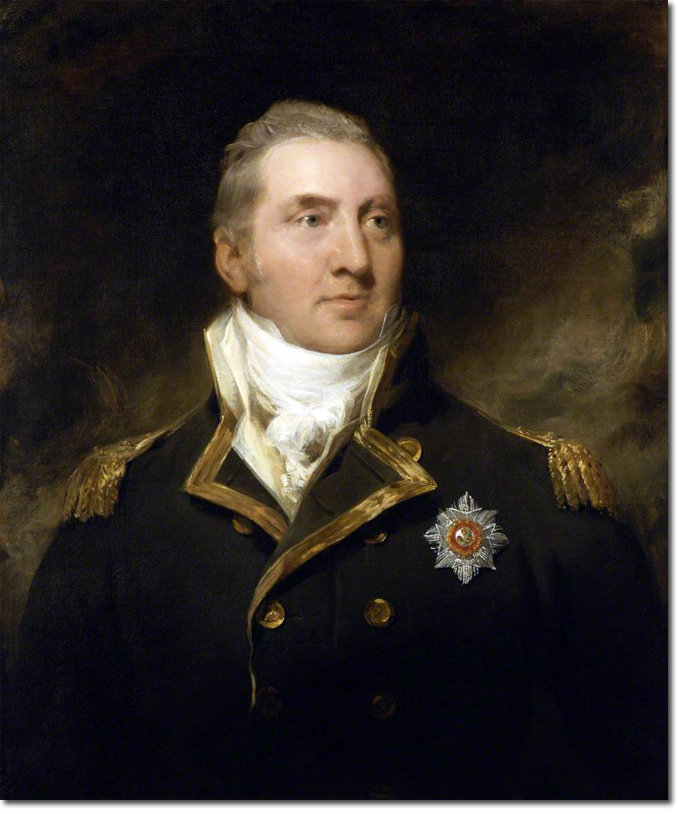
Sir Edward Pellew (1757–1833), later created Viscount Exmouth, was one of the most notable naval officers of the late eighteenth and early nineteenth centuries. Entering the Royal Navy as a boy, he served through the American War of Independence, the French Revolutionary Wars, and the Napoleonic Wars, before rising to the highest rank of Admiral of the Fleet. His career illustrates both the demands of Britain’s naval conflicts and the global reach of the service during this period.
Pellew first distinguished himself during the American War of Independence, where he saw action at Saratoga. In the 1790s he became one of the navy’s most successful frigate captains, gaining public attention for the capture of the French frigate Cléopâtre in 1793 and for his part in the rescue of passengers from the transport ship Dutton at Plymouth in 1796. These exploits established his reputation for seamanship and personal courage, qualities that were valued highly in the age of sail.
His later commands reflected the expanding responsibilities of the Royal Navy. As Commander-in-Chief in the East Indies (1805–1809), Pellew oversaw operations across the Indian Ocean, protecting trade routes and consolidating British influence in the region. In the Mediterranean, he directed the 1816 Bombardment of Algiers, an action that compelled the release of enslaved Europeans and curtailed the activities of the Barbary corsairs. The campaign was widely reported at the time and contributed to his elevation to the peerage as Viscount Exmouth.
In 1812 Pellew purchased the Canonteign estate in Christow, establishing a lasting connection with the Teign Valley. He became Baron Exmouth of Canonteign in 1814, and his family memorials remain in St James’ Church, Christow. The heraldic glass at Ashton also records the Chudleigh and Pellew alliances, linking his name to the parish churches of the valley. Canonteign provided him with a country seat in Devon, while his naval duties continued to take him abroad.
Pellew’s final years were spent at Teignmouth, where he died in 1833. His funeral was noted locally, and his memory is still present in the town’s heritage collections. For Teignmouth, he was remembered as both a distinguished officer and a resident whose career connected the community to wider events at sea.
Today, Pellew’s story illustrates the interplay between local and global history. His service took him from the Atlantic to the Indian Ocean and the Mediterranean, yet his later life was rooted in the Teign Valley. His legacy is reflected not only in the record of his naval achievements but also in the associations with Christow, Canonteign, Ashton, and Teignmouth, where his presence remains part of the valley’s historical landscape.
Image courtesy of National Maritime Museum, Greenwich, London

