Sir John Kennaway, 1st Baronet (1758–1836), was a career soldier and diplomat in the service of the East India Company, belonging to the generation often labelled “nabobs” whose Indian careers translated into landed status at home. Educated at Exeter Grammar School, he went to India in 1772 as a cadet and served in the Carnatic during the Company’s conflicts with Hyder Ali and Tipu Sultan. His abilities in negotiation brought him to the attention of senior officials, and he was appointed British Resident at the court of Nizam Ali Khan, Asaf Jah II, at Hyderabad. Kennaway played a central role in securing the 1790–91 alliance between the Nizam and the Company against Tipu Sultan, a diplomatic achievement that strengthened British influence in southern India.
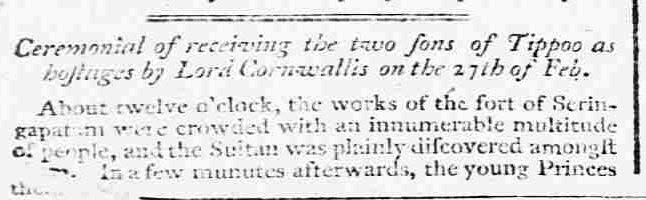
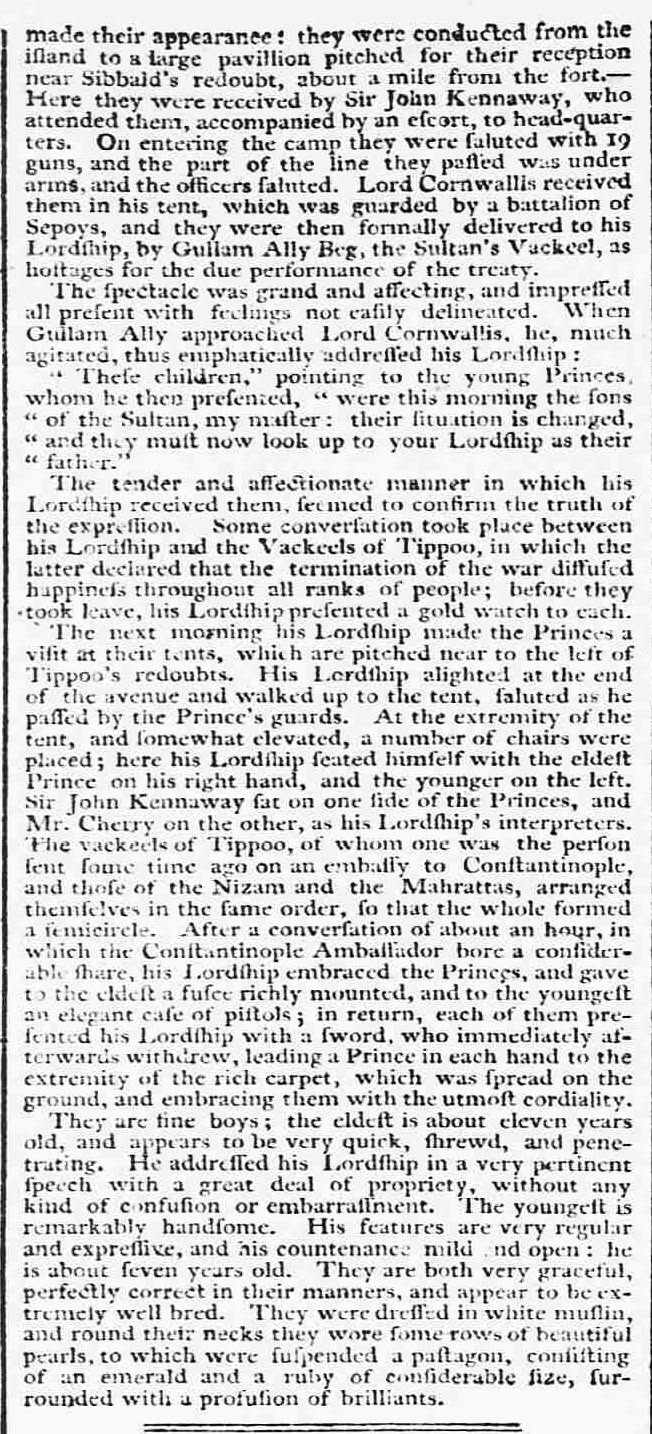
Kennaway’s most significant work came in 1792 when he acted as the British negotiator at the Treaty of Seringapatam, concluding peace between Lord Cornwallis and Tipu Sultan after the Third Anglo–Mysore War. His conduct during these negotiations was formally recognised by the Crown, and he was created a baronet “of Hyderabad” in 1791, one of the few Company servants to receive such distinction for diplomatic service. The picture above shows Lord Cornwallis receiving the sons of Tipu Sultan who were entrusted to Sir John Kennaway until payment of an indemnity. Possibly one of the people on the right of the picture is Sir John himself. He returned to England in 1794 and purchased the Escot estate in Devon, establishing himself as a landed gentleman in the county. His position reflected the typical trajectory of Company officials who returned from India with wealth, connections, and expectations of public responsibility.
Kennaway’s later life was centred on Escot and Devon. He served as a magistrate and took part in county affairs, representing the interests of landowners and agricultural communities. His estate responsibilities were substantial: Escot House was destroyed by fire in 1808, and the rebuilding programme required significant investment and reorganisation of the surrounding land. Kennaway oversaw improvements to tenant housing, adjustments to farming arrangements, and the general reconstruction of the estate after the fire. His family maintained links with Sidmouth, where Kennaway interests became part of local civic life, reflecting the broader integration of returned Company families into Devon society.
In the early nineteenth century William Makepeace Thackeray stayed at Larkbeare while visiting East Devon and became acquainted with Sir John Kennaway, 1st Baronet, and his children. The connection left a lasting impression. By 1852, long after the Baronet’s death, Thackeray drew on his recollections of Escot when shaping the setting of History of Pendennis. Major Pendennis was modelled on the 1st Baronet, and several features of the estate appear in the novel under thin disguise: Ottery St Mary became “Clavering”, Escot itself “Clavering Park”, the oval pond before the house “Carp Pond”, and the River Tale the “Brawl”. The Kennaway household thus provided both the social pattern and the physical landscape for Thackeray’s fictional world.
Sir John Kennaway, 1st Baronet, died in 1836. His career combined military service, high-level diplomacy in India, and the establishment of a landed presence in Devon. He was a representative figure of the East India Company generation whose actions shaped British policy in southern India and whose return home reshaped the social and political landscape of rural Devon. His legacy at Escot was continued by his descendants, but the achievements of the 1st Baronet were distinct: Indian service, Hyderabad diplomacy, the Treaty of Seringapatam, the baronetcy, and the reconstruction of Escot after the 1808 fire.