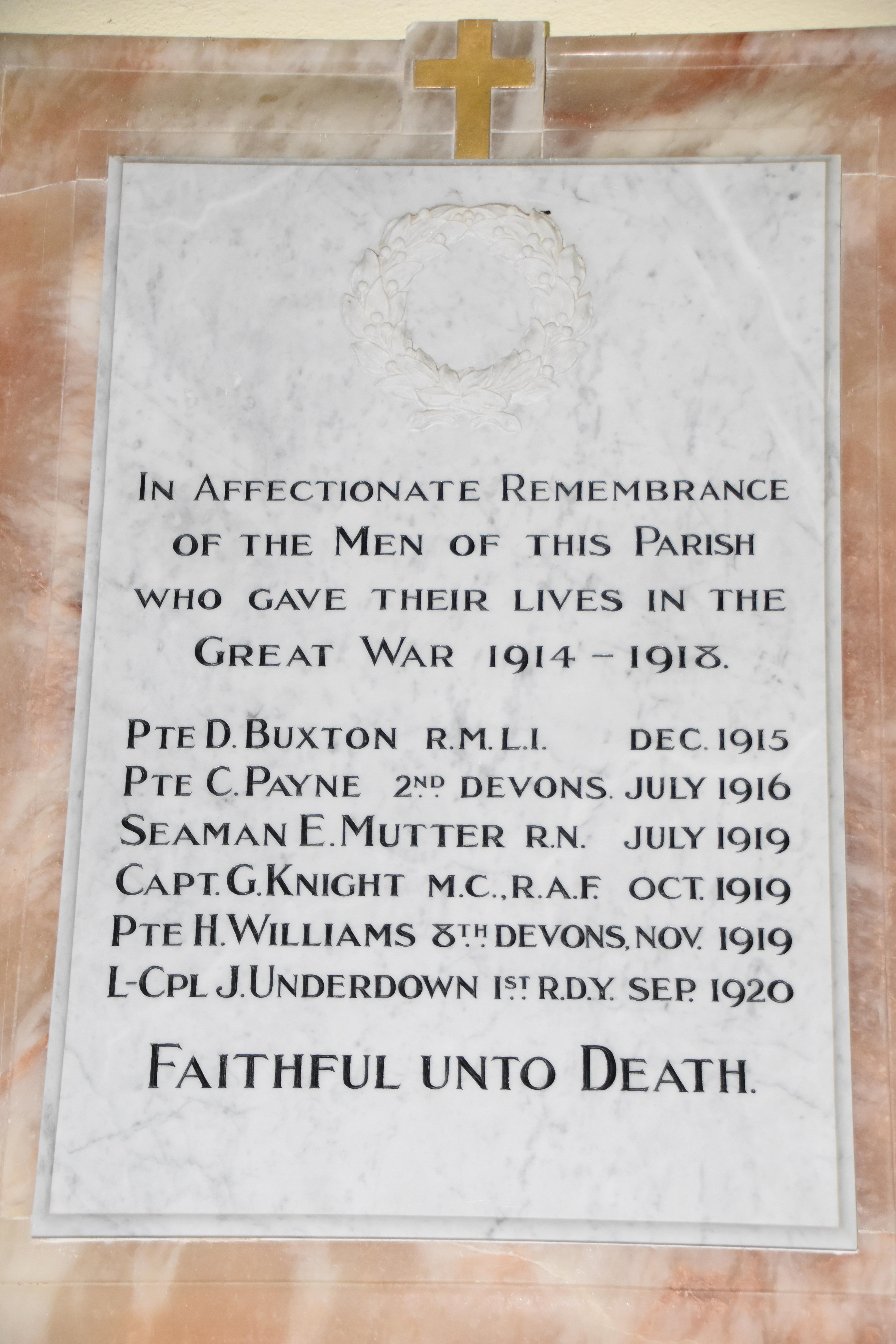
The marble tablet inside St Lawrence’s Church, Southleigh, records six names: Pte D. Buxton, R.M.L.I., December 1915; Pte C. Payne, 2nd Devons, July 1916; Seaman E. Mutter, R.N., July 1919; Capt. G. Knight, M.C., R.A.F., October 1919; Pte H. Williams, 8th Devons, November 1919; and L‑Cpl J. Underdown, 1st R.D.Y., September 1920. Only the first two died during the war itself; the remaining four deaths occurred after the Armistice, illustrating the long reach of wounds, illness and continued operational duties.
Private Donald J. W. Buxton served as Private 18734, Chatham Division, Royal Marine Light Infantry, attached to the 2nd Field Company of the Royal Naval Division. His service is recorded among those connected with the Dardanelles and Gallipoli campaign, and he died in December 1915 during the final phase of the evacuation. His presence on the Southleigh memorial indicates a parish connection, although his surviving biographical details are sparse.
Private Christopher Payne was born at Wiscombe Park on 16 January 1893, the son of Samuel and Mary Payne. In 1911 he was living with his parents in the Stables at Wiscombe Park and working as a gardener and general domestic. He enlisted at Exeter and entered France on 19 January 1915 with the 2nd Battalion, Devonshire Regiment. The battalion fought at Neuve Chapelle, Aubers, Bois Grenier and in the Lys Valley before moving to the Somme in March 1916. Payne was killed in action on 1 July 1916, the opening day of the Somme offensive, and has no known grave; he is commemorated on the Thiepval Memorial. His widow was left expecting their only child, born later that month. His death represents the earliest of the Southleigh losses in France, and the memorial plaque in the church is one of the few surviving local records of his short life.
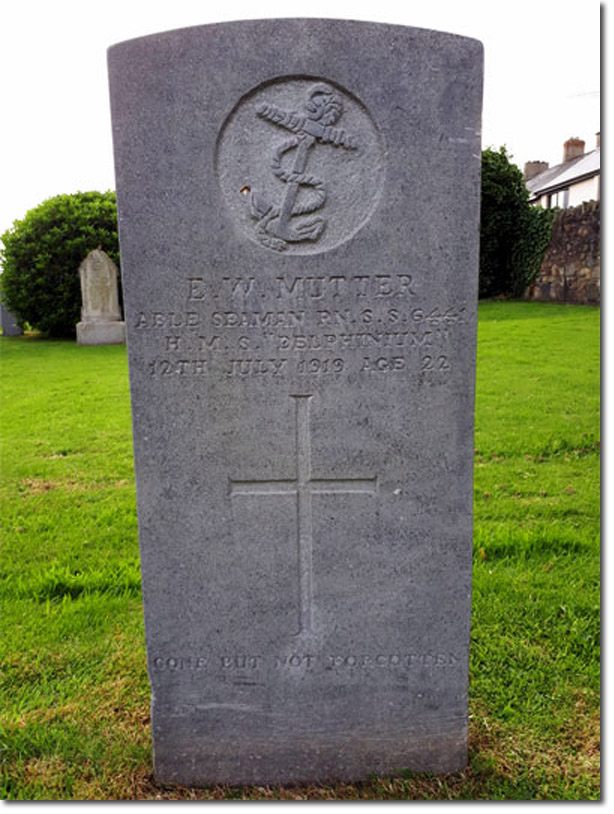
Able Seaman Ernest William Mutter was born on 28 March 1897 at Colyford, living in Southleigh by 1901 and working as a domestic servant at Woodbridge, Farway, in 1911. He served as Able Seaman S.S. 6441 in the Royal Navy and died in an accident on 12 July 1919 while serving aboard HMS Delphinium, an Arabis‑class minesweeping sloop operating from Buncrana, County Donegal, then an important Royal Navy base for Atlantic fleet and minesweeping operations. He is buried in Buncrana (Christ Church) Churchyard, his grave maintained by the Commonwealth War Graves Commission. His death, months after the Armistice, reflects the continuing hazards of naval service in the immediate post‑war period.
Captain George Knight, later Major, had been a Captain as early as 1910 and rose to Major by 1918. He was awarded the Military Cross in the 1918 New Year Honours for distinguished service. At the time of his death he was serving as an instructor in aerial fighting with No. 5 Fighting School. He was killed in an aircraft accident on 23 October 1919 while flying Avro D5505 and is buried in Cairo War Memorial Cemetery. His name appears on the Southleigh memorial as “Capt. G. Knight, M.C., R.A.F.” and represents one of the many post‑war aviation fatalities during the rapid expansion of the Royal Air Force.
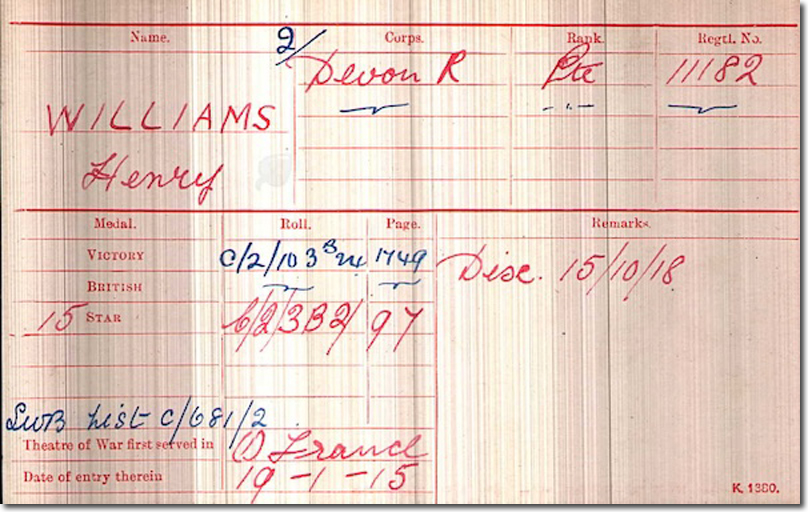
Private Henry Williams of the 8th Battalion, Devonshire Regiment, came from a long-established Beer and Branscombe farming family whose story links Rock Farm in Beer, Lower Bulstone in Branscombe and finally Totiskay Farm in Southleigh. His mother, Ida Routledge Williams (née Hammett), born at Beer on 13 January 1863, was the daughter of Henry and Hannah Hammett of Rock House. Ida’s middle name came from Mary Ann Routledge, the family governess who later married Edward Cox, assistant schoolmaster at Beer. Ida married John Williams, a butcher from Branscombe, in 1881. They began married life running a butcher’s shop in Beer before moving to Lower Bulstone Farm, Branscombe, around 1889. Ida bore nine children and raised eight. Around 1905 the family moved to Totiskay Farm, Southleigh, where they farmed 222 acres with 50 acres in tillage, four cart horses, twelve milk cows and fifty sheep. Henry enlisted at Honiton on 7 September 1914, aged 26, joining the Devonshire Regiment. He entered France on 19 January 1915 with the 2nd Devons. On 10 March 1915, during the attack at Neuve Chapelle, he was wounded by gunfire while advancing across No Man’s Land. After hospitalisation at Boulogne and then Gosport he returned to France in November 1915 and was transferred to the 8th Devons. In April 1916 he contracted German measles and spent time in hospital at Le Tréport. In July 1916 the battalion fought on the Somme, suffering heavy casualties. On 5 September 1916, near Ginchy, Henry was buried alive in his trench by an exploding shell, suffering head, back and abdominal wounds, a fractured pelvis and a ruptured urethra. He was treated at Rouen, then evacuated to England and admitted to Netley Hospital. Further operations followed at St George’s Hospital, London, where kidney stones and dead bone in the urethra were discovered. His disability was assessed at 60 per cent, later increased to 70 per cent. He was discharged as physically unfit on 15 October 1918 and returned to Totiskay Farm. He died in November 1919, aged 30. His parents received the Memorial Plaque, known as the “Dead Man’s Penny.” Ida’s other son, John, also served, first in the Devonshire Yeomanry and later in the 444th Agricultural Company, Labour Corps. He lost the sight in his left eye in February 1916 and was treated at military hospitals in Exeter and Bournemouth. He was discharged on 19 March 1919. Ida’s husband John Williams died in 1935, and Ida herself died at Totiskay Farm in 1940. Henry Williams is commemorated on the Southleigh memorial as “Pte H. Williams, 8th Devons, Nov 1919.”
Lance Corporal John Underdown of the 1st Royal Devon Yeomanry, service number 230230, died on 20 September 1920. The regiment had served in Gallipoli, Egypt and Palestine before returning to the United Kingdom, and many men continued to suffer from disease contracted overseas. Underdown’s death in 1920 reflects the lingering effects of wartime service and marks the last of the six Southleigh men commemorated on the memorial.