

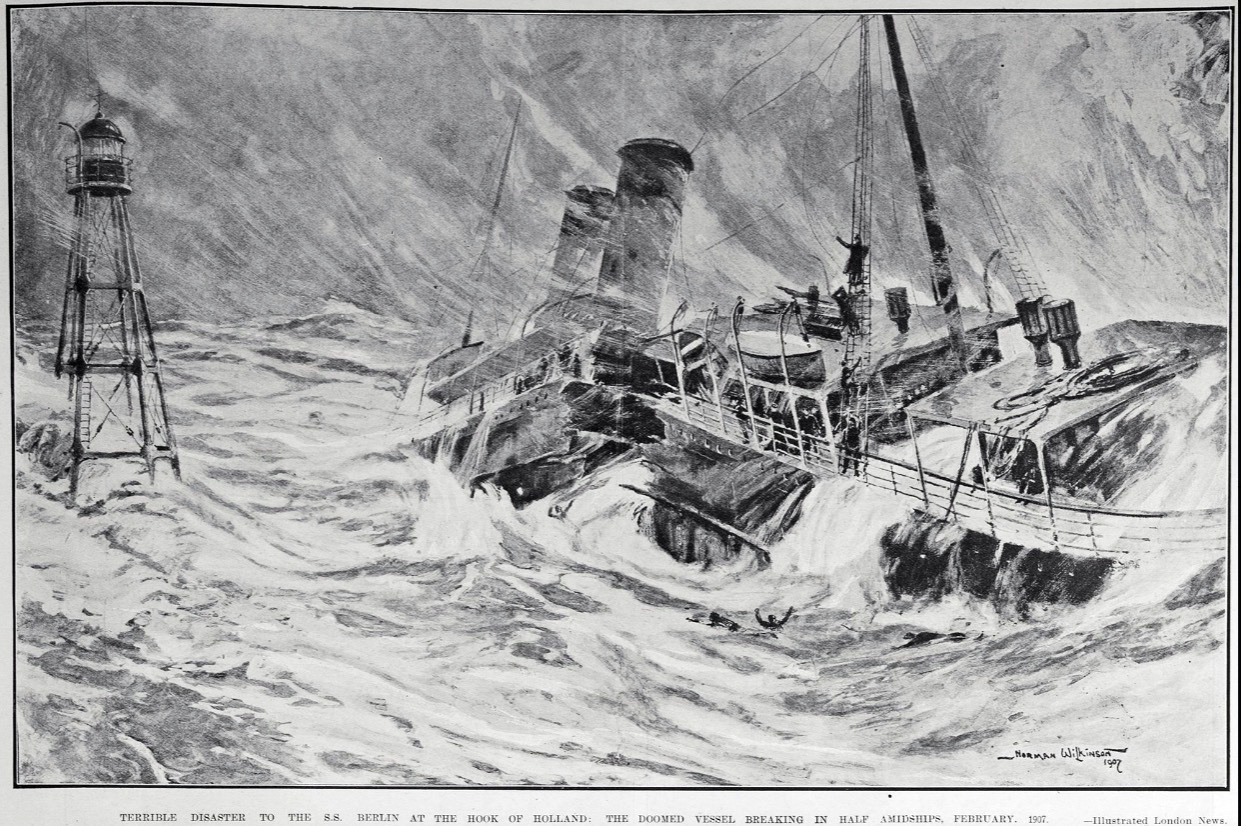
The loss of the SS Berlin in February 1907 was one of the worst maritime disasters of the early twentieth century and remains a sombre episode in the history of the Great Eastern Railway’s cross‑Channel services. Despite its German‑sounding name, the Berlin was a British‑owned steamship operating the regular ferry route between Harwich and the Hook of Holland. On the night of 21 February she attempted to enter the Dutch port in heavy seas, only to be struck by a succession of powerful waves that drove her onto the granite breakwater. Within sight of safety, the ship was impaled on the rocks and broke in two within an hour of grounding.
The bow section sank quickly, taking with it the majority of those on board. The stern, however, remained perched precariously on the breakwater, battered by the sea and in constant danger of sliding off into deeper water. A small group of survivors clung to the wreckage through a long and terrifying night, exposed to freezing spray and the continual pounding of the waves. Rescue attempts were hampered by the conditions, and it was not until the following day that a pilot boat was able to reach the wreck and bring off eleven survivors. In total, 128 of the 144 passengers and crew perished.
Among the dead was Iom Randall Garnsworthy, aged just twenty‑one, whose name appears on the elaborate Garnsworthy memorial in Exwick Cemetery. His father, Thomas William Garnsworthy, had himself been lost at sea fifteen years later while yachting off Dawlish, his body never recovered. The memorial therefore commemorates two men whose lives ended in the waters off the coast of Europe, neither of whom has a known grave. The third name on the stone, Randall Garnsworthy, survived the First World War with distinction, earning a D.S.O. and two mentions in despatches, only to die young in 1932. He is buried at Ide, leaving the Exwick monument as a cenotaph rather than a grave.
The wreck of the Berlin caused widespread shock at the time, not least because it occurred so close to harbour and in full view of those on shore. The inquiries that followed examined the difficulties of navigating the Hook of Holland in winter storms and the vulnerability of cross‑Channel steamers to sudden squalls and heavy seas. The disaster prompted improvements in harbour approaches and lifesaving equipment, but for families such as the Garnsworthys the loss was immediate and irreparable. The memorial in Exwick, with its ornate carving and multiple inscriptions, stands as a reminder of how a single family could be touched repeatedly by tragedy at sea.

