

St German’s may not appear on many Cornish itineraries, lying far to the east and almost on the border with England. Yet for travellers crossing into Devon, a pause here offers a glimpse of one of Cornwall’s most historic settlements. With a population of under 1,500, little changed for decades, the village retains its medieval footprint and its deep connection to the River Tiddy and the Port Eliot estate.
Named in the Domesday Book of 1086, St German’s ranked among the largest settlements in Cornwall, valued at £13 annually to its tenant-in-chief, the Bishop of Exeter. Around 930 King Æthelstan appointed Conan as Bishop of Cornwall, establishing the de facto cathedral at St German’s. This episcopal see lasted until 1050, when it merged with Crediton and transferred to Exeter. Alongside the early Anglo-Saxon church a monastery was founded, later reorganised as an Augustinian Priory by Bartholomew, Bishop of Exeter, between 1161 and 1184. The church was rebuilt during this period and consecrated in 1261 by Bransgrove, Bishop of Exeter. Its west front, with twin Norman towers and a richly carved doorway, remains one of the finest examples of Norman architecture in Cornwall.
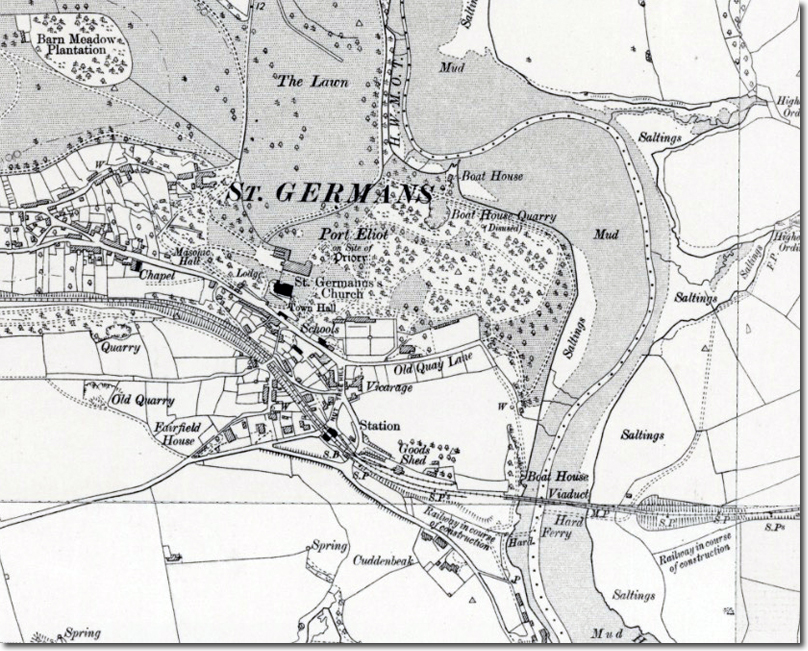
The dissolution of the priory in 1539 ended centuries of monastic life. The church became the parish church, while the adjoining priory buildings were sold to the Eliot family. The Eliots transformed the site into Port Eliot, rebuilding in neo-classical style under Sir John Soane and laying out gardens by Humphry Repton. Their influence extended beyond the estate: the course of the River Tiddy was altered to move the water away from the house and create formal gardens, reshaping the landscape shown on the Edwardian map above. The family’s stewardship over four centuries has left a lasting imprint on the village and its surroundings.
St German’s was once a parliamentary borough, electing two MPs until the Great Reform Act of 1832 abolished its representation. The railway arrived in 1859 with the opening of the Cornwall Railway Company’s station, later absorbed by the Great Western Railway. To the east of the station the original timber viaduct was replaced by the stone structure completed in 1908, marked on the map as “railway in course of construction.” The viaduct and station remain prominent features of the village today.
Historic buildings survive throughout St German’s, including the 16th-century almshouses known as The Galleries, built by Sir William Moyle in 1583 to house twelve poor folk. The quay on the River Tiddy, once busy with timber, limestone, and coal, now serves the local sailing club. The estuary’s saltmarshes form part of a Site of Special Scientific Interest, a reminder that the natural environment here is as significant as its architecture.
Festivities have long been part of village life. Medieval fairs and markets once drew crowds from across Cornwall, and the revived May Tree Fair continues that tradition with music, dancing, and local produce. In modern times the Eliot family hosted the Elephant Fayre (1981–1986) and later the Port Eliot Literary Festival, events that brought thousands to the estate and became notable features of the late 20th-century village calendar.


