

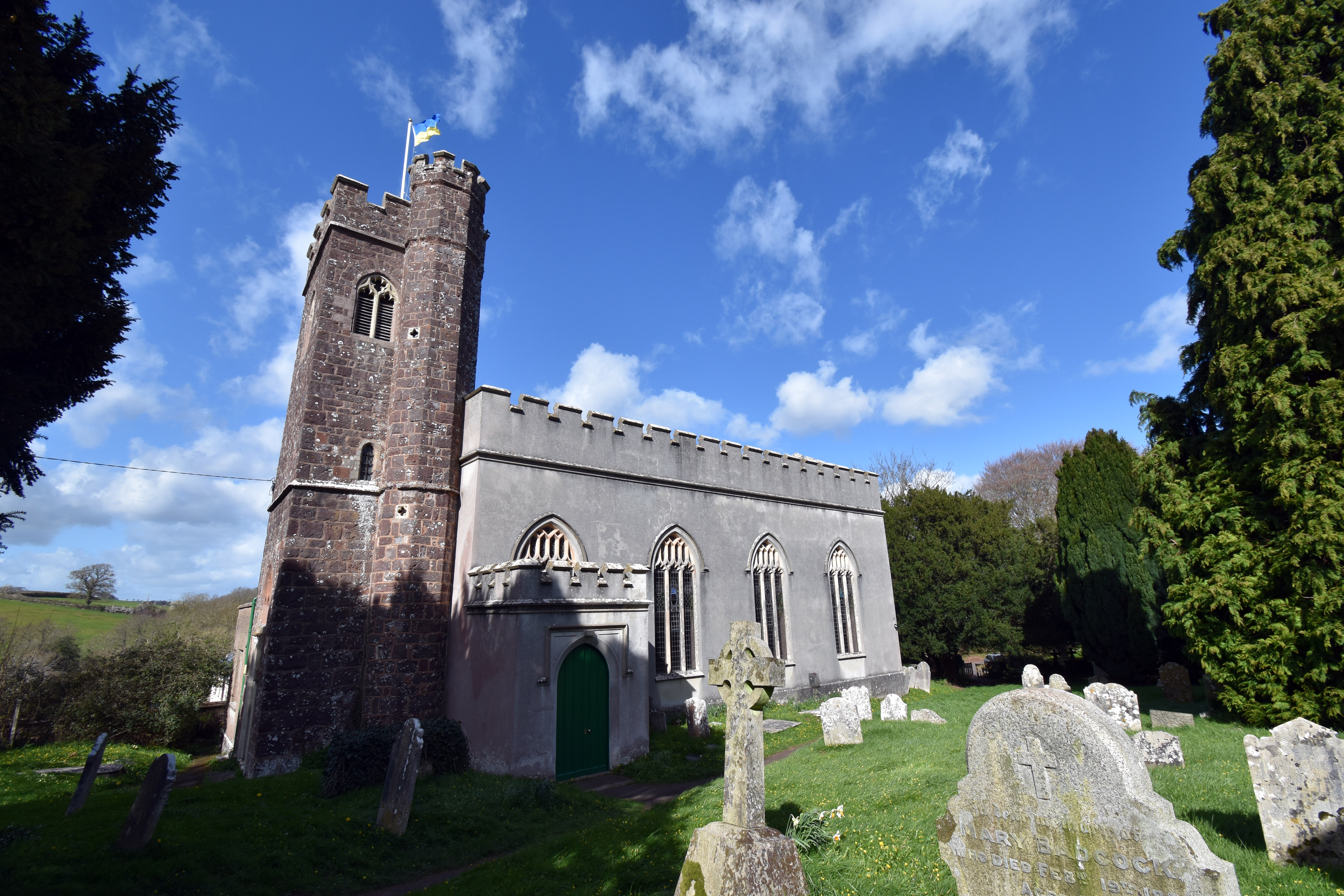
St Ida’s at Ide is a parish church consisting of a fifteenth‑century Perpendicular tower and a complete rebuilding of the nave and chancel carried out in 1833 by the local architect‑builders Hooper and Cornish. The tower is constructed of volcanic trap brought to course, while the nineteenth‑century work is cement‑rendered with a slate roof. The plan comprises the medieval tower, a rectangular nave, a shallow chancel, a north‑west vestry and a south porch.
The 1833 rebuilding produced a plain early nineteenth‑century Gothic structure typical of the period immediately before the Victorian Gothic Revival. The nave is a four‑bay battlemented rectangle with tall three‑light windows with Perpendicular‑style tracery. The shallow chancel has a similar four‑light east window and a battlemented gable. A flat‑roofed vestry occupies the north‑west corner and the south‑west porch is battlemented with an arched outer doorway. The west tower, without pinnacles, has a four‑sided south‑east stair turret, two‑light traceried belfry openings on all faces and a single chamfered opening at the bellringer’s stage on the south side. The nineteenth‑century west doorway cuts into the remains of the original three‑light Perpendicular west window with its volcanic‑trap tracery.
The interior has plastered walls and no chancel arch. The ceiling is plastered with a segmental profile. A west gallery is carried on moulded iron columns. Some fittings from 1833 survive, including panelled box pews against the north and south walls, fragments of Gothick panelling in the chancel and a small octagonal‑bowl font. The remainder of the furnishings are early twentieth‑century work by Herbert Read: a thirteen‑bay chancel screen with square‑headed openings, matching parcloses, a reredos, choir stalls, a large timber drum pulpit on a wineglass stem with carved figures under traceried niches, and nave benches. The stained glass is early twentieth century with an Art Nouveau influence. A 1721 wall monument to Joseph Tothill with a broken pediment and an achievement survives from the earlier church, as does an unusual mid‑ to late‑nineteenth‑century coffin waggon kept in the nave.
The church also contains a bier used for carrying coffins and a dedication to William Edwin Braddon, who died in Buenos Aires in 1930. The First World War memorial lists twenty‑three parishioners, and a separate tablet commemorates Paul Francis William Studholme, killed at Passchendaele in 1917. The organ was brought here from St Edmund’s on the medieval bridge in Exeter. These details underline the building’s role as the parish’s long‑standing record of local and overseas connections.
Although St Ida’s is not technically architecturally distinguished, it is historically valuable as an example of how a local builder approached the reconstruction of a medieval church immediately before the Gothic Revival reshaped ecclesiastical design. Its mixture of a medieval tower, a utilitarian 1830s nave and chancel, and early twentieth‑century fittings gives it a layered character that reflects the village’s long continuity and the practical decisions required to keep a parish church functioning on a difficult sloping site. It is quite simply unique.

