

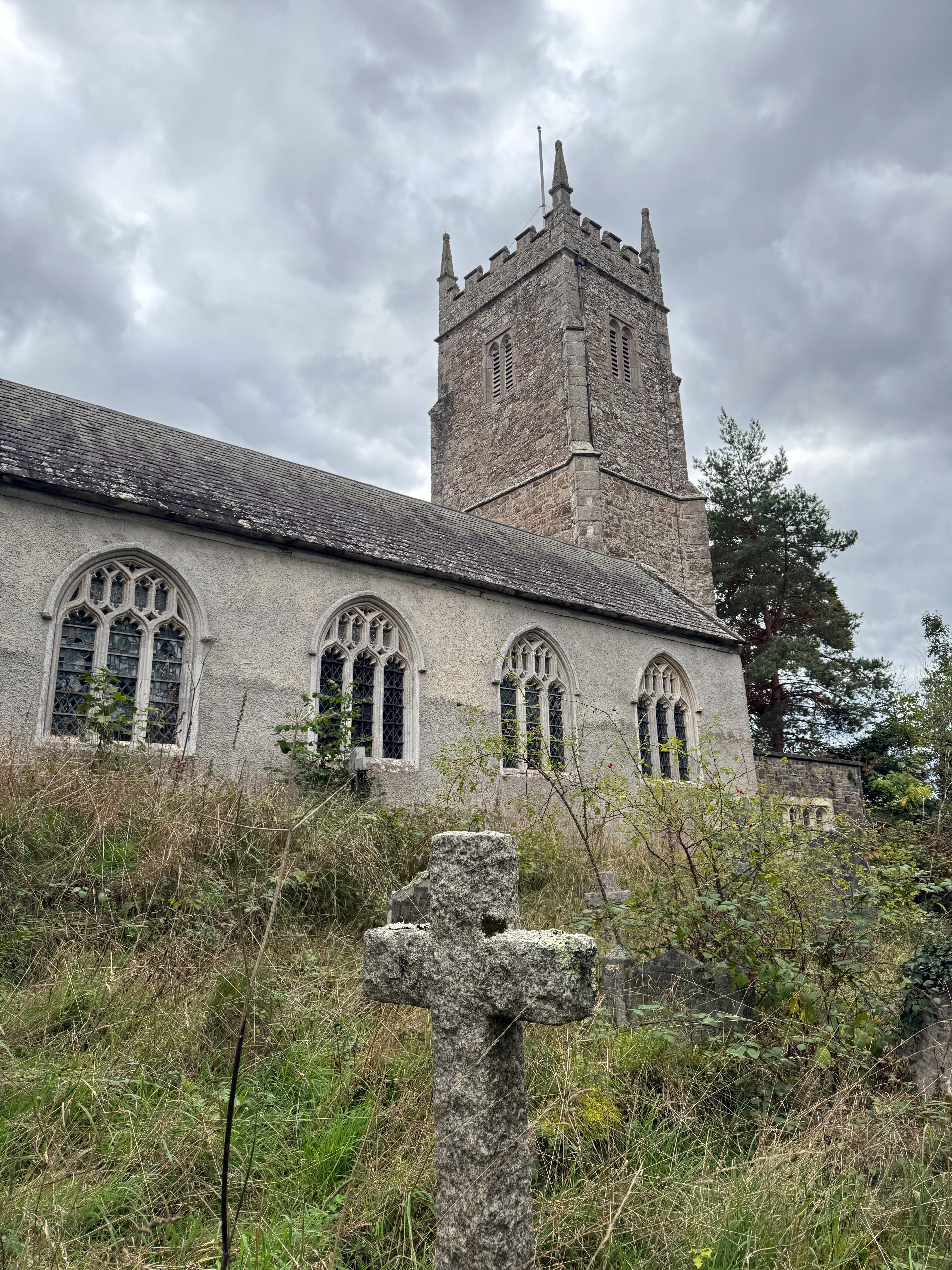
The parish church of St John the Baptist at Ashton stands as one of the most remarkable medieval survivals in the Teign Valley. Its fabric is largely of the early fifteenth century, a period of confidence and prosperity in Devon, when the Perpendicular style filled churches with light and grandeur. Though restored in the late nineteenth century — first by the rector, Rev. R. Dennett (1881–83), and later by the architect Ponting of Marlborough (1899–1901) — the church retains an extraordinary wealth of medieval woodwork, glass, and painting that makes it a treasure-house of English parish art.
The exterior is dominated by the battlemented west tower, built of dressed moorstone with obelisk finials at the corners. Its deeply recessed granite doorway and traceried west window proclaim the craftsmanship of the fifteenth century. The south porch, with its moulded medieval roof and trefoil-headed niche above the doorway, still shelters a seventeenth-century studded door. Around the church, Perpendicular windows — many with nineteenth-century repairs — light the nave, chancel, and north aisle, while a small stair turret on the south side once gave access to the rood loft.
Inside, the church is outstanding. The nave and chancel are covered by open wagon roofs with moulded ribs and carved foliage bosses, while the granite tower arch and the elaborate five-bay Beerstone arcade display the masons’ skill. Yet it is the rood screen that takes pride of place. Stretching across eight bays, it is one of the finest in Devon. Its painted panels, with conventional figures on the west side and large demi-figures on the east, are exceptionally well preserved and have been described as among the best in the county. The parclose screen of the Lady Chapel, with its traceried bays, adds to the richness of the ensemble.
The fittings are equally distinguished. The Perpendicular font, carved from Beerstone, bears heraldry said to commemorate the 1476 marriage of Sir James Chudleigh of Place Barton and Margaret Stourton, linking the church to the powerful local family who long held the manor. The late sixteenth-century timber pulpit, with its tester richly decorated with ribs, bosses, and stars, is a masterpiece of Elizabethan woodwork. The nave retains a full set of medieval benches with blind tracery bench ends, some with carved backs, a rare survival of parish seating from the fifteenth century.
The chancel holds further treasures: a trefoil-headed piscina, a tomb recess with a granite slab carved with a cross, eighteenth-century altar rails, and nineteenth-century choir stalls. Over the nave door hangs the painted Royal Arms of 1735, while the north-east chapel preserves a seventeenth-century altar table. On the north wall is a remarkable timber wall monument to Sir George Chudleigh, who died in 1657, recording the descent and alliances of the family with painted heraldic shields. Nearby, a severe Egyptian-style tablet commemorates William Godfrey (d. 1798), signed by the sculptor T. Robinson.
The stained glass is of national importance. Though fragmentary, the heraldic panels in the tracery date from the episcopate of Bishop Lacy (1420–55) and are attributed to the so-called Doddiscombsleigh school of glass painters. They record the alliances of the Chudleighs and once formed part of a much larger scheme. Restored in 1901–02 by F. Morris Drake of Exeter, the glass was praised for its remarkable technical quality. The east window, also designed by Drake, continues this tradition of colour and light. On the north wall of the Lady Chapel, a rare wall painting of the Mass of St Gregory survives, with further fragments nearby — tantalising hints of a once richly painted interior.
Taken together, St John the Baptist, Ashton, is an outstanding medieval church. Its rood screen, stained glass, wall paintings, and woodwork form a collection of national significance, while its monuments and heraldry root it firmly in the story of the Chudleigh family and the wider history of Devon. To step inside is to encounter not only the craftsmanship of the fifteenth century but also the layers of devotion, memory, and artistry that have shaped this parish for over six hundred years.

