

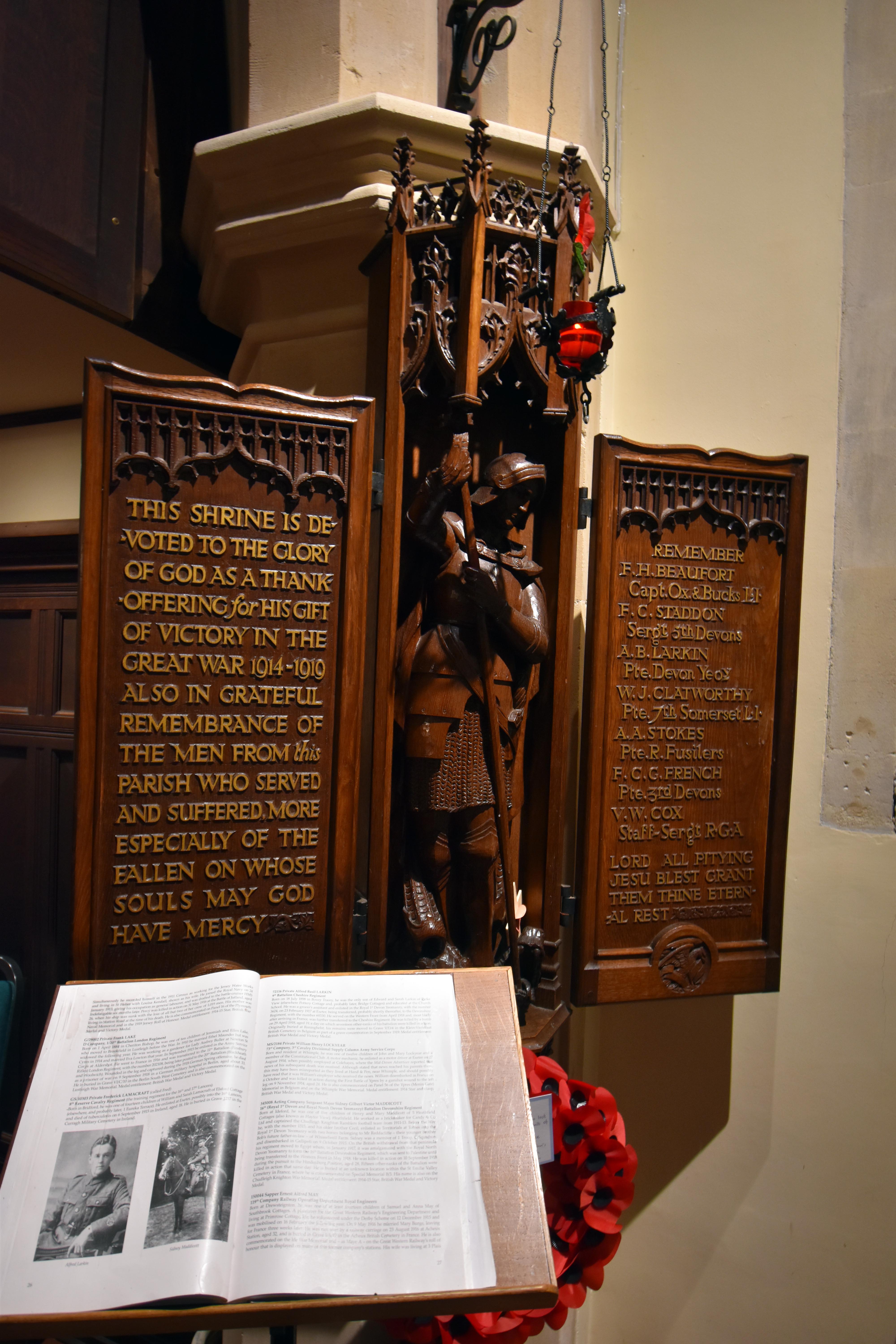
In addition to Francis Hugh de Beaufort being remembered both inside and outside the church, many other members of this parish are commemorated on a beautifully carved wooden memorial within the nave. A carefully compiled book beside it records their stories in detail, allowing visitors to understand not only the names but the lives behind them. What follows are some of the men of Bovey Tracey whose service and deaths are preserved there.
Private Walter James Clatworthy was born on 26 August 1887 in Oakford, one of seven children of John and Mary Clatworthy. He was educated at Highweek Boys School and by 1911 was living with his parents at Foxwell Cottage, Wain Lane, Newton Abbot, working as a domestic gardener. On 27 October 1915 he married Elizabeth Mogridge, and the couple lived at 2 Thorn Cross, Bovey Tracey before she later moved to 1 Manor Cottages, Wolborough Street, Newton Abbot following his death.
Clatworthy left his job at Bridge House to enlist in the 3rd Battalion Devonshire Regiment at Newton Abbot, later transferring to the 7th Battalion Somerset Light Infantry. Serving in A Company, 3 Platoon, he received a commendation in 1917 from Major General Smith of the 20th (Light) Division for rescuing a wounded comrade under heavy shellfire. Acting as a stretcher bearer, he was captured at St Quentin on 22 March 1918 and died of wounds as a prisoner of war on 4 August 1918, aged 31. First buried in Quedlinburg Cemetery, he was later reinterred in Grave VIII/K/2 at Niederzwehren Cemetery in Germany, where his wife chose the inscription “He died that we might live.”
Fitter Staff Sergeant Verney William Cox was born in Islington, the eldest of eight children of William and Lydia Cocks (later Cox). By the time of the First World War he was living in Bovey Tracey at 26 Pottery Road and working as a vehicle engineer at the Bovey Pottery Potteries. He married Lily Daymond in 1897, though he had been widowed by 1911, and later married Millicent Julyan just four days before being posted to France in April 1916.
Cox enlisted at Woolwich on 18 January 1916 and served with the 138th Heavy Battery, Royal Garrison Artillery. He had previously served with the Mediterranean Expeditionary Force from July 1915 to January 1916. On the night of 23 August 1917, aged 42, he was killed by shellfire, only five days after returning from nine days of leave. He is buried in Grave III/B/14 of the Coxyde Military Cemetery in Belgium. Although a long obituary in the Mid-Devon Advertiser mentioned a Military Medal, no official corroboration appears in the London Gazette. At the time of his death his wife was living at Trethowell Terrace in St Austell and received a widow’s pension of 17s. 6d. His estate, valued at £381 14s. 10d., was administered by his widowed mother.
Private Frederick Charles George French was born in Bovey Tracey, one of two children of James and Florence French, who lived at 6 Mount Pleasant Cottages in the early 1900s. Before the war he worked for Candy & Co Ltd at Heathfield, a local firm employing many young men from the area. He enlisted at Exeter and joined the 9th Battalion of the Devonshire Regiment.
On 1 July 1916, the opening day of the Battle of the Somme, French was killed in action near Mametz during the Battle of Albert. He was 20 years old. The 9th Battalion suffered heavy losses that day, with 155 other ranks killed in the initial assault. French’s body was never recovered, and he is commemorated on Pier & Face 1C of the Thiepval Memorial in France.
Private Alfred Basil Larkin was born on 18 July 1898 in Bovey Tracey, the youngest son of Edward and Sarah Larkin of Parke View. He was educated at the Church School and later worked as a grocer’s assistant. He enlisted in the Royal 1st Devon Yeomanry, later transferring to the Devonshire Regiment and finally to the 9th Battalion of the Cheshire Regiment, serving under the number 72116.
Larkin was sent to the Western Front in April 1918, just as the final phase of the war was intensifying. On 29 April, only weeks after arriving, he was killed by a bomb. He was originally buried at Reninghelst, but later reinterred in Grave V/D/4 of the Klein-Vierstraat British Cemetery in Belgium. His medal entitlement included the British War Medal and the Victory Medal.
Sergeant Frank Charles Staddon was born in Bovey Tracey, one of at least three children of Charles and Elizabeth Staddon of 2 Heathfield Terrace. He attended the Church School and later worked as a clerk at the Bovey Pottery Company Ltd. A pre-war Territorial Force soldier, he originally served under the number 1395 before being renumbered 240212. His battalion, the 1/5th Devonshire Regiment, was posted to India at the outbreak of war and later transferred to Egypt in April 1917.
Staddon was killed in action on 21 November 1917 near Saris, aged 22. He is buried in Grave P/4 of the Jerusalem War Cemetery in Israel. Four other ranks of the battalion were killed that same day. His family chose the inscription “Never forgotten” for his headstone. His medal entitlement included the British War Medal, Victory Medal and the Territorial Force War Medal.
Together, these men represent a cross-section of Bovey Tracey at the time of the First World War: gardeners, clerks, engineers, stretcher bearers and young apprentices, each drawn into a conflict that carried them far from the town’s lanes and potteries. Their names, carved in wood and preserved in the church’s memorial book, offer a quiet record of the parish’s experience of the war and the individual lives behind the memorial.

