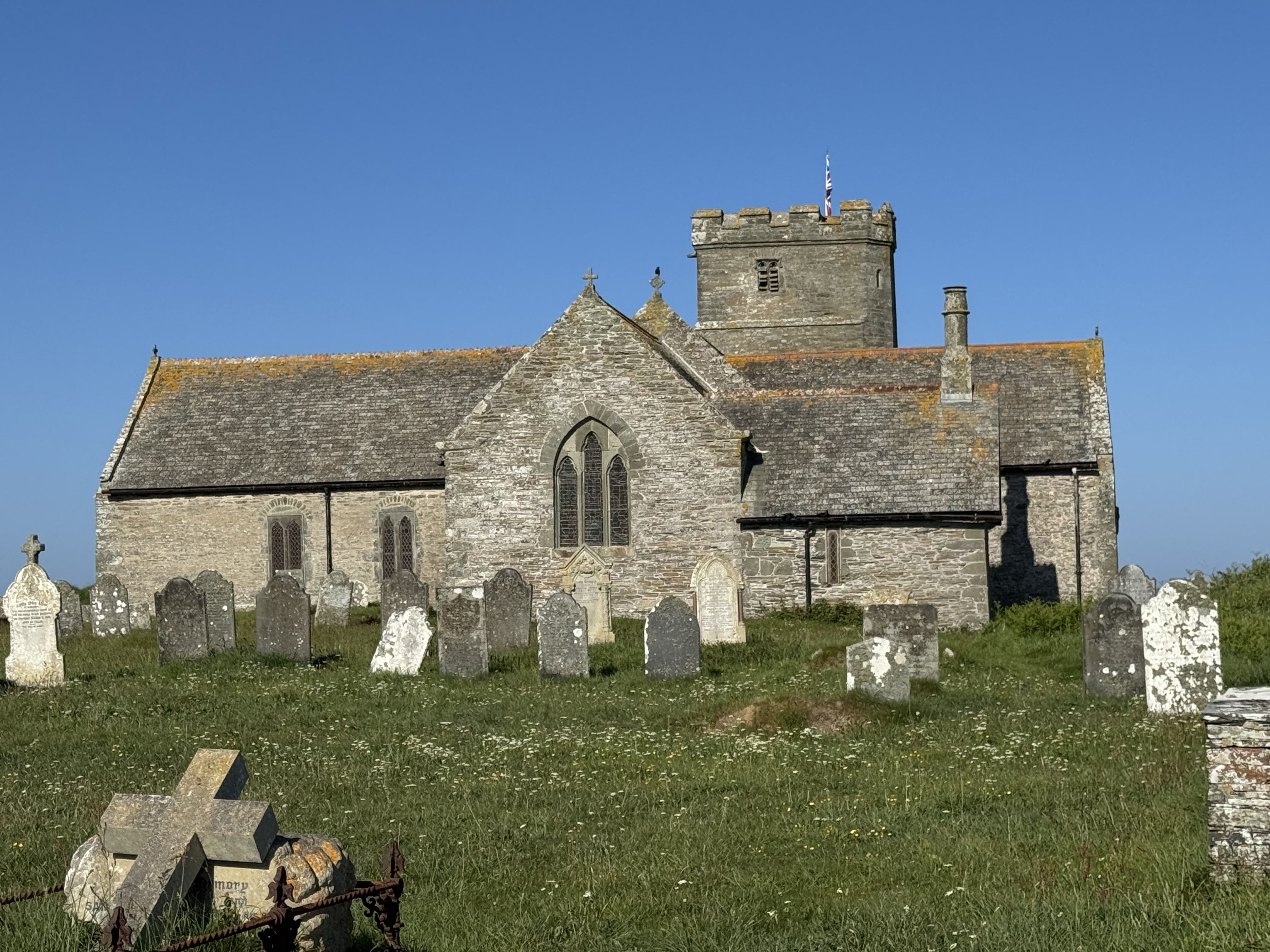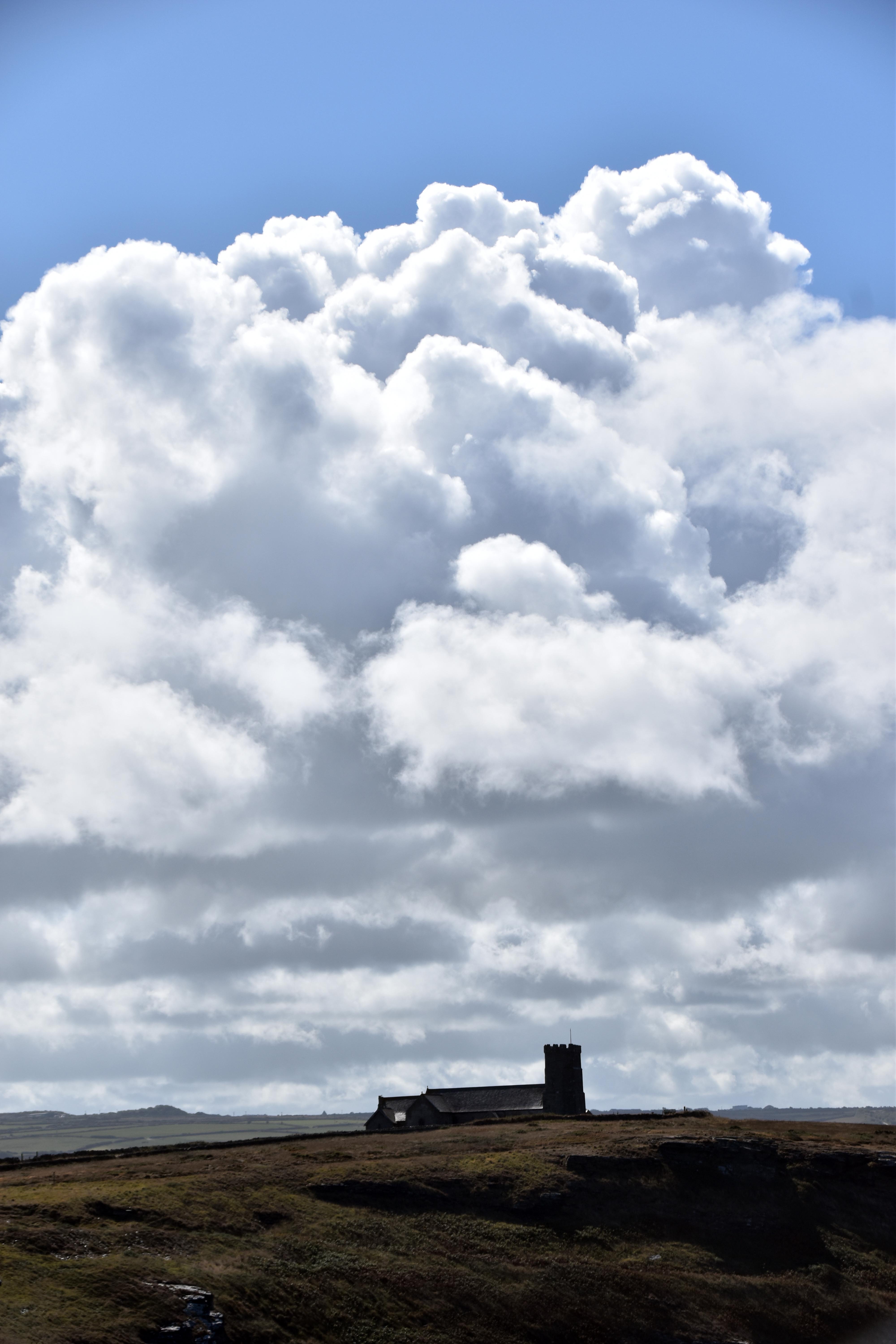
Whilst most visitors come to Tintagel in search of King Arthur, the ruined castle and the dramatic Atlantic scenery, one of the most historically important sites in the parish stands quietly on the neighbouring headland. St Materiana's Church occupies one of the most remarkable ecclesiastical locations in Cornwall and possesses a history stretching back far beyond its present Norman walls.
The church is dedicated to St Materiana, sometimes recorded as Mertheriana or Mertherian. She appears to have been a Welsh saint rather than a Cornish one and was regarded as the patron saint of Tintagel by at least 1258. She was also the patron saint of nearby Minster, where tradition maintained she was buried. Later legends made her a daughter of King Vortimer, one of the rulers who opposed Saxon expansion into Britain during the fifth century, although such traditions are impossible to verify. What is clear is that the dedication reflects the strong links between Cornwall and Wales during the centuries following the end of Roman rule.
The present church stands beside a site of even greater antiquity. Excavations to the north of the church have revealed an important early Christian cemetery dating back to the sixth century. Archaeologists uncovered a small Christian enclosure, a font and the remains of an earlier church serving the community associated with the Dark Age settlement at Tintagel. This was the same period in which the headland now occupied by Tintagel Castle was an important high-status settlement with trading links stretching as far as the Mediterranean.
The discovery of this burial ground transformed our understanding of Tintagel. Rather than being merely an isolated royal settlement, it appears to have possessed an organised religious community on the neighbouring headland. The church and cemetery almost certainly served the rulers, inhabitants and traders associated with the settlement on Tintagel Island.
The first stone church on the site of St Materiana's was constructed between about 1080 and 1200. The original Norman building consisted simply of a nave and chancel. Shortly afterwards a small chapel was added on the north-east side, now known as the Blessed Sacrament Chapel. Excavations have also revealed the remains of one or possibly two Norman cemetery chapels within the churchyard itself, demonstrating that the surrounding burial ground remained an important place of devotion throughout the medieval period.
Much of this Norman church remains visible today. The north and south doorways survive from this earliest phase, as do several of the nave windows. Most remarkable are the hinges of the north door, which are traditionally regarded as original twelfth-century ironwork. Such survivals are increasingly rare and provide a tangible connection to the craftsmen who worked here nearly nine hundred years ago.
The church continued to expand as Tintagel's importance increased during the Middle Ages. During the late thirteenth or early fourteenth century north and south transepts were added, transforming the church into the cruciform shape seen today. This work took place during the period when the Earls of Cornwall controlled Tintagel Castle and when Richard of Cornwall's new castle still dominated the nearby headland.
The tower at the west end was added later and has been variously dated to the thirteenth, fourteenth or early fifteenth century. The belfry openings, however, appear to belong to the sixteenth century, indicating that the tower underwent further modification. Rising above the cliffs, it remains one of the most striking landmarks on the North Cornish coast and is visible for miles in both directions.
Like most medieval churches, St Materiana's displays evidence of architectural changes spanning centuries. Norman windows survive alongside Early English, Decorated and Perpendicular work, whilst Victorian restorers introduced further alterations and replacements. The result is a building that reflects almost every major phase of English ecclesiastical architecture from the Norman Conquest onwards.
Among the church's most important furnishings is its Norman font. Carved from stone and decorated with serpents at the corners, it remains in regular use after more than eight centuries. Excavations have uncovered fragments of an even earlier Norman tub font which had been reused within the foundations of one of the cemetery chapels. A second Norman font bowl, brought from St Julitta's Chapel within Tintagel Castle itself, is now preserved within the north-east chapel.
One of the most remarkable survivals is the early sixteenth-century rood screen. Unlike many Cornish screens it does not appear to have been heavily reconstructed during the Victorian period. Darkly stained with age, it still displays the substantial timbers necessary to support the medieval organ loft, organist and the great rood or crucifix that once stood above it. Looking at it today, it is not difficult to imagine the appearance of the church immediately before the Reformation transformed English religious life.
The chancel contains medieval canopied recesses dating from the fourteenth century, whilst the reredos behind the altar is assembled from carved fifteenth-century bench ends, some of which are known to have originated at St Teath. The bishop's chair is said to be late Tudor in date, whilst the priest's reading chairs incorporate medieval carved wood re-used during the Victorian period.
The church also contains an impressive collection of monuments. A substantial thirteenth-century memorial stone carved with a foliated cross survives within the building and stone seating runs around part of the south transept. Particularly notable is the three-quarter length memorial brass of Johanna Kelly dating from about 1430. Memorial brasses of this quality are relatively rare in Cornwall and it offers a valuable glimpse of late medieval commemorative art.
Perhaps the most historically significant object within the church is easily overlooked. In the north transept stands a Roman inscribed stone bearing the name of the Emperor Licinius. Since Licinius died in AD 325, the stone can be securely dated to the early fourth century. Its presence provides compelling evidence for Roman influence and activity in this part of Cornwall and demonstrates that the transition from Roman Britain to early medieval Cornwall was far more complex than once believed.
The church's memorials also tell stories extending far beyond Cornwall. One commemorates a soldier who died on the North West Frontier after the Second Afghan War. Another records an officer of the Indian Army who died whilst a prisoner of the Ottoman Empire following the surrender of Kut-el-Amara in 1916. A particularly moving memorial remembers an RAF fighter pilot killed during the Battle of Britain after shooting down four German bombers. The inscription notes that he was baptised in the Norman font over which his memorial now keeps watch.
Perhaps no memorial better illustrates the relationship between the church and the sea than the relics associated with the Italian barque Iota, wrecked beneath the cliffs at Bossiney Cove in 1893. Local rescuers managed to save nearly all aboard, but a fourteen-year-old Italian cabin boy lost his life. He was buried in the churchyard and is still remembered through the ship's life belt and memorial which survive as poignant reminders of the dangers of the North Cornish coast.
Attached to the church is one of its most intriguing features, a small chapel on the northern side which may once have served as an anchorite's cell. Although definitive proof is lacking, its location and arrangement make the suggestion plausible. An anchorite was a religious recluse who lived in seclusion whilst devoting their life to prayer. Significantly, the chapel contains one of the very few pre-Reformation stone altars to survive in Cornwall, giving visitors a rare glimpse of how medieval worship was conducted before the religious upheavals of the sixteenth century.
The church's stained glass includes modern works alongside older memorial windows. The great west window presents scenes from the history of Tintagel, linking the church to the wider story of the parish from its Celtic origins through to the age of Arthurian tourism. Elsewhere, icons and devotional artwork create an appearance unusual in many Anglican churches and reflect the continuity of Christian worship on the site over many centuries.
What makes St Materiana's unusual is not simply its age but the sheer breadth of human experience preserved within its walls. Few churches can point to evidence of Roman Cornwall, a nearby sixth-century Christian cemetery, Norman architecture, medieval memorials and Tudor furnishings all in the same building. Fewer still contain memorials linking a remote Cornish headland to Afghanistan, Mesopotamia, the skies above southern England during the Battle of Britain and the wreck of an Italian ship beneath the cliffs below.
It is often overshadowed by Tintagel Castle and the legends of Arthur and Tristan. Yet whilst those stories belong partly to the world of myth and literature, the church preserves the lives of real people who worshipped here, were baptised here, were married here, were buried here or were remembered here by those left behind. The castle tells us what medieval people imagined about Cornwall's past. St Materiana's tells us how generations of Cornish people actually lived their faith.