

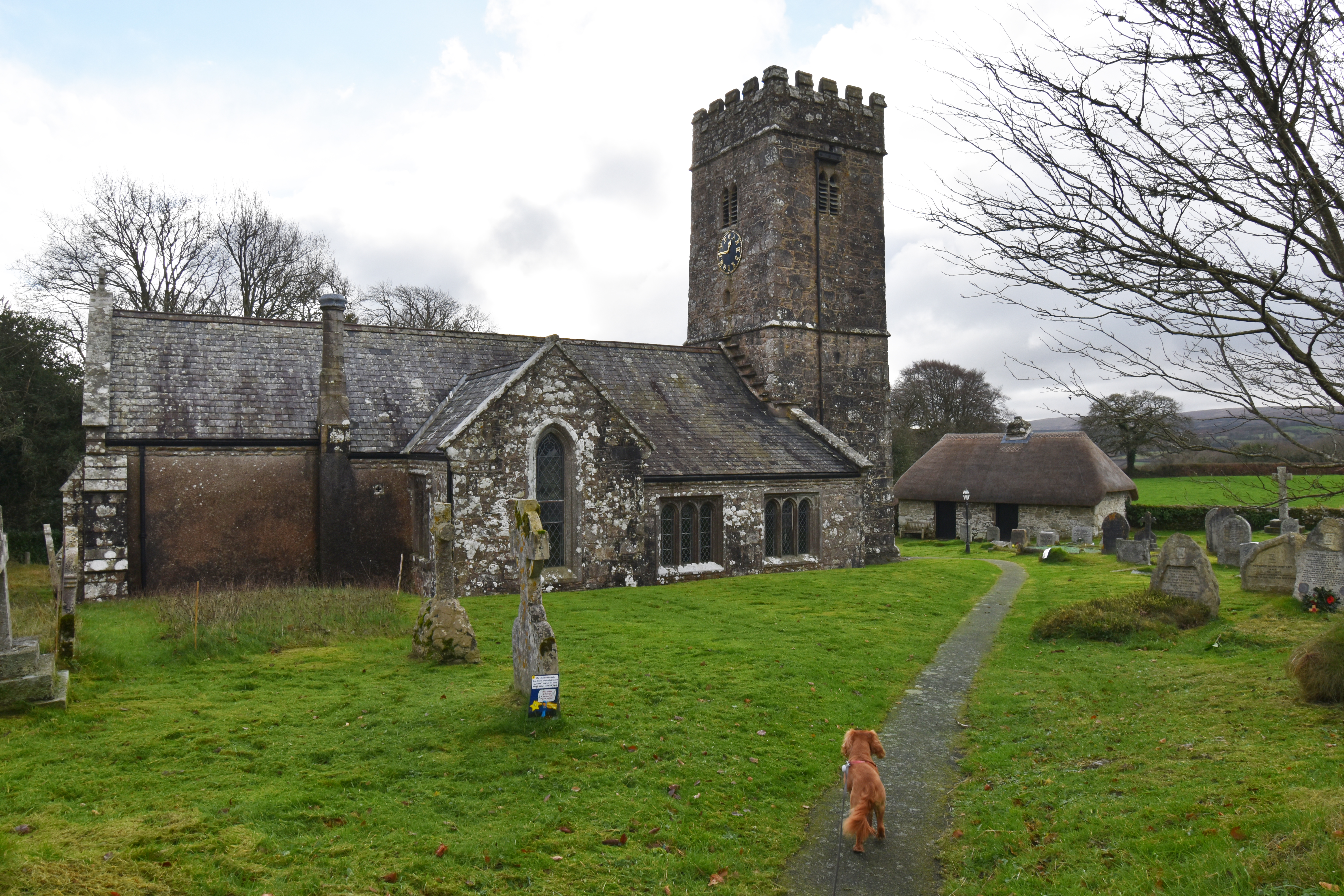
St Peter’s Church at Buckland‑in‑the‑Moor sits quietly on the slope of the valley, its granite tower rising above the gravestones with a kind of quiet permanence. The church seems to grow out of the Dartmoor rock itself, and it’s easy to see why people say it feels as though it has always been here. Rupert trotted ahead along the path, quite at home among the mossy stones and winter light. The whole scene invites reflection — not only on the landscape, but on the long history of worship and community that has shaped this place.
Christian rites have likely been observed here for over a millennium. Buckland is a Saxon name, and the Domesday Book records a thriving agricultural community here by 1085. The first Norman church was probably built around 1200, possibly by the Abbot of Torre Abbey, which had received the manor in the early 12th century. Evidence of this early church survives in the Caen stone font by the south door and the thick south wall of the nave, which reflects different phases of construction. The pillars along the north side also date from this period, though the aisle was later rebuilt and extended. The church was substantially altered around 1400, a time when many Devon churches were rebuilt following the upheavals of the Black Death.
One of the most striking features is the medieval rood screen, built during the Perpendicular period and painted in a style common to Devon in the 15th century. Its panels depict saints and biblical figures, including the Virgin Mary, the infant Jesus, the Magi, the Archangel Gabriel, and St Anne. Some panels are damaged or lost, but others remain vivid. The reverse side shows unusual figures — possibly Suleiman I and a Christian soldier — suggesting a concern with wider events beyond the moor. Above the screen, the later work of Ethel Pinwell restores a sense of completeness to a structure that had lost its loft centuries earlier.
The roof bosses are equally intriguing. Three are said to depict Henry VIII, Anne Boleyn and Thomas Cranmer, which would date them to the early 1530s, though this seems unlikely given the turmoil of the Reformation. More plausibly, the surrounding bosses with Tudor roses and a face resembling Henry VII suggest a slightly earlier date, contemporary with the tower itself. The west wall of the tower may even have been salvaged from an earlier structure. The tower houses eight bells, originally five cast in 1759 and later augmented. The current ring was rehung in 1990, and the bells are still rung in traditional Devon call changes, as they have been for centuries.
One of the church’s most distinctive features is its clock, commissioned in 1930 by William Whitley in memory of his mother Elizabeth. Instead of numbers, the clock face spells out “MY DEAR MOTHER”, and every quarter hour it chimes “All Things Bright and Beautiful”. The mechanism was made by John Smith and Sons of Derby, who also produced clocks for St Paul’s Cathedral and Beverley Minster. The original instructions for regulating the clock are still preserved, warning sternly against “dabbling by inexperienced men”.
Just beyond the churchyard wall stands something truly exceptional: the only known thatched vestry in England. Listed as Georgian and dating from around 1750–1800, its origins are uncertain. It may have begun life as a church house — a communal building used for brewing ale and hosting parish events — or even as a small cottage or workshop. Records from 1635 show the parish paying to maintain its church house, which suggests the vestry’s listing may be inaccurate. For many years it belonged to the Buckland Estate and was used as a schoolroom and vestry before being transferred to the Church about a century ago.
The vestry has seen its share of Dartmoor weather and accumulated history. During woodworm treatment in 2004, a trove of forgotten correspondence was found relating to the 1850 restoration of the church, along with the vestry bell and handbells dated to 1840. The parish handbells, gifted by the bell‑founders in 1931, were hidden in the vestry during the war years — whether from fear of invasion or the presence of billeted troops at Buckland Court is unclear. Four more handbells were added in 2010 to make a ring of twelve.
Inside the church, the floor tiles at the west end of the nave date from around 1300 and may have originally been laid in front of the altar. The chancel was added later, and the tiles were moved during the 1907 restoration. The memorial slab of Raphe Woodleigh, Lord of the Manor, was also relocated at that time, having previously been buried in front of the altar in 1593. These small shifts in the building’s fabric reflect centuries of adaptation and care.
The church has never been isolated from the wider world. Records show alms given to Irish refugees taken by pirates, to victims of a fire in Fleet Street, and to soldiers returning after the Civil War. Churchwarden accounts mention payments for pulpit cushions, stocks, and even for keeping dogs out of the church. In 1663, George Townsend was paid to paint the King’s Coat of Arms and write the Ten Commandments — part of a wider effort to reinforce Anglican identity after the Restoration. The current royal arms above the south door date from 1745, the year of the Jacobite uprising, and were painted over an earlier depiction from 1663.
St Peter’s is a church of quiet depth — not grand, but deeply rooted. Its stones carry the marks of Saxon, Norman, medieval and modern hands. Its vestry, humble and thatched, is a rare survivor. And its clock, with its unusual face and gentle chimes, speaks to a family’s love and a community’s memory. Together, church and vestry form a pair unlike any other in England: one a granite sentinel watching over the valley, the other a thatched companion building whose very existence feels like a gift from another age.

