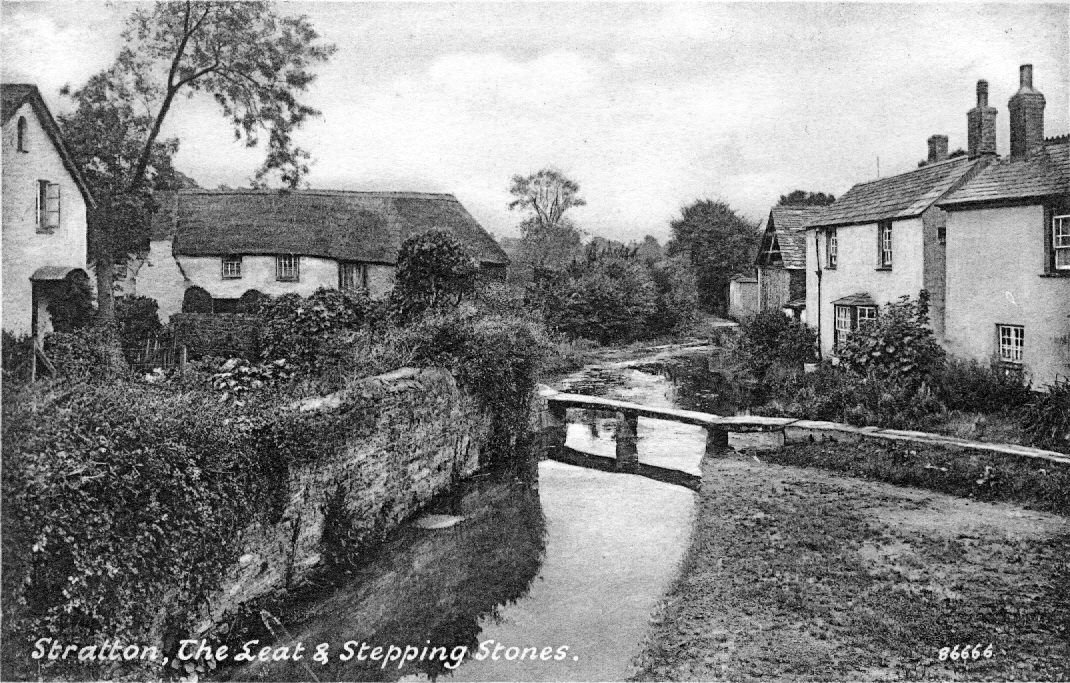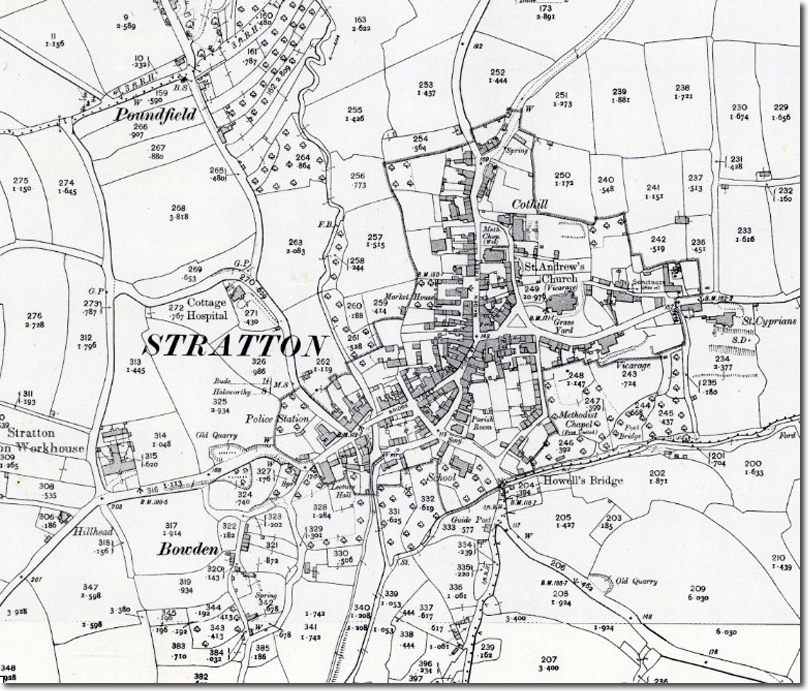
Stratton is one of the oldest recorded settlements in north‑east Cornwall, with origins that pre‑date the Norman Conquest and a documented history that reflects its long role as an administrative and market centre. The town developed on rising ground above the River Neet, controlling the routeways that linked the Cornish interior with the coastal strip around Bude. Its position made it a natural meeting point for local courts, markets and military musters, and Stratton served for centuries as the principal town of the hundred that bore its name. The layout of the streets, the churchyard and the surviving buildings reflect a settlement that grew steadily through the medieval and early modern periods without undergoing major planned redevelopment.
The parish church of St Andrew, with its prominent tower, was the focal point of the medieval town. Much of the present structure dates from the thirteenth to fifteenth centuries, with later repairs and additions. The churchyard formed the centre of Stratton’s civic life, and the surrounding lanes preserve the pattern of the early settlement. Stratton’s importance as a local administrative centre is recorded in medieval documents that refer to courts held in the town and to its role in collecting dues and rents for the surrounding manors. The town’s markets and fairs served the agricultural communities of the district, and Stratton remained the principal settlement of the area long before Bude developed as a port and resort in the nineteenth century.
Stratton’s position on the main east–west route through north Cornwall gave it strategic significance during periods of conflict. In the Civil War the town became the base for Sir Ralph Hopton’s Royalist army in May 1643, and the Tree Inn was used as the Royalist headquarters before the Battle of Stratton. The proximity of the town to Stamford Hill meant that Stratton was directly involved in the events of the campaign, providing billets, supplies and a secure rear area for Hopton’s troops. After the battle the town was used to hold prisoners and to organise the captured Parliamentary stores. The association with the battle remained strong, and Stratton’s identity became linked to the Royalist victory and to the figures of Sir Bevil Grenville and Anthony Payne.
In the eighteenth and nineteenth centuries Stratton retained its role as a local centre even as Bude expanded. The town contained the principal legal and administrative institutions of the district, including the hundred court and later the petty sessions. Inns, shops and small workshops served the surrounding rural population. The arrival of improved roads and, later, the canal and railway at Bude shifted commercial activity towards the coast, but Stratton continued to function as a residential and service centre. The built environment of the town reflects this continuity, with a mixture of medieval, Georgian and Victorian structures that illustrate gradual adaptation rather than large‑scale redevelopment.
Modern Stratton is effectively contiguous with Bude, but it retains a distinct identity rooted in its long history. The street pattern, the church, the inns and the surviving older houses preserve the character of a small Cornish market town whose importance once exceeded that of its coastal neighbour. The association with the 1643 battle remains a defining element of Stratton’s historical identity, and the landscape around the town, including Stamford Hill and the site of the Royalist headquarters, continues to reflect the events that took place there. Stratton’s history is therefore a combination of administrative continuity, local service, and its role in one of the most significant military actions fought in Cornwall.