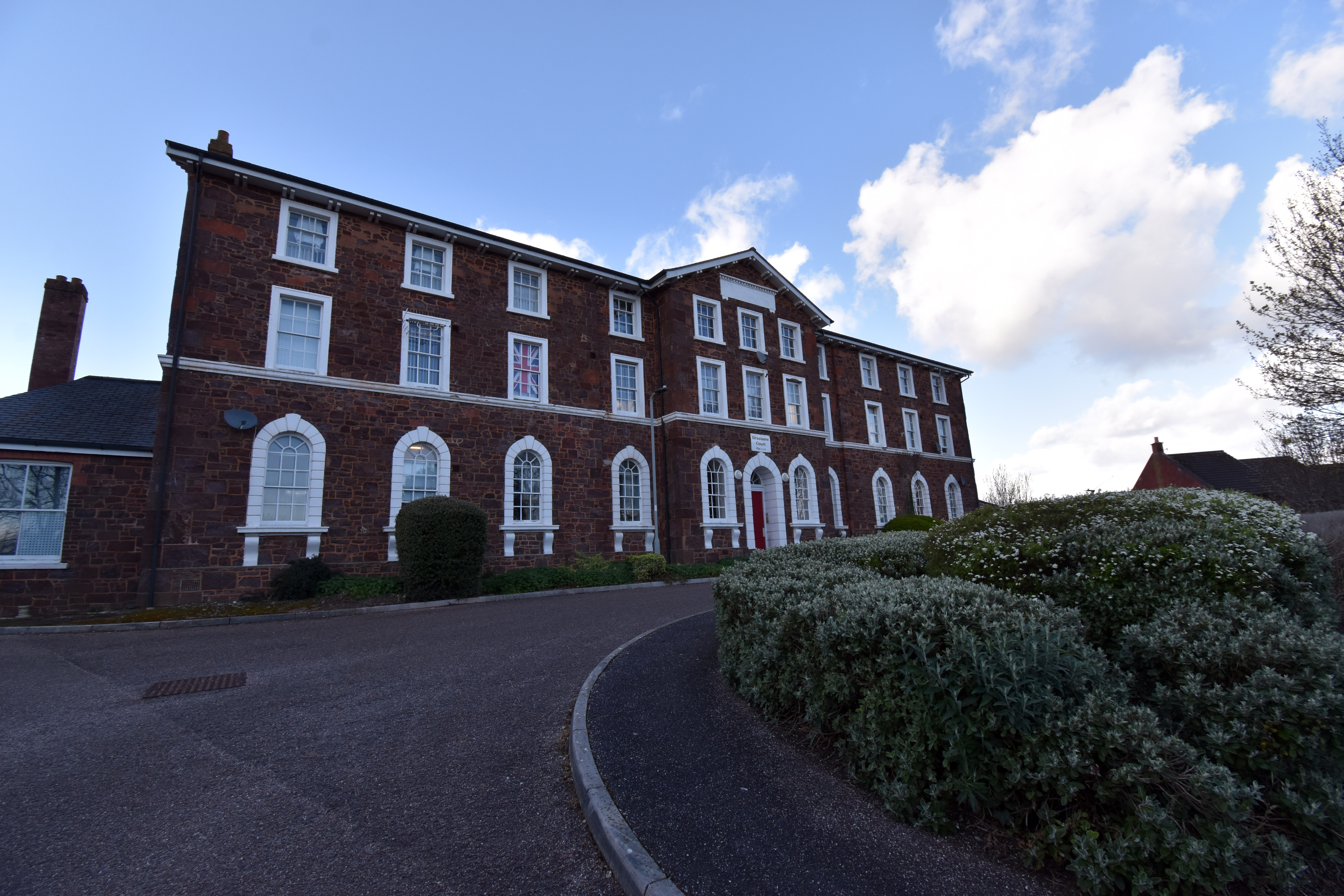
The former St Thomas Union Workhouse stands on the corner of Exwick Road and Okehampton Road, a substantial brown‑stone complex whose scale reflects the administrative reach of the St Thomas Poor Law Union. Before the incorporation of St Thomas into Exeter in 1899, the parish was responsible for its own poor relief, and the Union was created on 21 April 1836 to administer assistance across forty‑nine parishes, including Alphington, Exmouth, Heavitree and Woodbury. Sixty‑one elected Guardians oversaw its operation, replacing the older system of small parish workhouses that had struggled to cope with rising poverty in the early nineteenth century. The population of the district at the 1831 census had been 19,490, with poor‑rate expenditure averaging £10,218 in the years immediately before the 1834 Poor Law Amendment Act.
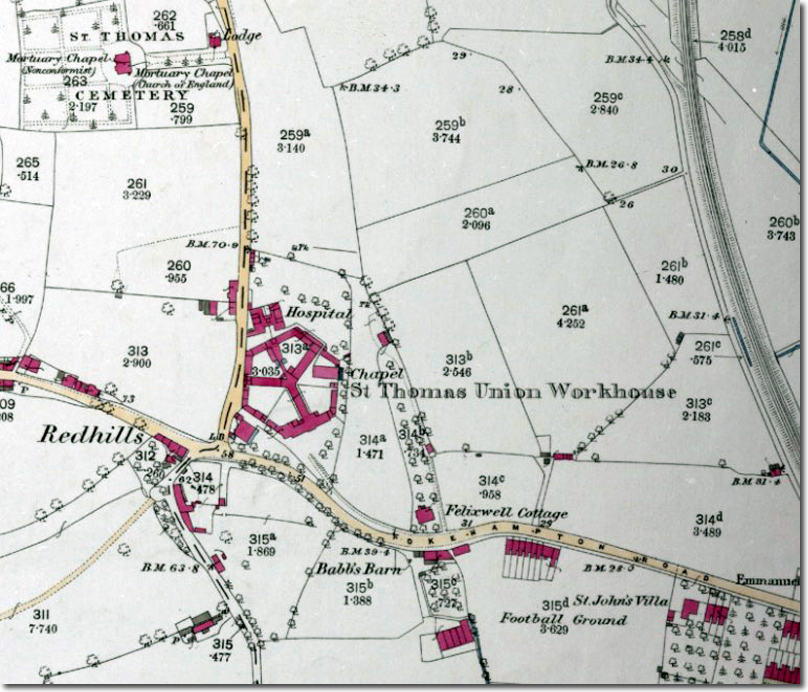
A new workhouse was built at Redhills in 1837 on the boundary between St Thomas and Exwick. It occupied three and a half acres and cost £11,000 to construct. The architect was Sampson Kempthorne, who designed several other Devon workhouses and was known for his hexagonal or Y‑plan layouts. The St Thomas building followed this pattern: three main accommodation wings of three storeys radiated from a central supervisory hub, each wing meeting at right angles a long single‑storey range forming the hexagonal perimeter. The spaces between the wings were divided into exercise yards to separate the various classes of inmate. The design embodied the principles of the 1834 Act, which required strict segregation, constant supervision and a deterrent regime intended to make the workhouse less attractive than the lowest paid labour outside.
The building was constructed of brown stone with slate roofs, and its plan was intended to allow the master or matron to observe multiple wards from the central point. The entrance and administrative block stood at the south, containing the Guardians’ board room, the porter’s room and the offices of the clerk and relieving officer. A chapel was placed in one of the exercise yards, reflecting the requirement for religious instruction as part of the workhouse routine. To the north, a hospital block known as the Victoria Block was added at an early date, and in 1897 a second infirmary building, the Albert Block, was constructed and linked to it. These additions reflected the increasing medical responsibilities of workhouses in the later nineteenth century, as they became the default institutions for the chronically ill, the elderly and the infirm.
The sinking of the workhouse well in 1837 was reported in the local press when a well‑sinker narrowly escaped death after the upper brickwork collapsed, burying him under debris for several hours before he was dug out uninjured. Such incidents illustrate the scale of the construction project and the hazards involved in creating a self‑contained institution intended to house hundreds of people. Once operational, the workhouse became a familiar feature of local reporting. Newspapers regularly described the Christmas dinner provided for the inmates, emphasising the quality of the food and the decorations in the dining hall. In 1870 the Exeter and Plymouth Gazette noted rounds of beef, roast pork, plum pudding and vegetables served in a hall decorated with holly and coloured lanterns, followed by tea, cake and evening amusements. These accounts presented the institution in a favourable light, though they did not reflect the harsher conditions and limited diet that prevailed for the rest of the year.
Daily life in the workhouse followed the standard pattern of the new poor‑law system. Inmates were classified by age, sex and moral status, and each group was kept strictly separate. Work was allocated according to ability, with men employed in labouring tasks and women in laundry, cleaning and domestic duties. Children were educated within the institution and often apprenticed out at a young age. The workhouse provided basic clothing, food and shelter, but its regime was intentionally austere. The principle of “less eligibility” required that conditions inside be worse than those of the poorest labourer outside, to discourage all but the most desperate from seeking relief.
By the end of the nineteenth century the medical role of the workhouse had expanded significantly. The Victoria and Albert Blocks provided infirmary accommodation, and the site increasingly functioned as a hospital for the chronically ill and elderly. In 1930 the Poor Law Union was abolished and the Redhills site became a Public Assistance Institution under the control of Devon County Council. With the creation of the National Health Service in 1948, the buildings were incorporated into the NHS as Redhills Hospital. During and after the Second World War the hospital block was used as a maternity facility, and in the 1950s the former workhouse served as a geriatric hospital before later becoming a drop‑in centre for the elderly. In 1996 it operated as a day centre for mental‑health patients under the Exeter Community Health Trust.
The workhouse buildings closed as a hospital in 1990–91 and were later redeveloped for residential use. Despite these changes, the main ranges, the administrative block and the perimeter buildings survive, their brown‑stone construction and slate roofs forming a distinctive landmark on the western approach to Exeter. The complex is listed at Grade II for its architectural and historical interest, representing one of the most complete surviving examples of Kempthorne’s hexagonal workhouse design and a significant element in the history of poor relief and public health in Devon.