

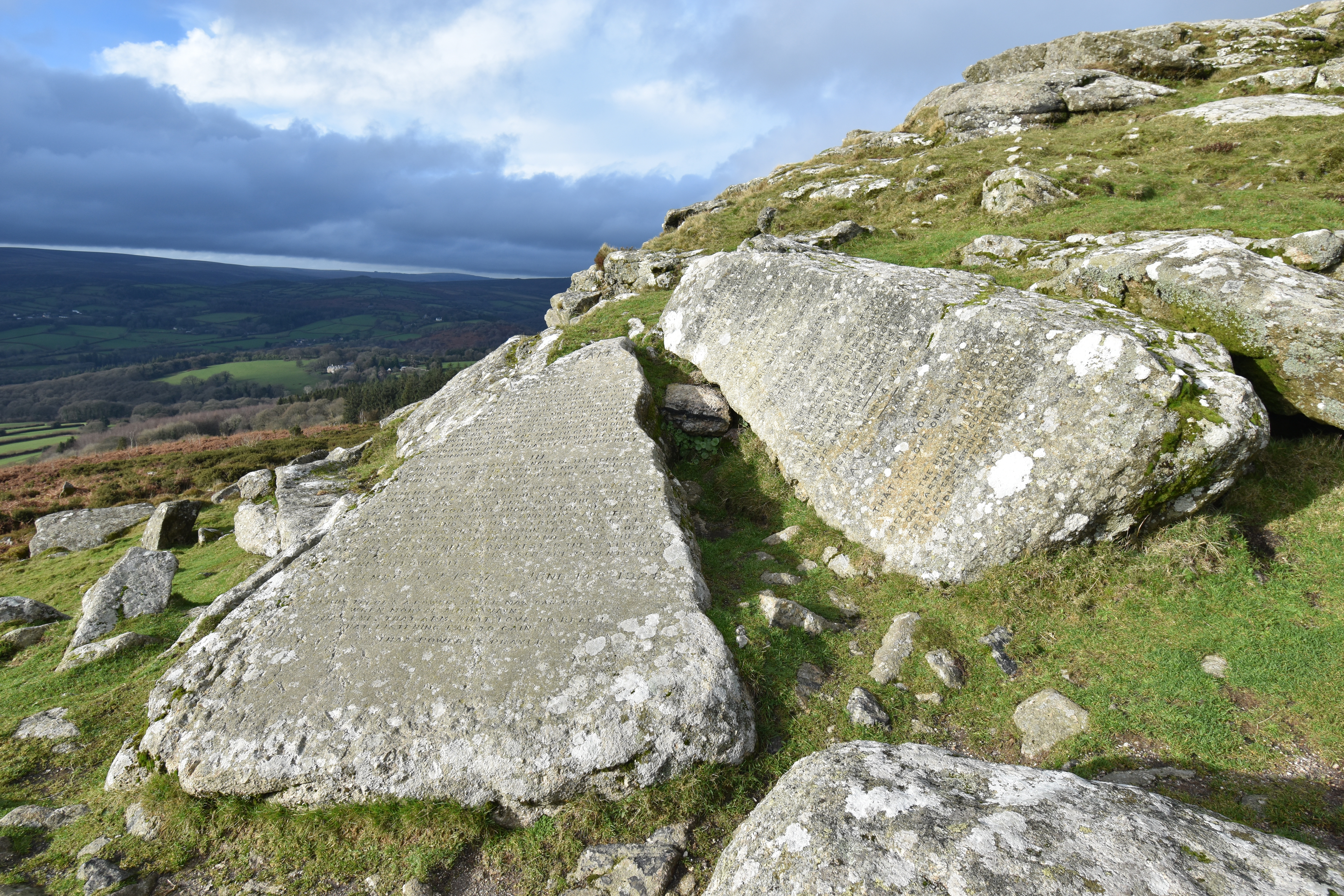
The Ten Commandments Stones on Buckland Beacon are not a curiosity or a whimsy but one of Dartmoor’s most striking intersections of landscape, faith and history. Set just below the summit, the two granite tablets face out across the valley with a quiet authority, their inscriptions first cut in 1928 at a moment of intense debate within the Church of England. From this height the moor falls away on all sides, and the stones feel rooted in something older and more elemental than the controversy that inspired them. They stand as deliberate, enduring markers in a place where weather, light and time are constantly shifting.
Their creation was bound up with the attempted revision of the Book of Common Prayer in 1927 and 1928. The Church had hoped to bridge the divide between its Protestant and Anglo‑Catholic wings by producing a revised Prayer Book that allowed greater liturgical freedom and the reserved sacrament. Although approved by the Church’s own assemblies, the revisions required parliamentary consent because the sovereign is Head of the Church. Twice the Bills were rejected, amid fears that the Church was drifting towards Roman Catholic practice. For many Protestants this was a moment of relief, even triumph, and nowhere was that sentiment more visibly expressed than on this ridge above Buckland‑in‑the‑Moor.
William Whitley, lord of the Buckland Estate and a staunch defender of the traditional Prayer Book, commissioned the stones as a celebration of Parliament’s decision. He had moved from Liverpool to Devon in the early 1900s with his brother Herbert, both sons of the Greenall Whitley brewing dynasty. William bought the Buckland Estate; Herbert bought Primley, where he founded the menagerie that later became Paignton Zoo. For William, the Beacon offered the perfect setting: from the tablets he could look directly down to Buckland Court, his home, and to St Peter’s Church beside it, aligning scripture, house and church in a single sweeping view.
The carving was entrusted to the stonemason W. A. Clements, who began work on 23 July 1928. Living in a makeshift shelter in the nearby woods, he spent five weeks dressing the stones and cutting the full text of the Commandments, the dates of the parliamentary debates, a favourite quotation of Whitley’s, and later an additional “eleventh commandment” from John 13:34. Locals quickly nicknamed him “Moses”, a title he accepted with humour, noting that unlike his biblical namesake he had no intention of carrying the slabs down from the mountain. The labour was considerable: day after day kneeling on exposed granite, chipping letters in all weathers on one of Dartmoor’s most windswept heights.
Dartmoor’s climate has never been gentle, and the inscriptions have had to be recut several times. They were restored in 1995, and again in 2016 during a major £16,000 conservation project funded by the Dartmoor Communities Fund and the Moor Than Meets the Eye scheme. Conservator Ian Cotton cleaned and deepened the most weathered lettering, leaving the lichens intact and repainting the inscriptions to ensure their survival. Today the tablets remain crisp and legible, their lines of scripture standing out clearly against the granite.
Whitley’s original intention was to mark the preservation of the Prayer Book, but the stones have gathered a deeper resonance over time. He had already lost a beloved brother in the First World War, and in the Second he would lose two sons—one lost over the North Sea with Bomber Command, the other a doctor who died of wounds after tending to an enemy soldier in Normandy. Seen in that light, the Commandment Stones feel less like a triumphant proclamation and more like a quiet testament to faith, endurance and grief, carved into the hill he loved and visible from his home and church far below. What began as a celebration of national religious continuity has become, in its own way, a memorial shaped by the sorrows of a family and the steadfastness of the moor itself.

