

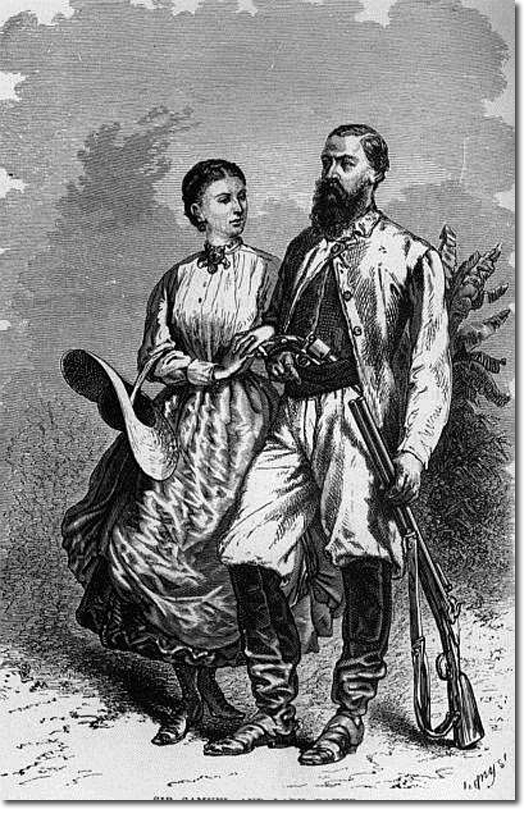
In the pantheon of 19th-century African exploration, names like Livingstone, Stanley, Speke, and Burton dominate the popular imagination. Yet among their contemporaries stood a remarkable couple whose story, though less widely known, rivals any in drama, endurance, and historical significance: Samuel White Baker and Florence von Sass.
Florence’s early life reads like a tale from a historical novel. Born in Hungary in the early 1840s as Flóra Sass, she was orphaned during the Hungarian Revolution of 1848–49 and ended up in a refugee camp in Vidin, then part of the Ottoman Empire. There, she was taken by an Armenian slave merchant and raised in a harem. At around 14 years old, she was brought to a white slave auction in Vidin—an event that would alter the course of her life.
Samuel Baker, an English gentleman from a wealthy family, had lost his first wife to typhoid in 1855. In 1859, while travelling down the Danube with his friend Maharaja Duleep Singh, Baker attended the slave auction out of curiosity. There he encountered Florence, and—according to accounts—was instantly captivated. Though outbid by the Ottoman Pasha, Baker managed to rescue her and took her under his protection. Their relationship, begun when Florence was still a teenager, would become a lifelong partnership marked by exploration, hardship, and shared ambition.
Inspired by the exploits of John Hanning Speke and the mystery surrounding the source of the Nile, Baker resolved to undertake his own expedition. In 1861, he and Florence set out for Ethiopia and Sudan, determined to trace the river to its origins. Florence, fluent in Arabic from her years in the harem, proved indispensable. Their journey took them from Khartoum to Gondokor (modern-day Juba), a hub of ivory and slave trading.
There they met Speke and James Grant, returning from Lake Victoria, which they believed to be the Nile’s source. The Bakers pressed on, travelling south by foot through disease-ridden terrain and hostile conditions. Despite mutinies and illness, they persevered, eventually reaching Murchison Falls and Lake Albert—then considered the Nile’s primary source.
After four arduous years in Africa, the Bakers returned to England and married in secret in 1865. Samuel was awarded the Royal Geographical Society’s gold medal and knighted in 1866. Though initially welcomed into society, the circumstances of their meeting and relationship—particularly Queen Victoria’s disapproval of their premarital intimacy—led to their exclusion from Court.
In 1869, the couple returned to Africa at the invitation of Isma’il Pasha, the Viceroy of Egypt, who tasked Baker with suppressing the slave trade in the Equatorial Nile region. Appointed Governor General with a substantial salary, Baker led a well-equipped force into Bunyoro, where Florence again proved her resilience. Ostensibly serving as a medic, she carried rifles, a pistol, brandy, and umbrellas—ready for both battle and diplomacy.
Despite their efforts, the Bakers were ultimately unable to eradicate the entrenched slave trade. They returned to England in 1873 and settled at Sandford Orleigh in Devon, where Samuel continued writing and Florence became a respected hostess. They hosted such illuminaries as Charles Gordon and the Prince of Wales.
Samuel Baker died in 1893; Florence lived on until 1916. They are buried together in Grimley, near Worcester. Though overshadowed by more famous explorers, their contributions to African geography and anti-slavery efforts remain significant. Florence, in particular, defied Victorian norms—riding astride, wearing trousers, and surviving unimaginable hardship. As Baker once wrote, she “was no screamer,” a testament to her courage and fortitude.
Their story, blending romance, resilience, and reform, offers a compelling counterpoint to the more familiar narratives of imperial exploration. It is a reminder that history often hides its most extraordinary figures in the margins.


