

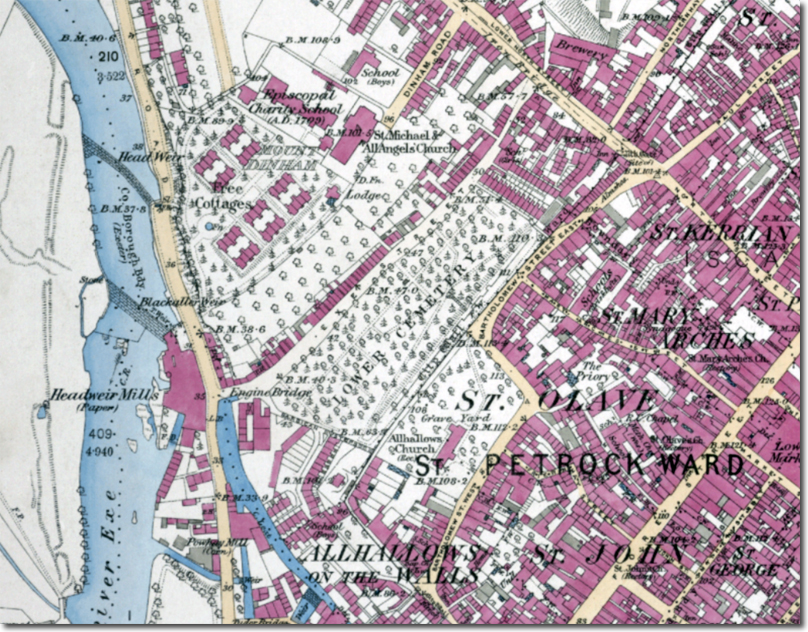
Victorian Exeter expanded far beyond the line of its medieval walls, transforming from a compact historic town into a modern provincial city. Suburbs grew rapidly in every direction: St Thomas spread across the floodplain, Heavitree developed along the old London road, Newtown filled the fields east of the city, and St Leonard’s and Mount Pleasant saw sustained building. The walls, once a hard boundary, became increasingly irrelevant as Exeter pushed outward into open land and former industrial plots.
Within the old city, Victorian redevelopment altered the medieval fabric. Streets were widened, paved and lit, and older lanes were absorbed into a more regulated urban plan. Parliament Street, already one of the narrowest streets in England, survived but became increasingly hidden behind larger Victorian frontages and commercial buildings. Its medieval width contrasted sharply with the broader Victorian streets around it, illustrating the city’s shift from cramped medieval circulation to modern urban planning. St Petrock’s Church, once prominent on the High Street, became visually obscured as Victorian shopfronts rose around it. The church’s medieval form remained, but its presence was diminished by the scale and uniformity of nineteenth‑century commercial development.
Industrial change accompanied this physical expansion. Exeter’s traditional woollen industry declined, but new trades emerged. Iron foundries, brickworks, timber yards, breweries and engineering workshops appeared along the river and railway corridors. The Exe was managed more intensively, with improved quays, warehouses and wharves supporting increased commercial activity. Gasworks provided lighting for streets and businesses, and water supply and drainage systems were modernised to meet the needs of a larger population. Although Exeter never became a major manufacturing centre, its industrial base diversified and supported steady economic growth.
Communications were transformed. The arrival of the railways in the 1840s and 1850s connected Exeter directly to London, Bristol, Plymouth and the wider national network. St David’s and Queen Street stations became gateways to the city, stimulating trade, travel and suburban growth. Turnpike roads were improved, new bridges constructed, and horse‑drawn omnibuses provided local transport. Postal services expanded, telegraph lines were installed, and Exeter became more closely integrated with national systems of communication and commerce.
Urban improvements reflected Victorian priorities in public health, education and civic administration. Slum clearance schemes targeted overcrowded medieval districts, particularly in the West Quarter, where narrow lanes and timber houses were replaced by more regulated Victorian development. New public buildings appeared across the city, including schools, chapels, civic offices and institutions such as the Royal Albert Memorial Museum. Streets were straightened, surfaces improved, and public amenities expanded. The rebuilding of the Guildhall and the enhancement of public spaces demonstrated Exeter’s confidence as a regional centre.
Social change accompanied these physical and economic developments. Middle‑class suburbs grew rapidly, while working‑class districts expanded around industrial sites and transport routes. Charitable organisations, religious societies and civic bodies played prominent roles in addressing poverty, health and education. Exeter’s Victorian identity was shaped by this mixture of tradition and innovation, with medieval streets and churches standing alongside new terraces, factories and public buildings.
By the death of Queen Victoria in 1901, Exeter had been reshaped into a modern city. Its boundaries had pushed far beyond the medieval walls, its industries had diversified, and its communications had been transformed by rail, road and telegraph. The Victorian period left a lasting imprint on Exeter’s layout, architecture and civic life, marking the transition from a historic walled town to a growing urban centre poised for the changes of the twentieth century.

