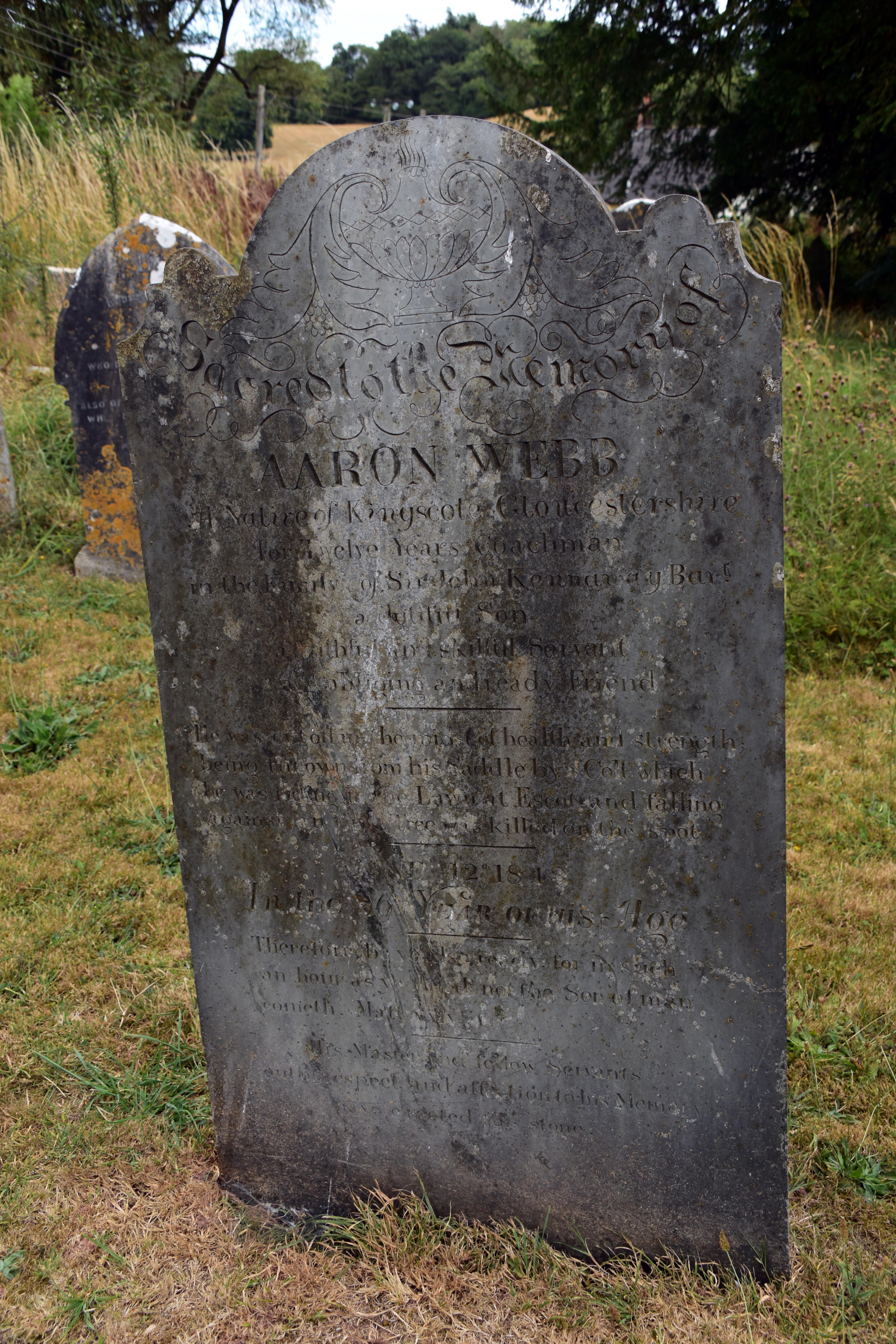
The graves of Aaron and Susan Webb in Talaton churchyard form one of the most striking memorial groups connected with the Kennaway estate. They record a sequence of tragedies between 1838 and 1848 that affected a young servant family closely tied to Escot House. Their stones are unusually elaborate for estate servants, reflecting the respect in which they were held and the personal involvement of Sir John Kennaway, 2nd Baronet, in commemorating their lives.
Susan Webb and her childhood friend Caroline Gullwell were both natives of Gloucestershire. Their inscription notes that they were “brought up in the same school” and later entered service together in the household of Sir John Kennaway at Escot. Gloucestershire provided a steady stream of domestic servants to Devon estates during the early nineteenth century, often through informal recruitment networks linking rural parishes. The two women were described as cheerful, amiable, and obliging, and their memorial emphasises their shared character and shared fate.
Both women died in 1838 of “lingering consumption,” the period term for tuberculosis. Rural Devon saw repeated waves of TB in the early nineteenth century, and domestic servants—often living in close quarters—were particularly vulnerable. Susan’s two infant sons, John and Thomas, also died in 1838, and the family’s triple loss was recorded on the same stone. The inscription’s theological language reflects the evangelical tone common in Kennaway family memorials of the period.
The second stone commemorates Susan’s husband, Aaron Webb, a native of Kingscote, Gloucestershire. He served for twelve years as coachman to the Kennaway family. Coachmen occupied a skilled and trusted position within estate service hierarchies, responsible for horses, carriages, and the safe transport of family members. Aaron’s memorial describes him as a “faithful and skilful servant,” a phrase typical of mid‑Victorian employer inscriptions.
Aaron was killed on 12 June 1848 while riding a colt on the lawn at Escot. Thrown against an oak tree, he died instantly. The inscription notes that his stone was erected “by his master and fellow servants out of respect and affection,” indicating direct financial support from Sir John Kennaway. Such employer‑funded memorials were uncommon but not unheard of; they were generally reserved for long‑serving or particularly valued staff.
The burial locations are significant. Susan, Caroline, and the two infants were buried at Talaton in 1838, before St Philip & St James at Escot was built. By 1848 the new church was in use, yet Aaron was buried with his family at Talaton. This suggests a deliberate choice to keep the family together rather than move the widower to the newer churchyard. It also reflects the strong connection between Escot estate servants and Talaton parish, which remained the principal burial ground for many workers even after the Escot chapel was established.
The Webb memorials illustrate the human side of estate life in nineteenth‑century Devon: the movement of rural families into service, the vulnerability of young workers to disease, the dangers inherent in horse‑handling, and the occasional willingness of employers to honour their staff in death. They remain among the most personal and affecting inscriptions connected with the Kennaway family.