

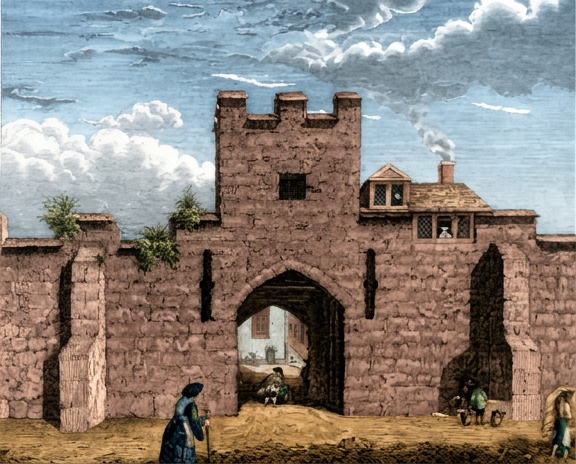
The West Gate began as part of the Roman defensive circuit constructed in the second century AD. It stood on the western side of Isca Dumnoniorum, aligned with the timber bridge that crossed the River Exe and the marshes beyond. Although the Roman gate’s structural details are not fully known, its purpose is clear: it controlled the western approach into the fortress and later into the town, forming the link between the Roman road system and the settlement. The road that left the West Gate continued across the Exe and climbed towards Haldon, probably following earlier Celtic trackways formalised by the Romans.
When the legion departed around AD 75 and the fortress became the civitas capital of the Dumnonii, the gate retained its strategic importance. The Anglo‑Saxons reused and refortified the original Roman gate during Athelstan’s overhaul of Exeter’s defences in the early tenth century, demonstrating the durability of the Roman defensive plan and the continued relevance of its western approach. The medieval gatehouse that eventually replaced the Roman structure was built of volcanic stone first quarried by the Romans at Rougemont, chosen for its hardness and resistance to weathering. This material was used again in later centuries for rebuilding the city’s gates.
By the fourteenth and fifteenth centuries the West Gate had taken on the form familiar to antiquarians: a simple square tower rising slightly above the line of the city wall, pierced by a pointed archway. It lacked the architectural ambition of the South Gate or the drum‑towered East Gate, but it remained a functioning defensive entrance. The porter lodged nearby and was responsible for opening and closing the gate at fixed hours, questioning travellers who sought entry outside permitted times. The gate was shut nightly, a practice that had continued since the Roman period when control of movement was essential to the security of the settlement.
The West Gate played a significant role during the Prayer Book Rebellion of 1549. Catholic rebels from Devon and Cornwall besieged Exeter after the city refused to admit them. They attempted to undermine the gate’s foundations and lay explosive charges beneath it. Counter‑mining within the city revealed the rebels’ tunnel, and the steep descent from the city centre to the gate was used to defeat the attack: residents placed large tubs of water outside their houses on Stepcote Hill and neighbouring streets, and at a signal the tubs were overturned, sending a torrent down the slope and flooding the mine. The explosives were rendered useless and the rebels abandoned their attempt to breach the gate.
The gate again saw action during the English Civil War. In 1643 Parliamentarian forces rode out through the West Gate, crossed the medieval Exe Bridge and attacked Royalist troops occupying Hayes Barton on the opposite bank. The gate served as the principal western exit from the city, just as it had in Roman times, and its position at the head of the bridge made it the natural point from which any western sortie would begin.
In 1688 the West Gate witnessed the entry of William of Orange into Exeter. Although initially shut, it was forced open by his attendants, and William entered the city to widespread acclaim. The gate thus became associated with one of the decisive moments of the Glorious Revolution, linking its long Roman origins with a major event in British constitutional history.
After more than fifteen centuries of use, the West Gate was demolished in 1815. A plaque later marked its position, recording its defence during the 1549 siege and the entry of William of Orange. The only surviving physical remnant is the gate’s key, preserved locally. Although the structure itself has vanished, its line, its function and its historical significance remain clear: it was the western threshold of Exeter from the Roman period until the early nineteenth century.

