William Torquill Macleod Bolitho’s story begins in the comfortable world of late‑Victorian privilege, far from the mud and fire of the Western Front where it ended. Born in 1892 into the well‑established Cornish Bolitho family, he grew up in a household shaped by generations of commercial success — tanners who became tin smelters, smelters who became bankers, and bankers who eventually merged with Barclays. His upbringing followed the expected path for a young man of his class: Eton, then Trinity College, Cambridge, where he earned a reputation for steadiness, intelligence, and a quiet, dependable manner that made him well liked by his contemporaries.
Although the Bolithos were rooted in Cornwall, the family had long-standing ties to the eastern edge of Dartmoor, and it is this landscape — of deep lanes, granite tors, and scattered moorland parishes — that would later hold his most personal memorial. The church of St John the Baptist at Leusdon, perched high above the Dart valley, became a place of significance for the family, and it is here that William’s memory is preserved in stained glass.
William’s early ambitions lay with the Royal Navy, but chronic seasickness forced him to abandon that path. He transferred instead to the cavalry, joining the 19th (Queen Alexandra’s Own Royal) Hussars — a decision that, in the cruel arithmetic of war, may well have cost him his life. When the First World War broke out in August 1914, he was among the many young officers who volunteered immediately, swept up in the sense of duty and expectation that marked the opening months of the conflict.
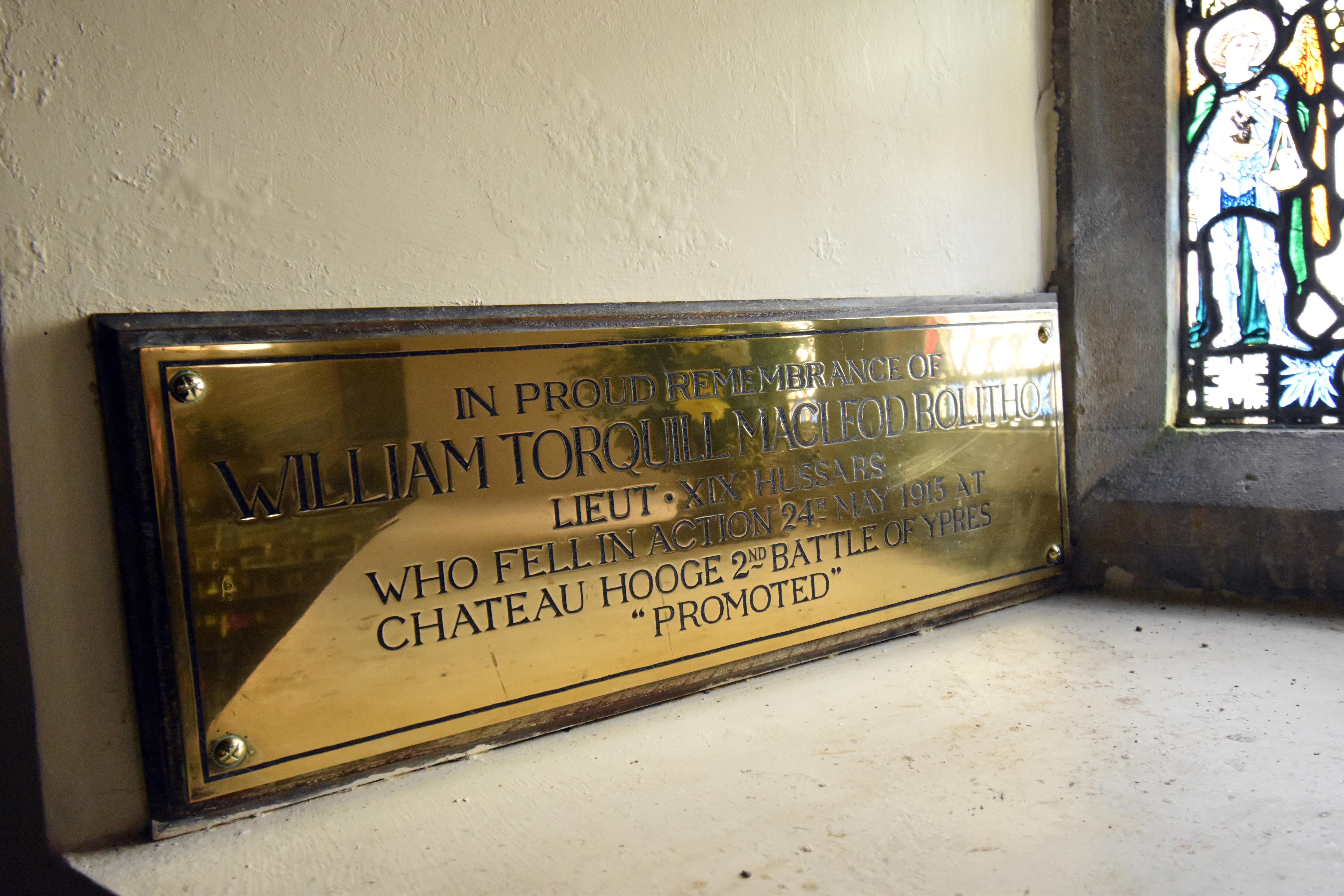
He served with the 19th Hussars during the early fighting in Flanders, a period of rapid movement that soon gave way to the entrenched stalemate of the Western Front. In the spring of 1915, during the Second Battle of Ypres, William was killed in the fighting around the shattered medieval town whose Cloth Hall became one of the most recognisable ruins of the war. He was twenty‑three years old. Like so many who fell in the early battles, he has no known grave.
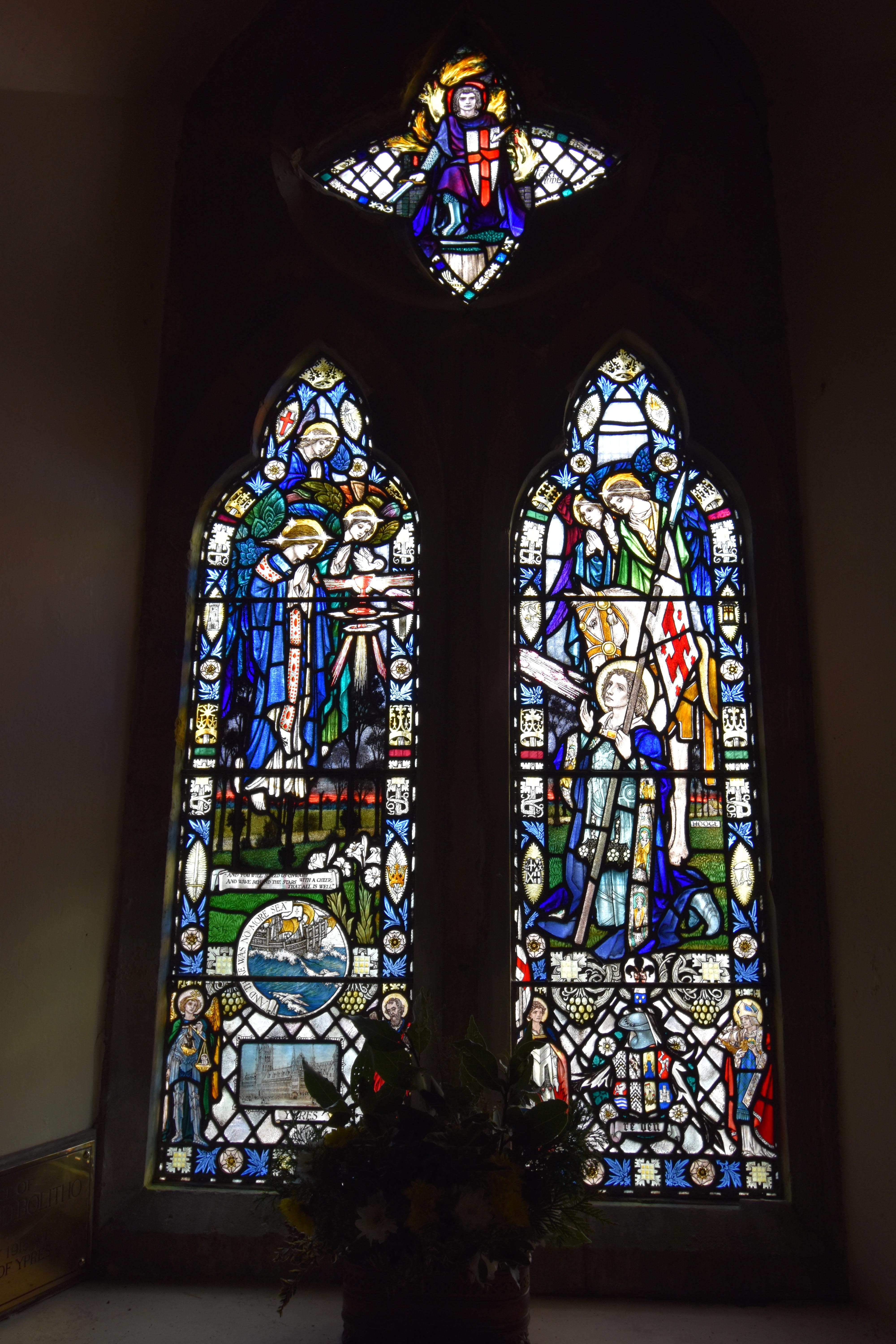
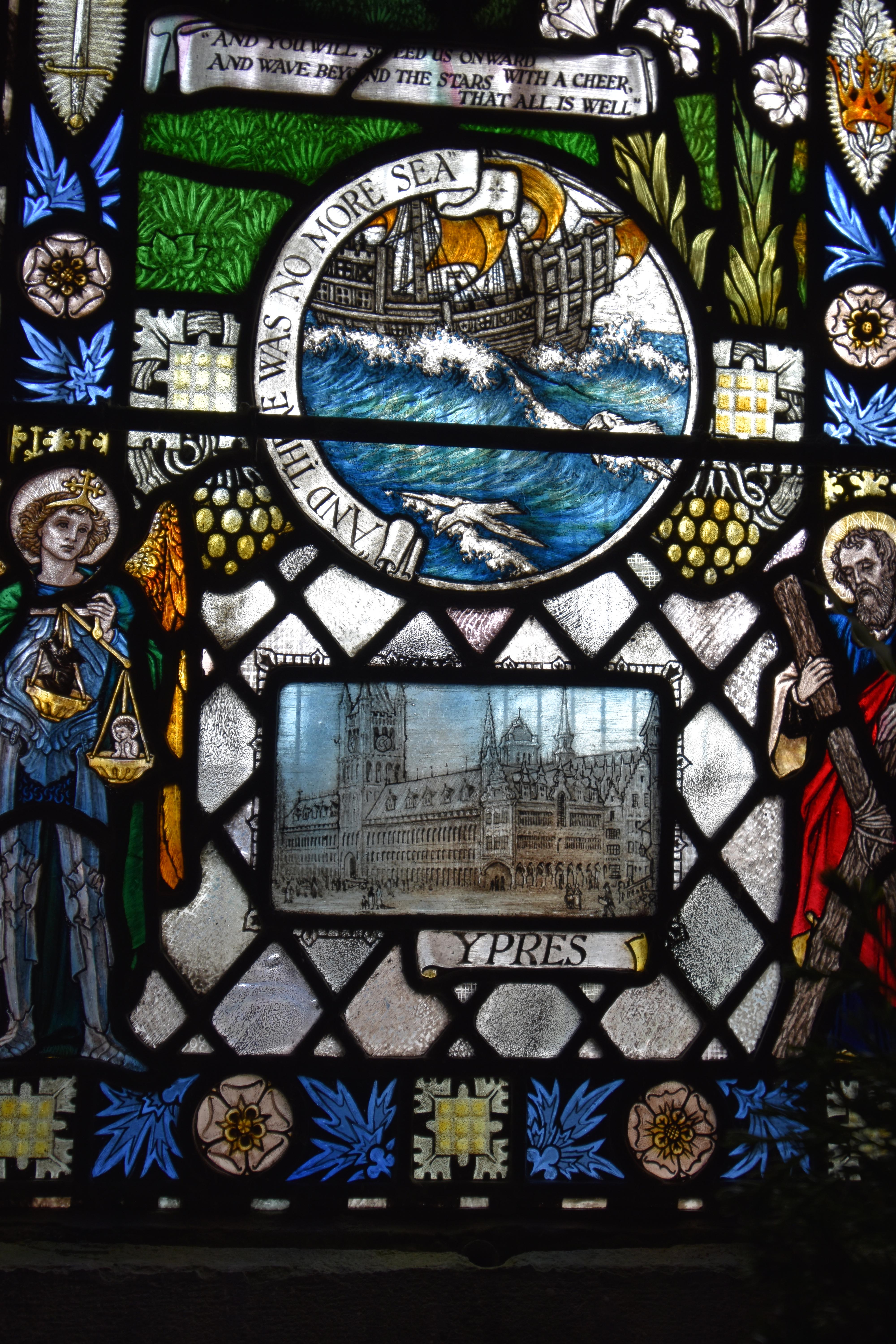
Back in Devon, his family ensured that his name would not be lost. In Leusdon Church, an elaborate stained‑glass window was installed in his memory — one of the most striking in the building. The window depicts William as Sir Galahad, the pure knight of Arthurian legend, surrounded by martial saints such as St Michael and St George, and by the patron saints of England and Scotland, a nod to his mother’s heritage. At its base is a poignant inscription drawn from the Book of Revelation: “And there was no more sea” — a gentle, almost wistful reference to the seasickness that had driven him from the Navy and into the cavalry.
The window also includes an image of the Cloth Hall at Ypres, its ruined silhouette a stark reminder of the battle in which he died. The combination of chivalric imagery, national saints, and the devastation of Ypres creates a memorial that is both personal and emblematic of its era — a Victorian‑Edwardian imagination meeting the brutal realities of modern war.
Opposite William’s window is another Bolitho memorial, this one to his younger brother Simon Bruce Tormod Bolitho, who died at the age of five. Known as the “Blue Bird” window, it depicts characters from the Belgian play The Blue Bird, with tender images of childhood and the hopeful motif “There Are No Dead.” Together, the two windows form a deeply moving family testament within the quiet moorland church.
Today, Lieutenant Bolitho’s name appears on regimental rolls, on the memorials of Eton and Trinity, and on the great stone panels of the Menin Gate. But it is the window at Leusdon — glowing softly above the Dart valley — that offers the most intimate remembrance. It anchors his story in the landscape his family knew so well, and stands as a lasting tribute to a young man whose promising life was claimed in the early months of the Great War.
Lieutenant William Torquill Macleod Bolitho Image: IWM (HU 114029)