

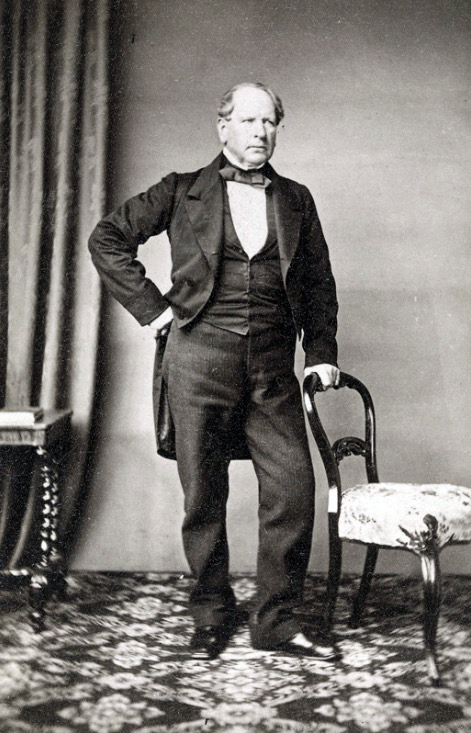
William Langdon was born on 6 November 1790 at Montacute Vicarage, the fifth son of the Rev. William Langdon. While at school in Beaminster he became inspired by the naval career of Admiral Hood, Viscount Bridport, and secured an interview with him. As a result he was appointed a first‑class volunteer in HMS Weymouth in April 1804 and sailed to Madras escorting East Indiamen.
He saw early action. In September 1806 he was present at the capture of a French frigate off Rochefort. He transferred to HMS Monarch in 1806 and to HMS Champion in 1807. At the age of seventeen he was sent to Plymouth in command of a captured French prize. In 1810 he joined HMS Badger and in 1811 became acting lieutenant in HMS Ringdove in the West Indies, his promotion confirmed in November that year. He was invalided from May 1812 to September 1814.
After the peace of Paris he saw little prospect of further naval advancement and retired from active service. He purchased the trading vessel Lusitania and sailed her to Sydney and Hobart Town, first arriving in October 1821. A second voyage brought him to Sydney in May 1823. He exchanged the Lusitania for the Hugh Crawford, which reached Sydney in April 1825. He later acquired the Wanstead in 1828 and the Thomas Lawrie in 1829.
In 1823 Langdon received a grant of 1500 acres on the Clyde River near Bothwell in Van Diemen’s Land. He named the estate Montacute. He added to the property by purchase and on several voyages brought his wife Anne (née Elliott of Somerset) and their daughter Anne with him. In 1827 they gave a ball aboard the Hugh Laurie.
On return voyages from Hobart his ships twice called at Louis Vernet’s settlement at Port Louis in the Falklands. The Hugh Crawford arrived on 22 May 1827 and sailed on 25 May. The Thomas Laurie arrived on 25 October 1831 and sailed on 1 November. On the second visit Langdon and his family were entertained by Vernet, who on 29 October 1831 granted Langdon possession of ten square miles of East Falkland. Langdon urged the British government to reassert control of the Falklands without displacing Vernet.
In December 1833 Langdon wrote from London stating that he was returning to Van Diemen’s Land and asking Vernet to allow his grant to be assigned to the London merchant G. T. Whitington. Vernet agreed in May 1834. Whitington later lobbied the British government to settle the islands and in 1841 sent his brother J. B. Whitington to colonise the land. The British government did not recognise Vernet’s right to sell land, and Whitington had to purchase his holdings anew.
Langdon returned to Tasmania from 1834 to 1838, settling on Montacute and introducing blackbirds, thrushes, goldfinches, pheasants and partridges to the colony. In 1837 he let his properties, then totalling 6000 acres with 2000 sheep, for £1300 a year. In 1838 he returned to England and lived at Inwood Lodge near Sherborne, where he encouraged emigration to Tasmania and paid the fares and education of several emigrants. His daughter Anne married Sir Thomas Howland Roberts in 1842.
His first wife died in 1844. In 1846 he returned to Tasmania with his second wife, Anne (née Chaffey of Martock, Somerset). He remained in Tasmania thereafter except for visits to England in 1857 and 1872. He was promoted honorary commander in 1853 and appointed to the Legislative Council. In 1856–57 he built a church on his own property at a cost of about £2000. In 1860 he helped establish the practice of opening parliament with prayer. He was elected to the Legislative Council in 1859 and served until 1872.
Langdon made his home at Derwentwater, Sandy Bay. He died there on 23 May 1879. His widow died in Hobart in 1902 aged 84. They had three sons and three daughters. Langdon was the first Englishman to own property in the Falklands, although he never settled it. He believed his lobbying helped persuade the British government to reoccupy the islands in the early 1830s. A sketch by him of Port Louis appears on a map of the Falkland Islands surveyed by Captain Robert FitzRoy and printed by John Arrowsmith in 1841.

