

Lt.-Col. William Peter Bertram Arkwright D.S.O. (1910–1962) was born on 10 November 1910 at Cromford, Derbyshire, the son of Bertram Harry Godfrey Arkwright and Grace Emma Julia Hurt. He was baptised in St Mary’s Church, Cromford, on 18 December that year, continuing the long association between the Arkwright family and the Derwent Valley. His early life followed the expected pattern for a young man of his background: Eton, then the Royal Military College, Sandhurst, and finally a commission into the Royal Scots Fusiliers on 28 August 1930.
His military career advanced steadily. He became Lieutenant in 1933 and Captain in 1938. During the early years of the Second World War he was “specially employed,” a broad term that often covered instructional or organisational duties. In 1942 he was seconded to the Royal West African Frontier Force, serving with the 5th Battalion, The Nigeria Regiment. This secondment would define the most significant period of his wartime service.
His Distinguished Service Order was earned while serving with this battalion in Burma in 1945. The original recommendation survives on Army Form W.3121, a periodic award recommendation for the Burma / Arakan campaign. The form records the following details:
The main citation reads in full:
“Lt. Col. ARKWRIGHT was 2nd in command of his battalion when he took over command on the death in action of his commanding officer. The unit was engaged in a difficult independent operation at the time which gave ample scope for bold, energetic and skilful handling.
Lt. Col. ARKWRIGHT fought four successful actions in the next three days and arrived at his final objective quicker than was thought possible at the time. The battalion though in need of a rest after a period of forced marching and fighting, was immediately sent on another and more dangerous outflanking movement to release the enemy stranglehold on the TAUNDU Pass. In spite of heavy casualties and considerable privation through lack of water this movement eventually was completely successful and undoubtedly led to the fall of TAUNDU.
Immediately afterwards Lt. Col. ARKWRIGHT’s battalion played a conspicuous part in the opening of the road to LETMAK to join up with other forces there.
Throughout this period of over three weeks Lt. Col. ARKWRIGHT never spared himself or his battalion and no call was made on it which was not cheerfully responded to immediately in spite of a mounting toll of casualties which fell heavily on the junior leaders.”
These excellent results were due to Lt. Col. ARKWRIGHT’s unremitting energy, bold tactical skill and inspiring leadership.
During his tour of duty as 2nd in command he was of the greatest assistance to his commanding officer during the formation and training of the battalion and tireless in his efforts to this end.
Since he assumed command on the death of his previous commanding officer, he has achieved outstanding success with his unit. The excellent results achieved by them are due to his outstanding and exemplary devotion to duty throughout a most difficult period.
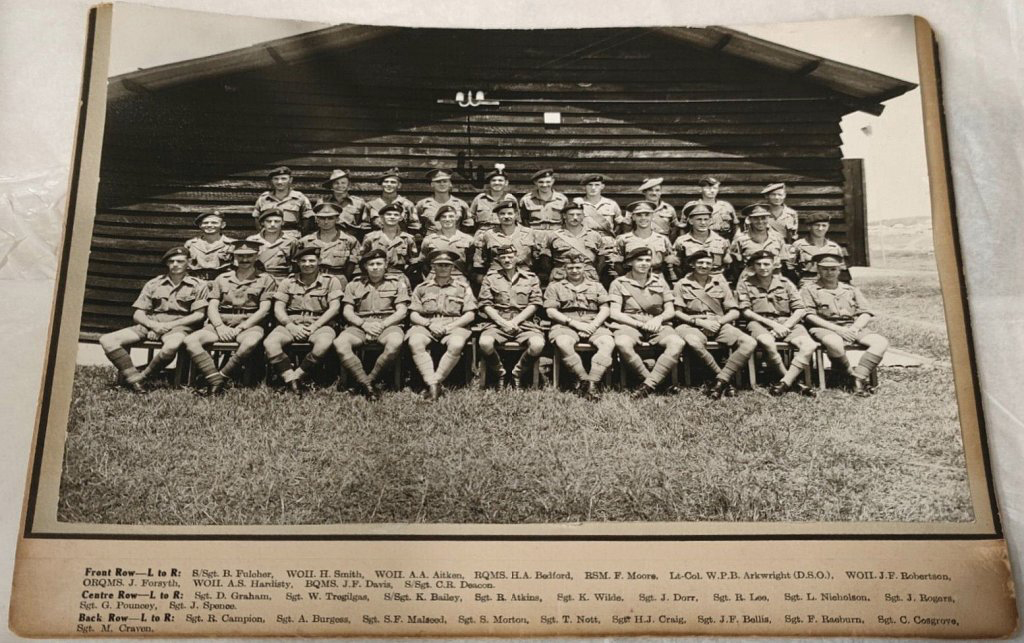
The photograph above shows him much later, in the 1950s, during his time as Commandant of the Training Centre, Far East Land Forces, a senior instructional post he held from 1953 to 1956. By then he was an experienced senior officer, shaping the training and doctrine of units serving across the region.
On 18 October 1941 he married Isabella Constance Marion O’Neil Roe, daughter of Lt.-Col. Charles Douglas Roe and Daisy Blanche Marion Mackenzie-Kennedy. They had one son and one daughter. Although William inherited Coton House in Warwickshire from his uncle Francis Arkwright in 1915, he did not make it his permanent home. Over the years he lived at Frith, Stalbridge in Dorset, and later at Pen-y-Bryn Hall in Churchstoke, Montgomeryshire, before eventually settling in Devon.
Military service ran strongly through the family. William’s eldest brother, Major-General Robert Harry Bertram Arkwright (28043), rose to high rank and was appointed CB and awarded the DSO & Bar. Another brother, Francis Godfrey Bertram Arkwright (31864), served with the 12th Royal Lancers in the Royal Armoured Corps and was awarded both the DSO and the Military Cross before being killed in action on 1 July 1942. A third brother, Albert Seymour Bertram Arkwright (9547), served with the 2nd Battalion, Royal Scots Fusiliers and was awarded the Military Cross. Their careers underline the strong military tradition within the family and the extent to which the Arkwrights were shaped by the demands of the first half of the twentieth century.
William died in 1962 at Exeter following an accident, aged just fifty-two. His will was proved that summer, with an estate valued at £11,485. Although his family background lay firmly in Derbyshire, his later life brought him to the West Country, and he is now buried in Belstone churchyard. His grave is a modest one, marked simply with his rank and decoration, and sits quietly among the other twentieth-century stones. It reflects a pattern seen elsewhere in the churchyard: people whose lives were shaped far beyond Dartmoor, but who found their final resting place on the edge of the moor.


