Wiscombe Park sits in a steep, wooded valley west of Colyton, and the setting explains much about how the estate has been used over the centuries. The land originally belonged to Otterton Priory before being granted, in the reign of Henry III, to Sir William Bonville. The Bonvilles used the surrounding hills as a deer park, and when the foundations of the present house were dug in the 1820s a large quantity of antlers was uncovered, confirming the medieval accounts.
The estate then followed the complicated fortunes of the Bonville family. After the Wars of the Roses and the downfall of William Bonville, 1st Baron Bonville, the lands passed to his great‑granddaughter Cecily Bonville. Through her marriage to Thomas Grey, Marquess of Dorset, Wiscombe entered the Grey family. Their son was Henry Grey, Duke of Suffolk, father of Lady Jane Grey. His execution after Wyatt’s Rebellion saw the estate confiscated and transferred to the Petre family. From the Petres it passed to the How family, who held it into the early nineteenth century.
In 1815 the estate was purchased by Charles Gordon of the Aberdeen Gordons. The present house was built for him in 1826 by Joseph Power of Colyton, replacing the old manor house. Later in the nineteenth century the estate passed to the Edmonds family, who remained here until the 1950s and whose name appears frequently in Southleigh Church, including the large family vault and the memorial window to Lieutenant Nicholas Gifford Edmonds of the Black Watch, killed at Magersfontein in 1899.
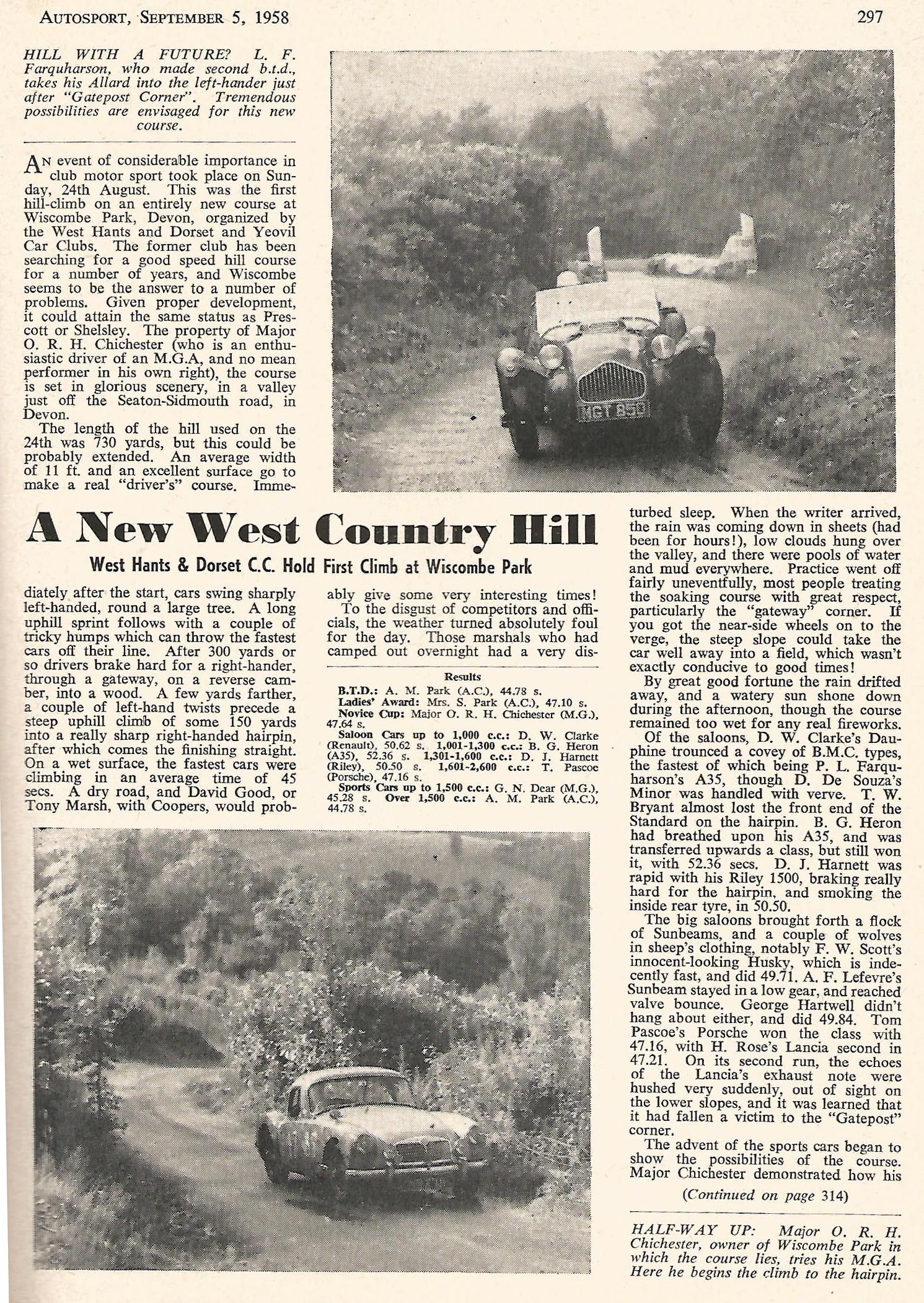
By the early 1950s the estate was in decline, and in 1953 it was bought by Major Richard Chichester and his wife Bunny. Chichester was a keen motoring enthusiast — among other exploits he once drove a Rolls‑Royce Silver Ghost from Palestine back to England — and he quickly realised that the steep, twisting valley road would make an ideal hillclimb course. The first Wiscombe Park Hillclimb was held on 24 August 1958.
The Autosport report of that inaugural meeting described a narrow, technical 730‑yard course: a sharp left‑hander around a tree immediately after the start, a long uphill sprint with humps that could throw the fastest cars off line, a gateway on reverse camber, and a steep climb to a tight right‑hand hairpin before the finishing straight. Even in heavy rain the potential was obvious. The article suggested that, with development, Wiscombe could rival Prescott or Shelsley, and the Chichesters supported the event enthusiastically. The course has since been extended and refined, but the essential character remains the same: a demanding climb through a wooded valley with little margin for error.
The house, the valley and the hillclimb now form a single landscape. The medieval deer park, the nineteenth‑century Gothic villa, the Edmonds memorials in Southleigh Church and the mid‑twentieth‑century motor sport course all sit within the same steep, sheltered terrain. Wiscombe Park remains one of the more unusual estates in East Devon: a place where a long sequence of families — Priory, Bonville, Grey, Petre, How, Gordon, Edmonds and Chichester — have left their mark on a valley that continues to shape how the estate is used today.