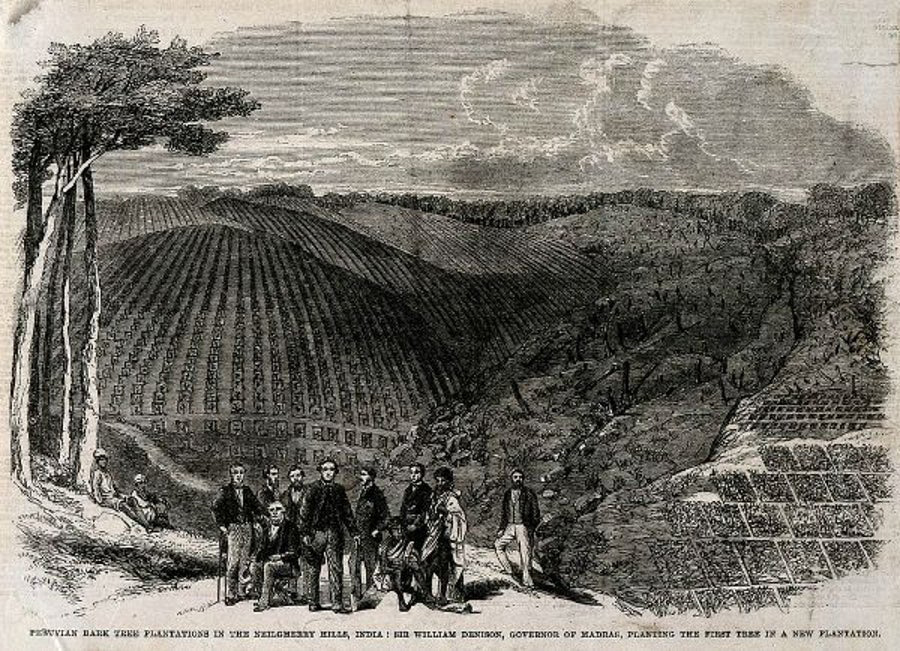
The illustration of Sir William Denison, Governor of Madras, planting the first cinchona tree in the Nilgiri Hills in 1861 marks a formal moment in the logistical expansion of imperial medicine in India. The Nilgiris, located in the Western Ghats of southern India, were selected for their elevation, rainfall, and soil conditions—factors that approximated the Andean environment where cinchona trees naturally thrived. The image depicts a structured plantation landscape, with rows of saplings extending across the hilly terrain, and a group of observers gathered to witness the ceremonial inauguration of the site.
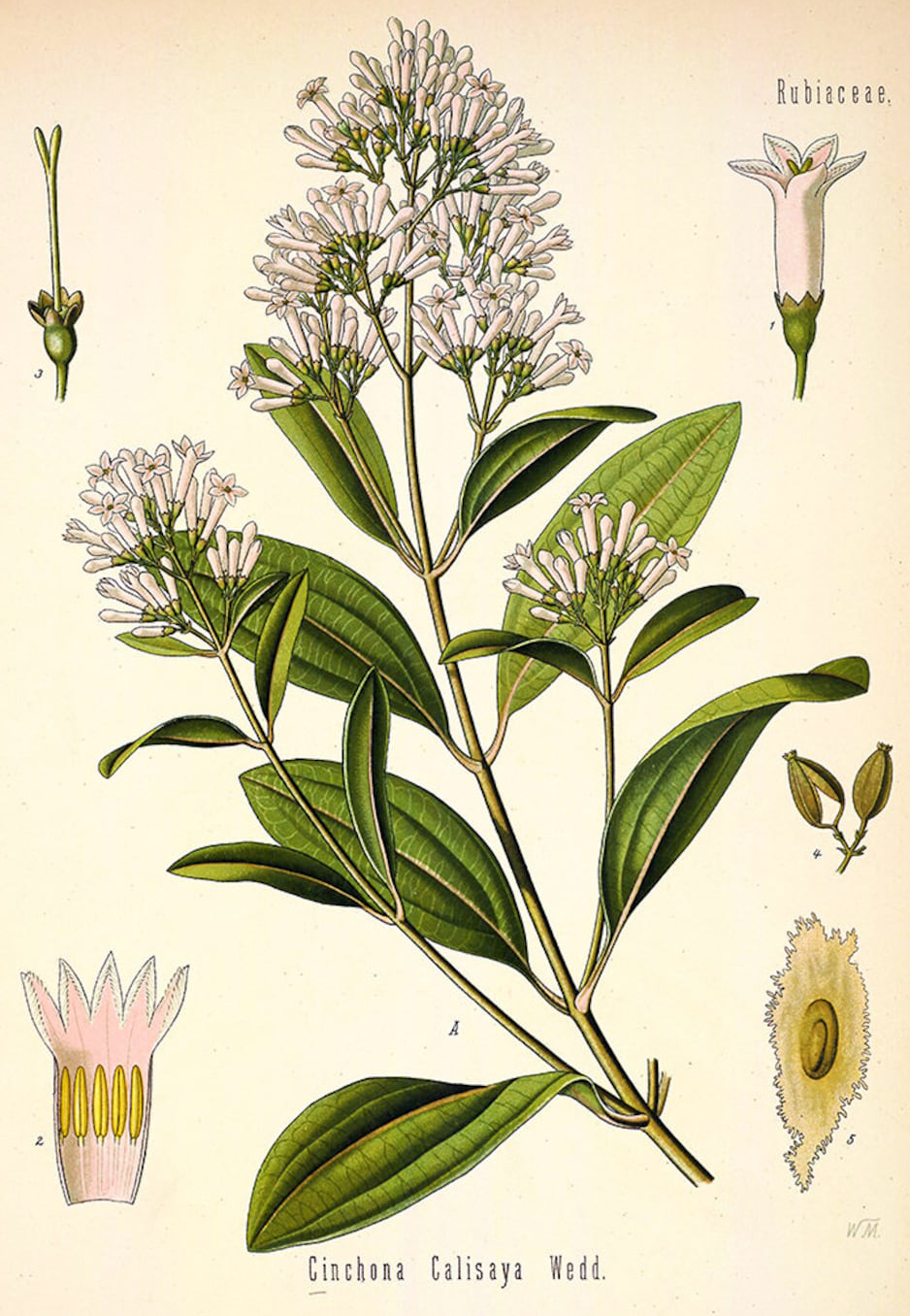
Cinchona bark contains quinine, an alkaloid compound effective against malaria. Its medical utility had been established decades earlier: in 1820, French pharmacologists Pierre Joseph Pelletier and Joseph Caventou isolated quinine and later produced a purified version for pharmaceutical use. By the mid-nineteenth century, quinine was being used both therapeutically and preventatively. The British Medical Department of the Army formally adopted quinine as a prophylactic in 1848, particularly for troops stationed in tropical regions.
As the British Empire expanded across Africa and Asia, demand for quinine increased substantially. By the 1850s, the British government was spending approximately £53,000 annually to import cinchona bark, primarily from South America. This reliance on foreign supply prompted efforts to cultivate the tree within imperial territories. In 1860, Sir Clements Markham led an expedition to Peru and Bolivia to obtain cinchona seeds and seedlings. Despite export restrictions imposed by the Peruvian government, viable specimens were successfully transported to India.
The Nilgiri Hills became one of the principal sites for cinchona cultivation. The terrain offered suitable conditions for acclimatisation, and the colonial administration provided logistical support for plantation development. Initial trials focused on species selection, yield optimisation, and alkaloid concentration. The ceremonial planting by Governor Denison, as depicted in the illustration, symbolised administrative endorsement and the integration of botanical science into colonial governance. Subsequent plantations were established in the Anamalai Hills, Coorg, and British Ceylon.
Cinchona cultivation required careful management. Trees took several years to mature, and bark harvesting involved stripping sections without killing the plant. Alkaloid content varied by species and growing conditions, prompting experimentation and chemical analysis. Government factories in Bengal and Madras processed the bark into quinine tablets and tinctures, which were distributed to military units, civil hospitals, and missionary dispensaries. The Nilgiri plantations maintained records on yield, potency, and disease resistance, contributing to the broader imperial knowledge base on medicinal crops.
The Dutch initiated parallel cultivation efforts in Java during the 1860s. Their plantations eventually surpassed British output in both volume and chemical consistency, due to selective breeding and standardised processing. By the early twentieth century, Java had become the dominant global supplier of quinine. British India continued to produce bark for domestic use and military provisioning, with the Nilgiri plantations remaining a key node in the supply network.