

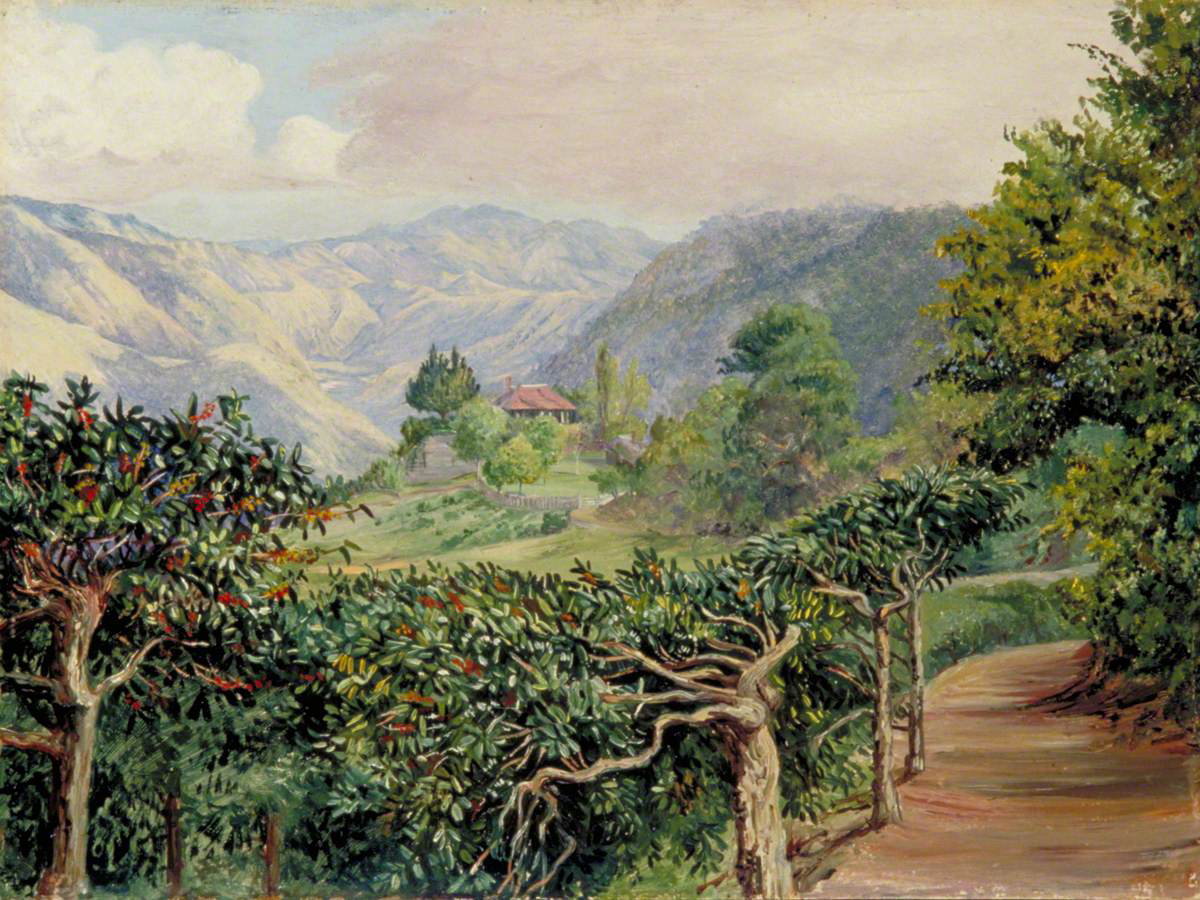
This images is from a painting by Marianne North in Kew Gardens entitled Coffee Plantation at Clifton Mount and the Blue Mountains beyond Jamaica.
Coffee production in colonial Jamaica was a significant component of the island’s plantation economy, particularly during the eighteenth and early nineteenth centuries. Introduced by British planters in the early 1720s, coffee quickly became a profitable export crop, cultivated in the island’s mountainous interior where the climate and elevation were well suited to Arabica varieties. Though overshadowed by sugar in terms of scale and revenue, coffee offered diversification and resilience, especially in upland regions less suitable for cane.
The expansion of coffee cultivation coincided with broader shifts in imperial agriculture. As sugar estates faced soil exhaustion, market volatility, and growing competition from other Caribbean islands and Brazil, planters turned to alternative crops. Coffee required less capital investment than sugar, and its cultivation could be managed on smaller estates. By the 1770s, Jamaica had emerged as one of the leading coffee producers in the British Empire, with exports reaching European and North American markets.
Colonial coffee production was deeply embedded in the plantation system. Enslaved Africans cleared forested slopes, planted seedlings, weeded fields, and harvested berries. Processing involved pulping, fermenting, drying, and sorting—labour-intensive tasks carried out under supervision. The mountainous terrain made transport difficult, and coffee estates often relied on pack animals and rudimentary trails to reach coastal ports. Despite these logistical challenges, the crop’s high market value justified its expansion.
Jamaican coffee was praised for its quality, particularly beans grown in the Blue Mountains northeast of Kingston. The combination of altitude, rainfall, and volcanic soil produced a mild, aromatic cup that commanded premium prices. Planters and merchants marketed the product as a luxury good, and by the early nineteenth century, Blue Mountain coffee had become a recognised brand within imperial trade networks.
The abolition of slavery in the 1830s disrupted the labour system that underpinned coffee production. Many formerly enslaved workers left plantations or demanded wages, and planters struggled to maintain output. Some estates were abandoned; others shifted to tenant farming or wage labour. Coffee production declined sharply, and by the mid-nineteenth century, Jamaica’s share of the global market had diminished. Brazil, with its vast estates and coerced labour systems, became the dominant producer.
Despite this decline, coffee remained part of Jamaica’s agricultural landscape. Smallholders, often descendants of freed people, continued to cultivate coffee in the island’s interior, selling to local processors or exporters. The crop offered a measure of economic independence and resilience, especially in regions unsuited to sugar or bananas. Colonial administrators encouraged coffee as a stabilising force, and agricultural stations provided training and seedlings to promote its cultivation.
Jamaica’s coffee industry illustrates the intersection of botany, labour, and imperial trade. The crop’s success depended on environmental suitability, plantation infrastructure, and access to global markets. Its decline reflected broader transitions in colonial agriculture, including emancipation, competition, and shifting trade priorities. Yet its persistence—especially in the Blue Mountains—speaks to the adaptability of both the plant and the people who cultivated it.
Today, Blue Mountain coffee remains one of Jamaica’s most iconic exports, with roots in the colonial era and a legacy shaped by centuries of botanical and social history. Its story is emblematic of how imperial plant transfers, labour systems, and environmental conditions converged to produce enduring agricultural traditions.
