|
“The greatest service which can be rendered to any country is to add a useful plant to its culture,” wrote Thomas Jefferson. The deliberate movement of plants by human agency has shaped the course of history. New staples have averted famines—such as when maize and sweet potato from the Americas were introduced to China in the sixteenth century—and supported population growth, as with the Andean white potato, which spread across northern Europe in the eighteenth and nineteenth centuries and sustained the workforce of industrial cities. The transfer of plantation crops has also had uneven economic consequences, enriching some nations while undermining local industries elsewhere.
Seeds have long been among the most valuable and portable cultural artefacts. Exchanged through local and long-distance trade, they have inspired voyages of exploration and travelled thousands of miles with migrating peoples. Just a century ago, the ‘Turkey red’ strain of hard winter wheat—a staple bread wheat—was brought to the United States by German Mennonite immigrants from the Russian Crimea. They transported the seeds in earthenware jars across the Atlantic to their new home in Kansas, where the crop became foundational to American grain production.
Archaeologist Kent Flannery has suggested that transhumant bands of food collectors played a key role in the domestication of the first grains in the Middle East over ten thousand years ago. By relocating plants from inaccessible niches—such as talus slopes beneath limestone cliffs—to more manageable environments like stream terraces near campsites, they relaxed the pressures of natural selection and introduced human selection. This principle underpins all successful plant transfers: in a new environment shaped by human intervention, natural enemies are left behind, and human attention attempts to mitigate new threats.
Natural monopolies in plant resources have rarely endured. Like diamonds or gold, seeds are small, concealable, and frequently smuggled. Until recently, plant hunters and their sponsors—whether governments, botanical institutions, commercial nurseries, or pharmaceutical firms—treated plants as part of nature’s bounty, freely available for collection. Yet any plant deemed valuable had almost always already been identified and utilised within its native ecosystem. Modern ethnobotanists are more inclined than their predecessors to recognise the scientific merit of local knowledge, consult indigenous experts, and establish formal agreements with national institutions. Today, it is widely accepted that rare plants, like minerals, constitute part of a country’s natural resources and should not be removed without permission or compensation—whether through scientific exchange or joint development. The concept of plant ownership is closely tied to the rise of the nation-state, territorial sovereignty, and the recognition of rights held by smaller or less developed societies.
 |
|
|
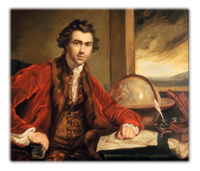
In the eighteenth and nineteenth centuries, botany was closely aligned with imperial expansion. Botanists accompanied the great exploratory voyages of Captain Cook and his successors, collecting specimens in the name of science and for the benefit of the metropole. Sir Joseph Banks—amateur botanist, president of the Royal Society, and privy councillor to the King—sailed with Cook on his first voyage and played a pivotal role in the identification of Botany Bay. Banks later advocated for the settlement of Australia, envisioning a colony that could supply naval provisions and materials such as masts, spars, and sails, based on the tall pines and wild flax observed on Norfolk Island. Botanists joined early expeditions up the Niger, Limpopo, and Zambezi rivers. One conducted border surveys in the Himalayas and returned with nearly 7,000 plant specimens. Another, employed by the British East India Company, acquired knowledge of tea cultivation and dispatched 2,000 tea plants and 17,000 seeds to initiate India’s tea industry.
 |
|
|
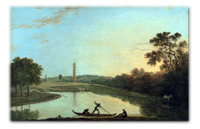
Under William J. Hooker’s leadership, Kew Gardens became a central depot for plant exchange across the Empire. Seeds collected from abroad were propagated in Kew’s greenhouses and redistributed to colonies with compatible climates. Cork oaks were sent to the Punjab; ipecac, mahogany, and papyrus to India; West Indian pineapples to the Straits Settlements; tea plants to Jamaica; and improved tobacco strains to Natal. While plant transfer is as old as agriculture itself, the scale and coordination achieved during the imperial period were unprecedented.
Victorian botanists, steeped in the imperial ethos of their time, occasionally disregarded the sovereignty of independent states with whom Britain maintained diplomatic relations. In certain cases, plant transfers were carried out with little regard for the economic or ecological loss sustained by the country of origin. Histories of Kew Gardens rarely mention the subterfuge and outright illegality involved in the acquisition of cinchona from the Andean republics of Colombia, Ecuador, Peru, and Bolivia in the 1860s, or rubber seeds from Brazil in 1876. Instead, they emphasise the humanitarian value of quinine—derived from cinchona bark—as a treatment for malaria, and the economic success of rubber plantations established in India, Ceylon, and Malaya.
Yet the countries said to owe this debt are overwhelmingly former British colonies—India, Malaysia, Sri Lanka (Ceylon), Kenya, and Zimbabwe (formerly Rhodesia). The rubber plantations of Java, Sumatra, and Borneo (now part of Indonesia), and those of Laos and Vietnam (formerly French Indo-China), were also founded using descendants of the rubber seeds removed from Brazil. These transfers relied on grafting, planting, and tapping techniques developed by British and Dutch botanists working in colonial botanical gardens. Such transfers were primarily designed to supply the metropoles of north-western Europe with tropical commodities produced under their own administrative, financial, and legal systems.
In the early phases of European expansion, the movement of plantation crops flowed from the Old World to the New. Eastern plant riches were carried to newly claimed territories. On his second voyage in 1494, Columbus brought sugarcane cuttings to Hispaniola, along with citrus fruits, grapevines, olives, melons, onions, and radishes. Although many of these failed in the climate of the Antilles, this marked the beginning of a two-way transfer of useful plants—what historian A.J. Crosby Jr. termed “the Columbian exchange.”
Sugarcane, originally domesticated in Southeast Asia, was transferred by Arab traders to Syria and Egypt, and by the tenth century to Mediterranean islands. By the fourteenth century, Venetians had adopted both the crop and the plantation system from the Arabs they displaced. The Spanish and Portuguese carried sugar to the Atlantic islands—Madeira, the Canaries, the Azores—and from there to the Caribbean and Brazil. In 1640, sugar arrived in Barbados, accompanied by the transatlantic slave trade and 150 years of prosperity for West Indian planters, British merchants, and the imperial treasury.
 |
|
|
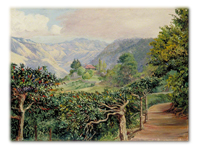
Coffee, native to the Ethiopian highlands, was domesticated by Arab growers and introduced to India. The Dutch later planted it in Ceylon in 1659 and Java in 1696. A single coffee plant from Java reached the Amsterdam Botanic Garden in 1706, and from this specimen most of the coffee plantations in the New World descend. Seeds were sent to Surinam around 1715, then to French Guiana, and in 1727 to Brazil. In the nineteenth century, both coffee and cocoa were introduced to West African colonies. Ghana, in particular, became heavily reliant on cocoa exports for foreign exchange and has faced economic challenges during periods of price decline.
Eliza Lucas introduced indigo to mainland North America. Indigofera plants had been cultivated in India since at least 2000 BC. In the eighteenth century, the French planted indigo in the Antilles and exported processed dye cakes. Colonel George Lucas, governor of British Antigua, sent indigo seeds to his daughter Eliza, who managed his South Carolina plantations. With assistance from a slave from a French island, she mastered the dye process and distributed seeds to neighbouring planters. By 1747, South Carolina exported 135,000 pounds of indigo to London. Parliament responded with a bounty, and a French embargo came too late to preserve their monopoly.
In 1770, Pierre Poivre, Intendant of Île de France (Mauritius), smuggled cloves and nutmeg from the Moluccas and planted them in the island’s Jardin Royal de Pamplemousses. Britain later seized the island, sending cloves to Zanzibar and nutmeg to Grenada. Grenada became known as “the Spice Island.”
By the nineteenth century, many desirable plants were native to Latin American regions that had become independent postcolonial states. European powers could no longer rely on military conquest or inter-imperial rivalry to secure botanical resources. Instead, they turned to diplomacy, covert acquisition, or both—as in the case of cinchona.
Cinchona’s natural habitat lies on the eastern slopes of the Andes, where bark was traditionally harvested by forest-dwelling Indigenous workers employed by absentee landowners. European observers, including the naturalist Alexander von Humboldt, viewed the practice of cutting down entire trees to strip bark as wasteful and unsustainable. In reality, the barkless trunks were vulnerable to insect damage, but new shoots would emerge from the roots and become harvestable within six years.
The transfer of cinchona is among the most intrigue-laden episodes in plant history, with both British and Dutch agents attempting to extract seeds from the Andean republics and later competing for dominance in the Asian-based trade. These republics, newly independent from Spain and destabilised by internal conflict, lacked the capacity to protect their nascent bark industry.
 |
|
|
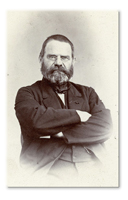
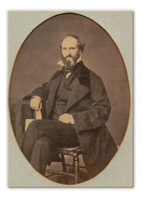
In 1854, Justus Carl Hasskarl, director of the Dutch Buitenzorg Gardens in Java, entered the Caravaya region of Peru and Bolivia under an assumed name. Six years later, Clements Markham led the British expedition, fleeing with cinchona seeds across southern Peru, avoiding towns and navigating by compass. Richard Spruce, a seasoned explorer and botanist who had travelled up the Amazon to Ecuador, was recruited by Kew Gardens to collect cinchona. He established a remote mountain camp, gathered 100,000 dried seeds, and cultivated over 600 seedlings. Though he successfully transported them by raft to the coast, the effort cost him his health and mobility.
 |
|
|
Of the various British attempts, only Spruce’s “red cinchonas” yielded viable stock, which were planted extensively in the hill regions of India and Ceylon. Ironically, this red bark proved inferior in quinine content to the Ledger varieties cultivated by the Dutch in Java from seeds acquired in 1865. These seeds had been smuggled out of Bolivia by an Aymara servant working for an English trader; the servant was later imprisoned for treason and died in custody.
Beyond species selection, the Dutch programme of intensive cultivation gave them a further advantage. By the 1890s, a cartel of Dutch quinine processors controlled the global market. Many British planters in India and Ceylon shifted to tea cultivation. The market for wild South American bark, which had peaked at nine million kilos in 1881, declined sharply once plantation bark became widely available.
Critics who argue that the British cinchona venture was a costly failure overlook its strategic purpose. The British government did not pursue cinchona for commercial gain, but to safeguard the health of its troops and civil administrators in India, especially in the wake of the 1857 Sepoy Mutiny. This objective was achieved: British-made quinine and quinidine were reserved for officials of the Raj, enabling a more secure and sustained imperial presence in India.
A programme to sell government-produced “totaquine”—a less refined and more affordable anti-malarial—through post offices in Bengal was announced but never vigorously pursued. European quinine processors profited from plantation-grown bark in South Asia. Quinine became increasingly expensive, often unaffordable for local populations in malarial regions, but remained essential to Western administrators and military forces.
During the First World War, the Allies faced a quinine shortage as the neutral Netherlands supplied bark and quinine to Germany. A representative of Howard & Sons, a British processing firm, negotiated an agreement to pool Allied resources and secure access to Java’s bark. He also diverted British estate output away from the India Office, limiting its availability to the Indian public.
In 1942, during a combined famine and malaria epidemic that claimed over two million lives in India and Ceylon, British authorities withheld quinine stockpiled in India from civilian use. At that time, Java’s cinchona plantations had been seized by Japan and were considered a major strategic asset. The United States, facing similar shortages for its South Pacific military operations, launched a crash programme to rehabilitate wild cinchona in the Andes. Within two and a half years, 18,000 tons of bark were harvested for processing in the U.S.
Quinine was also vital to European powers during the “scramble for Africa,” where high mortality rates had previously confined colonial agents to coastal zones. The adoption of quinine prophylaxis enabled deeper inland expansion, and it is notable that the New Imperialism of the late nineteenth century coincided with European incursions into malaria-endemic regions.
After the Second World War, synthetic anti-malarials largely replaced quinine in Western medicine, though demand persisted. In 1959, a new cartel of Dutch, German, French, and British quinine processors was formed to control global production and distribution. Each firm was assigned geographic markets and agreed to uniform pricing. The cartel’s primary aim was to eliminate competition—both internal and external—in bidding for the large U.S. stockpile of surplus wartime quinine. Members also agreed not to purchase from the Bandoeng factory in the Republic of Indonesia, a legacy of Dutch colonialism and the largest non-European processor of cinchona bark. By restricting Bandoeng’s market access, the cartel secured additional supplies of Javanese bark that would otherwise have gone to the Indonesian processor.
 |
|
|
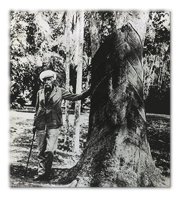
The celebrated rubber transfer took place in 1876, when Henry Wickham, an English adventurer working for Kew Gardens and the India Office, departed Brazil with a shipment of approximately 70,000 Hevea rubber seeds. Wickham misled Brazilian customs officials, claiming his cargo consisted of “exceedingly delicate botanical specimens specially designated for delivery to Her Britannic Majesty’s own Royal Gardens of Kew.” The seeds were planted in Kew’s greenhouses, and within months, 1,900 seedlings were dispatched to the Peradeniya Gardens in Ceylon. From there, seeds were sent to the Singapore Gardens, where Henry Ridley—a Kew-trained botanist—developed the wound-response method of tapping. Ridley, nicknamed “Mad Ridley” or “Rubber Ridley,” eventually persuaded British planters in Malaya to adopt the crop in 1895.
At the turn of the century, Brazil produced 98 percent of the world’s rubber. By 1919, its industry had collapsed. Singapore became the new global centre of rubber production. By the 1930s, before the end of the colonial era, 75 percent of the world’s rubber—then a strategic resource in both peace and war—came from British-owned plantations. Indentured Chinese labourers cleared forests in Malaya, while impoverished Tamil migrants from India crossed the straits to work on rubber estates in Malaya and Ceylon, often entering debt peonage. The agrarian societies of Asia supplied a compliant and abundant labour force.
In the early 1870s, when Kew Gardens and the India Office first attempted to acquire rubber seeds from Brazil, three initial efforts failed due to poor germination. At the time, the wild rubber trade was not subject to the cartel conditions that emerged later. Britain had no strategic imperative to violate Brazilian sovereignty—only an economic motive, and in the pre-automotive era, not a particularly compelling one. Yet because the motorised West came to rely heavily on rubber from Asian plantations, the seed transfer is often remembered as a bold and successful venture. Wickham’s deception of Brazilian authorities is rarely acknowledged.
Following the rubber coup of 1876, Kew Gardens did not organise further expeditions that contravened laws prohibiting the export of Latin American plants. No subsequent plant removal matched rubber’s economic and political significance. Nonetheless, Britain continued to encourage its consular officials to send specimens of protected plants and reports on their cultivation and processing. Kew Gardens remained active in acquiring such plants for study and publishing trade techniques in the name of science.
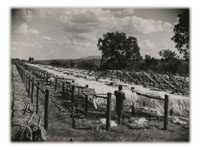
One example is sisal, a durable fibre used for twine and rope, derived from agave species native to arid regions of Central America. The fibre was known to the Maya and entered commercial production in the 1830s on the haciendas of northern Yucatán. Indian labourers were bound to these estates through debt peonage, reinforced by Ladino control of water sources that made independent village life untenable. After 1875, as grain production intensified on the American plains, the Argentine pampas, and in eastern Europe to feed growing urban populations, demand for binder twine surged. Yucatán’s sisal plantations became vast agro-industrial complexes, supported by American capital, mechanised stripping equipment, and rail transport. Once Mexico’s poorest state, Yucatán became its wealthiest, and Mérida a prosperous city.
Kew took notice. Sisal was considered suitable for cultivation in the Bahamas and other dry islands of the West Indies, which were economically stagnant in the post-sugar, pre-tourism period, as well as in Fiji, Mauritius, and potentially India. Mexico refused to export its plants or disclose its processing methods. In 1890, however, the British consul in Veracruz sent two shipments of sisal plants to Kew—many of which, according to Kew’s own report, were “dead on arrival.” Surviving specimens were distributed to botanical gardens in Antigua, Fiji, and Singapore. In 1892, Kew published a series of articles in its Bulletin of Miscellaneous Information detailing Mexican sisal cultivation and processing. In doing so, Kew fulfilled its charter to “aid the Mother Country in everything that is useful in the vegetable Kingdom.”
 |
|
|
Yet British plans faltered. Scientific knowledge spreads most effectively to societies prepared to receive it. A German agronomist working for the German East Africa Company read the Kew Bulletin and found, in a report from the director of the Trinidad garden, the name of a sisal bulbil supplier in Florida. Sisal had grown wild there since 1840, introduced by Dr Henry Perrine, a former U.S. consul in Campeche, Mexico. In 1836, Congress granted Perrine land on Biscayne Bay to establish a botanical garden of exotic plants. While awaiting the end of the Seminole War, he settled on Indian Key with his family and specimens, including figs, indigo, mulberry, tamarinds, mangoes, and agaves. Perrine had received permission to export agaves in recognition of his service during a cholera epidemic in Campeche. He was killed in an Indian raid in 1840, and his abandoned plants spread to the mainland.
Florida never developed a sisal industry, but descendants of Perrine’s plants became the foundation of a thriving East African enterprise. German colonists adopted modern planting and processing methods, using coerced labour from local tribes through land alienation and head-tax systems. Kenya followed suit, sourcing bulbils from German East Africa before a 1908 embargo on their sale. Britain acquired German East Africa—renamed Tanganyika—under the Versailles Treaty in 1919, along with its sisal industry. Between the world wars, Java also hosted extensive sisal plantations. By the 1960s, Mexico’s share of the global hard fibre market had fallen to 12 percent; Manila hemp accounted for 13 percent; the remainder was dominated by East African sisal. Another Latin American plant-based industry had been displaced in favour of European colonial production.
White settlers in the East African highlands also cultivated coffee, tea, and maize for export to Europe. The agricultural value of these colonies rested entirely on introduced crops. The political consequences of this imposed system continue to resonate. Yet their contribution to imperial prosperity was modest compared to South Asian colonies—especially Malaya, with its rubber, and Ceylon, with rubber and tea. Java under Dutch rule was arguably the most economically productive colony, with plantations of rubber, cinchona, coffee, tea, sisal, and tobacco.
The collaboration between colonial governments and botanical institutions in transferring and developing useful plants was mutually advantageous. State funding supported botanical research, both theoretical and applied. Botanic gardens repaid this investment many times over through the introduction of new plantation crops and improved yields. Tropical monoculture under European management extracted immense value from the land, but it also generated political and ecological imbalances that continue to challenge the modern world.
|